
|
|
Casualty of War – the pre-WW2 German ORTUS Sparkie
Even in their native Germany, examples of the ORTUS are apparently very rare today. The very informative website maintained by M.E.C.A. Region 16 (Germany) features only a single image of the engine which is unaccompanied by any text. What little I’ve been able to learn about this engine came primarily from the 1994 German-language book on German model engines written by Matthäus Weidner of the Deutsches Museum in Munich. This publication is known to German collectors as the “Blue Book”. Like almost every book on model engines that I've ever read, this very useful work is by no means free from error. However, it does contain information on more or less every German model engine marque, including the ORTUS and its immediate predecessor, the Bauer Motor from the same manufacturer. I freely acknowledge my indebtedness to Matthäus Weidner for his assembly of this invaluable source of information. I must also acknowledge the great assistance rendered to me by my good friend Ronald Valentine, who not only supplied the featured example of the ORTUS but also shared some of his personal insights into the history of the engine. Many thanks, my friend! A Predecessor – the Bauer Motor
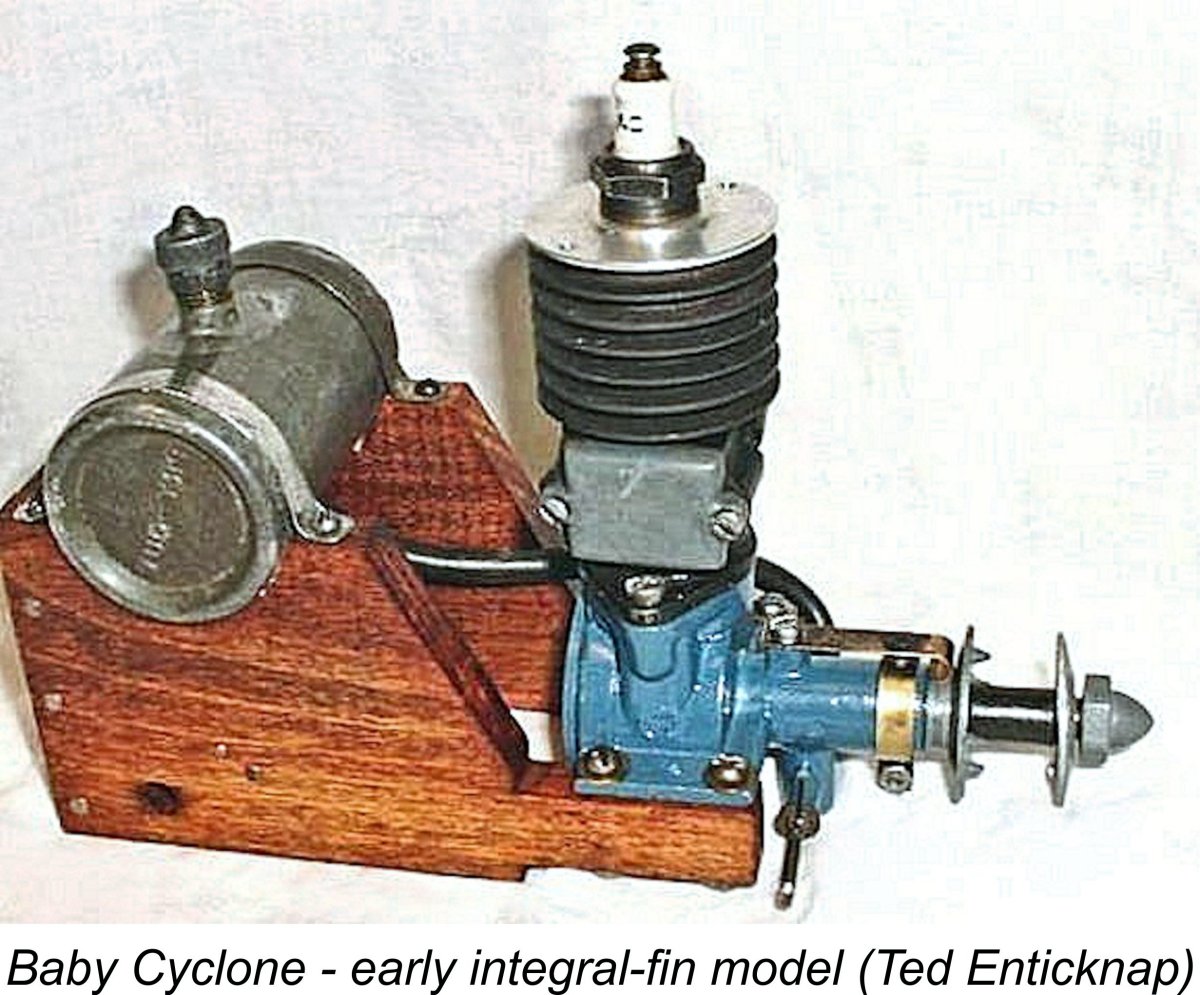
The original Baby Cyclone was designed primarily by Bill Atwood, with a significant contribution being made by Bill’s friend and colleague Mel Anderson. It made its commercial debut in America just in time for Christmas 1935. It was an immediate success, not least because it pointed the way towards the development of more compact models powered by smaller and lighter engines than the 10 cc (0.60 cuin.) or larger designs which had predominated up to that point. It weighed in at a bare figure of 199 gm (7 ounces) and developed a claimed 0.20 BHP at around 5,500 RPM. Later further-developed versions exceeded these figures by some margin.
Alexander Thusius doubtless provided design input to his friend Johann Bauer, also drawing up the design in a form which would facilitate its series production. In addition, he almost certainly assisted Bauer in the construction of prototype examples. Once the prototypes had proved themselves, arrangements were made to have the engine produced in the precision machine shop of Oswald Ried in Pasing. Alexander Thusius’s contribution was recognized by the attachment of the name Bauer-Thusius to the engine upon its market debut in early 1938. Despite this acknowledgement, the engines displayed the letters “JB” for Johann Bauer on their bypass covers, implying that Bauer was recognized as having been the principal instigator of the project.
Consequently, even before the outbreak of war in September 1939, organized model aircraft flying in Germany was state-controlled under the auspices of the Nationalsozialistisches Fliegerkorps (NSFK - National Socialist Flyers Corps) and Hitlerjugend (Hitler Youth) as a means of promoting air-mindedness among young Germans and expanding their technical knowledge in the aeronautical field. The Bauer-Thusius motor saw service during 1938 and 1939 in the hands of members of both organizations. Models were divided into specific classes, with the focus on advancing the state of the art and striving for records, rather than mere “sport” flying. The NSFK published its own official monthly magazine called “Deutsche Luftwacht Modellflug”, while at least one other magazine, “Der Deutscher Sportflieger”, was also in regular publication. Remarkably enough, both magazines continued to publish well into the final year of WW2 despite Germany's increasingly-precarious position during that year. It's unclear how many examples of the Bauer-Thusius motor ended up being manufactured, but the number can't have been particularly large. It appears that by early 1939 either Thusius or Oswald Ried had become convinced that the original design could be improved upon. The result was the all-too brief 1939 appearance of our subject engine – the ORTUS 5.67 cc sparkie. The ORTUS 5.67 cc Sparkie – Description
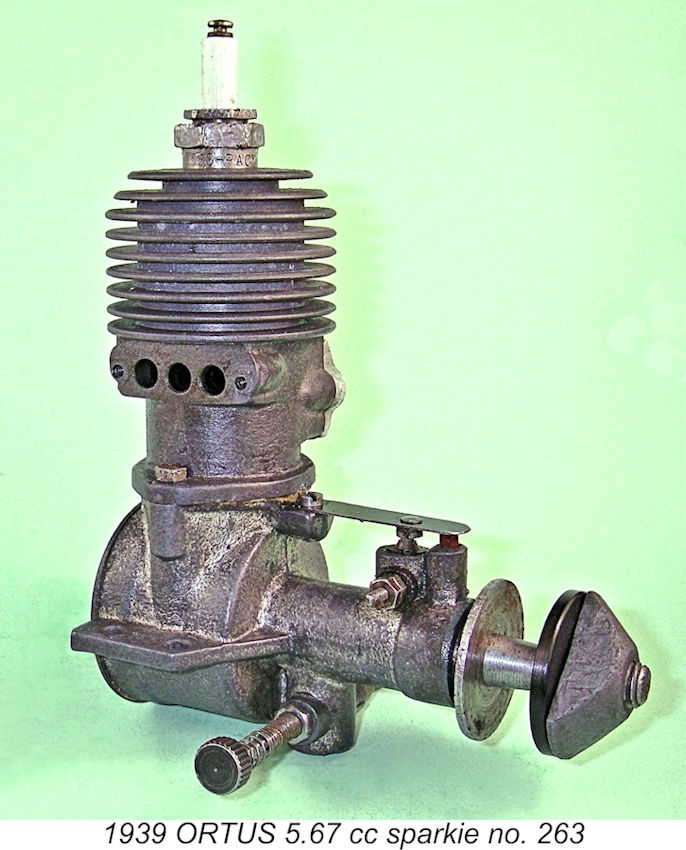
Bore and stroke of the ORTUS were 19 mm and 20 mm respectively for a calculated displacement of 5.67 cc (0.346 cuin.). The engine weighed in at a checked 213 gm (7.51 ounces) complete with plug but minus the ignition support system. The ORTUS employed a lapped baffle piston operating in a blind bore formed in the cast iron upper cylinder. The cylinder head was integral with the upper cylinder barrel casting. A feature relating to the Continental origin of the ORTUS design was the use of a metric M10x1.0 spark plug installation thread as opposed to the 3/8-24 thread used in America and Britain. The plug originally used on these engines was reportedly a Bosch item. The compression ratio was somewhat higher than the average at this time, being of the order of a checked 7 to 1. The exhaust ports consisted of three drilled holes in the vestigial stack. Two aditional M2 tapped holes near the fore and aft edges of the stack confirm that the engine could be fitted with a bolt-on stack extension similar to that used on the original Baby Cyclone. My example of the ORTUS arrived with its stack extension missing, but my good mate Dean Clarke of Cre8tionworx Engineering in New Zealand made the elegant replacement seen in several of the accompanying images. I must say that the engine looks far better with the stack in place! The design permitted the engine to be assembled with the exhaust on either the left-hand or right-hand sides, with the piston oriented accordingly. Both assemblies are encountered.
A very positive difference between the ORTUS and the original Baby Cyclone was the use of elektron (a lightweight magnesium alloy) for the production of the main die-casting. The original Baby Cyclone had used a zinc alloy casting, which suffered dreadfully from "zinc pest" (or Mazak rot), a form of inter-crystalline corrosion frequently encountered with even slightly impure zinc alloys. This deterioration leads to swelling, cracking and crumbling, often accelerated by humidity, contamination and poor storage. The damage is irreversible. By comparison, elektron is generally far less susceptible to major damage through corrosion, especially if subjected to a corrosion-resistant surface treatment and stored appropriately. The elektron castings used in the construction of the ORTUS were given some kind of surface treatment which imparted a somewhat shiny “metallic” look to the otherwise dark-coloured castings. This surface The ORTUS appeared at some point in mid-1939. A well-known and highly-regarded German competitor by the name of Helmut Kermeß from Munich reportedly achieved considerable success with his model powered by an ORTUS engine. This must have drawn modeller attention to the engine. Production of the ORTUS was initiated at the Oswald Ried machine shop in Pasing, with a small series being completed. If my example is any indication, the engine was produced to a very good standard. All fits on my engine are excellent, while the compression seal is beyond reproach. I have no information regarding how many examples were produced. All I can tell you is that my own example of the engine bears the serial number 263 stamped onto the upper surface of the right-hand mounting lug. The single letter G also appears stamped onto the upper cylinder casting immediately below the exhaust ports. The significance of that letter remains obscure. Ronald Valentine told me that he had seen other examples displaying the letter G, but his own remaining example bore neither that letter nor any serial number. The ORTUS appears to have been a quality product which should have enjoyed considerable market success in its native Germany. However, its production was ended prematurely by the September 1939 onset of WW2 and was never resumed. The number of examples completed cannot have been large – the engine is extremely rare today. Performance Being fortunate enough to have an excellent example of the ORTUS on hand, I felt that the least I could do was put it into the test stand to gain an impression of its handling and running qualities. The fact that it requires a 10 mm plug was not an issue – I even had an old oversize Bosch 10 mm plug of the type presumably used on these engines back in the day. A readily-available modern equivalent is the 10 mm NGK CM-6 plug – I also had several of those plugs on hand, one of which was used in this test. Do not attempt to re-tap the head of one of these engines to 3/8-24 - conservation of originality is important!! Besides, it doesn't work - 10 mm is larger than 3/8 in. (9.52 mm). You can re-tap 3/8-24 to M10x1.0, but not the other way round.
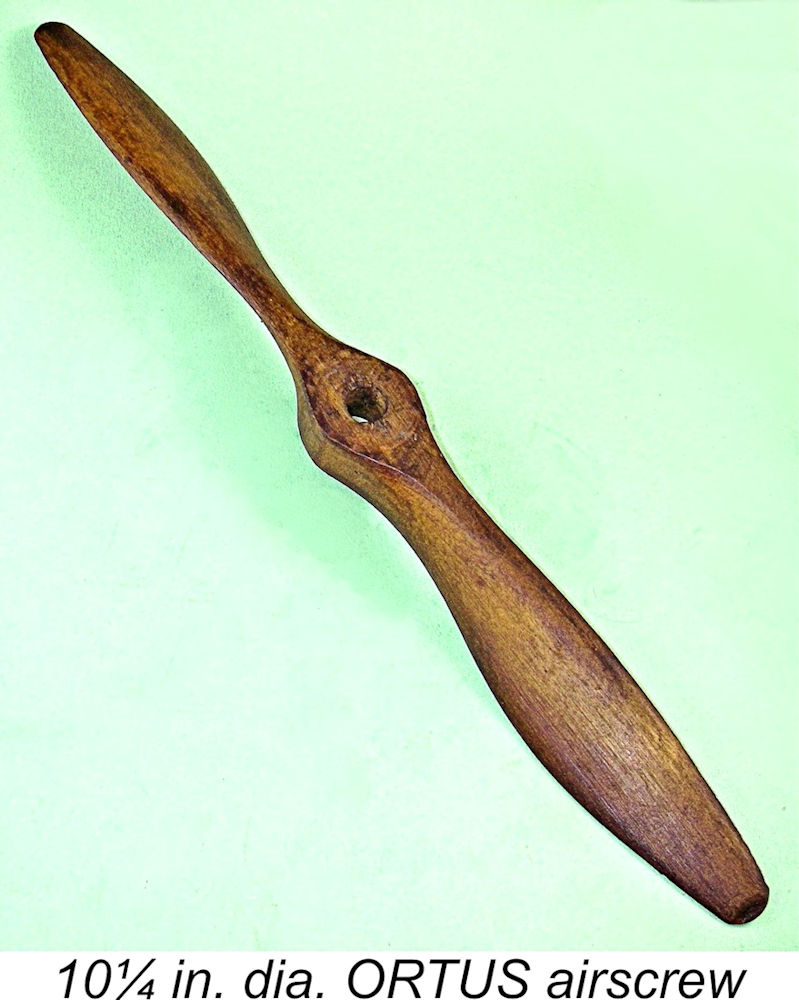
Pitch = 2πR x tan θ Where: π is the universal geometric constant 3.142 R is the prop radius (half the diameter) θ is the twist angle of the blades at the tip Tan θ is the tangent of that angle – a trigonometric ratio available from tables. Measuring the tip angle of the ORTUS prop, I found that the angle at the tip is around 18º, which has a tangent of 0.325. Plugging the figures for this prop into the above formula gives us a pitch of 10.47 in. – the old eyeballs didn’t lie! The airscrew is thus a 10¼x10½ (M260x260) item – quite a load for an engine of this displacement and vintage! The manufacturers claimed a peak output of 0.12 kw (0.16 PS), equivalent to 0.158 BHP, at a design operating speed of 4,500 RPM – how times change! I decided that since I had an example of the supposedly matching airscrew for the engine, I should use it as my test prop. Apart from my curiosity regarding the engine’s handling, the main point of interest was to assess the likelihood or otherwise of the engine reaching the 4,500 RPM mark in flight using the standard prop.
I began as always by checking the timer function using a continuity tester, finding that the timer was working perfectly. The test also showed that the timer was set to open the points (triggering the spark) at around 15 degrees before top dead centre. This is pretty late by normal running standards for old sparkies, but it must be remembered that this engine was designed to operate at only 4,500 RPM. The fixed timing is probably well suited to such a low speed, besides which it was quite appropriate for starting. Having ensured that the timer was working well, I hooked up the ignition support system, filled the tank and was all set. I anticipated that this engine would require a relatively modest supply of fuel to sustain running. Accordingly, I set the needle by guesswork at only two turns open. I quickly found that choking was a practical impossibility in the test stand – the updraft intake was more or less inaccessible. Moreover, most of the fuel drawn in by choking would simple drip out of the updraft intake. Instead, I used gravity to fill the fuel line by temporarily lifting the small tank that I was using to create gravity feed – since any excess fuel simply dripped out of the intake without entering the engine, there was no risk of flooding. Because no fuel could be introduced into the engine by choking, I realized that an exhaust prime would be essential to get some fuel into the cylinder for starting. Since there was no fuel in the crankcase to sustain any initial firing burst until the carburettor function was established, I administered a fairly healthy prime. Once I had the engine firing, it produced a firing burst in fairly short order. However, it would not keep going, revving up and then stopping dead. Clearly the needle was set too lean. I opened it half a turn, administered a dry prime this time (exhaust ports closed) and was quickly rewarded with another firing burst. However, once again the engine did not keep running. It turned out that the required needle valve setting for starting was around 3½ turns. Having established a satisfactory needle setting and determined that the best starting procedure was a dry prime on a full fuel line, I experienced no further starting difficulties. It generally took a few flicks to optimize the amount of fuel in the cylinder, but I would objectively classify this engine as a relatively easy and completely dependable starter.
In performance terms, the ORTUS turned the 10¼x10½ standard wood prop at a steady 3,900 RPM on the bench, shifting a lot of air in doing so. This says to me that this prop is indeed well matched to the engine – it would undoubtedly unload in the air to something approaching the design 4,500 RPM operating speed. Having got on top of the engine’s handling and running characteristics, and not wishing to subject this very rare 87-year-old survivor to an excessive amount of running, I elected to end the test at this point. I’d proved to my own satisfaction that the ORTUS was a very well-made and easy-handling engine which performed well up to its manufacturer’s claims. That’ll do me! Conclusion It’s clear from my experiences summarized above that the ORTUS was a quality product having the potential to serve its owners well. It’s most unfortunate that the outbreak of war prevented its production in the numbers which its worthy qualities merited – the timing of its release couldn’t have been worse! Given the pace at which model engine design was advancing at this time, there’s little doubt that the ORTUS would have been supplanted quite quickly by other designs if the war hadn’t intervened. Even so, it was very much amenable to further development and would doubtless have seen use by a far larger number of modellers than circumstances actually allowed. German modellers lost a good ‘un here! ___________________________ Article © Adrian C. Duncan, Coquitlam, British Columbia, Canada First published May 2026 |
 In a separate article to be found elsewhere on this website, Maris Dislers has documented the remarkable extent to which the ground-breaking
  Matthäus Weidner tells us that very little has been written about engine designer Johann Bauer, even in his native Germany. He was apparently an acquaintance of the noted pioneering German model engine enthusiast Alexander Thusius of Pasing (a suburb of Munich), who was a keen aeromodeller and model engineer with a particular interest in the development of model I/C aero engines. By profession, Thusius was a draftsman, producing outstanding perspective cross-sectional views of full-sized motor vehicle engines.
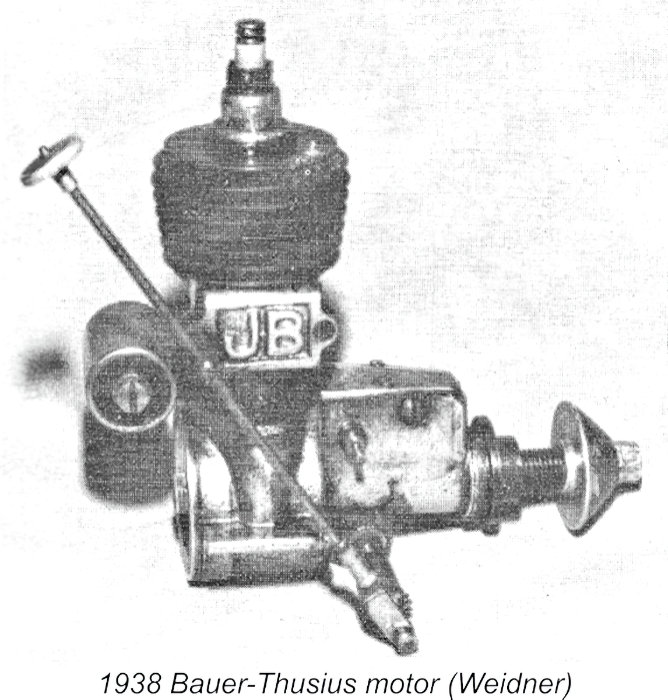 It appears that Johann Bauer must have somehow got a pretty good look at an example of the original Baby Cyclone. As early as 1937, he came up with a design for a 5.67 cc (0.346 cuin.) engine which was based very closely upon the design of the American trend-setter. It retained the fixed non-adjustable ignition timing of the original Baby Cyke, although a more sophisticated enclosed timer was featured. It also utilized the cast iron cylinder, two-bolt cylinder attachment, bolt-on exhaust stack, lapped ringless piston, updraft crankshaft front rotary valve and bolt-on bypass cover of its design inspiration.
 Of course, the development and manufacture of this engine took place at a time when Germany was totally under the sway of Adolph Hitler's Nazi party, then riding the crest of the political wave. Aeromodelling was seen by the Nazi regime as having a high value in encouraging air-mindedness and aeronautical knowledge which could be extremely valuable in preparing young Germans for service in (or in support of) the Luftwaffe.
 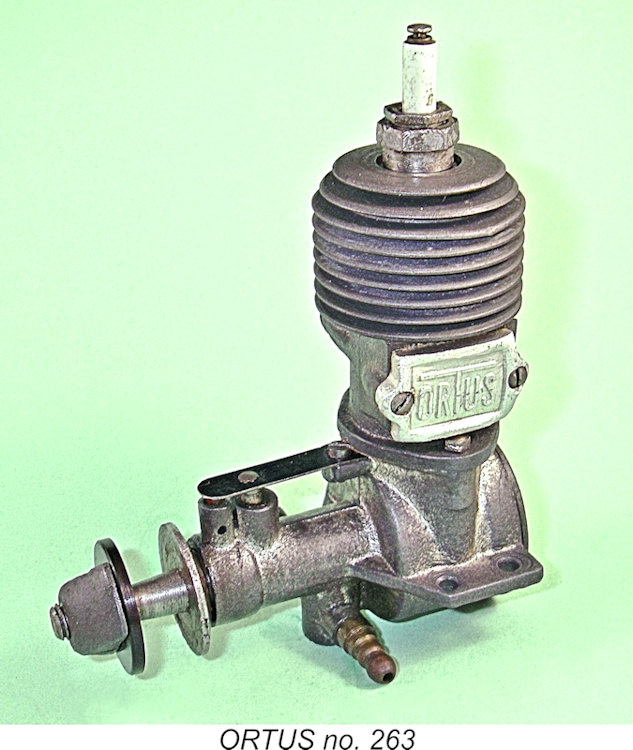 The ORTUS was very obviously a development of the earlier Bauer-Thusius motor, still retaining a far more than coincidental similarity to the original Baby Cyclone of 1935-36. However, its design was somewhat “cleaned up” from that of its predecessor. The name ORTUS clearly reflected the joint involvement of Oswald Ried and Alexander Thusius in its development.
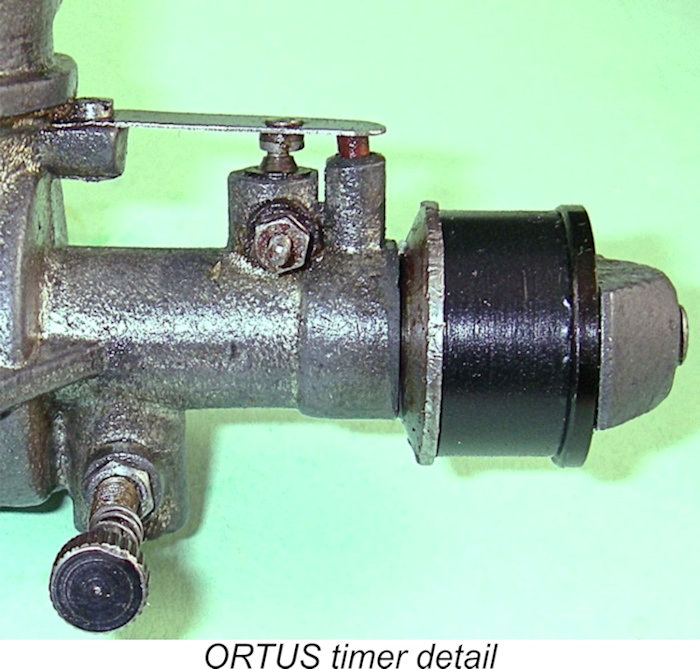 The ORTUS abandoned the enclosed timer of the Bauer-Thusius model in favor of a completely exposed unit. However, unlike the Baby Cyclone timer, which was activated by a cam formed at the rear of the prop driver, that used on the ORTUS was activated by a non-conducting plunger which responded to a cam formed in the crankshaft just behind the prop driver. Somewhat surprisingly for 1939, the ignition timing was still fixed, with no provision being made for ignition timing adjustment.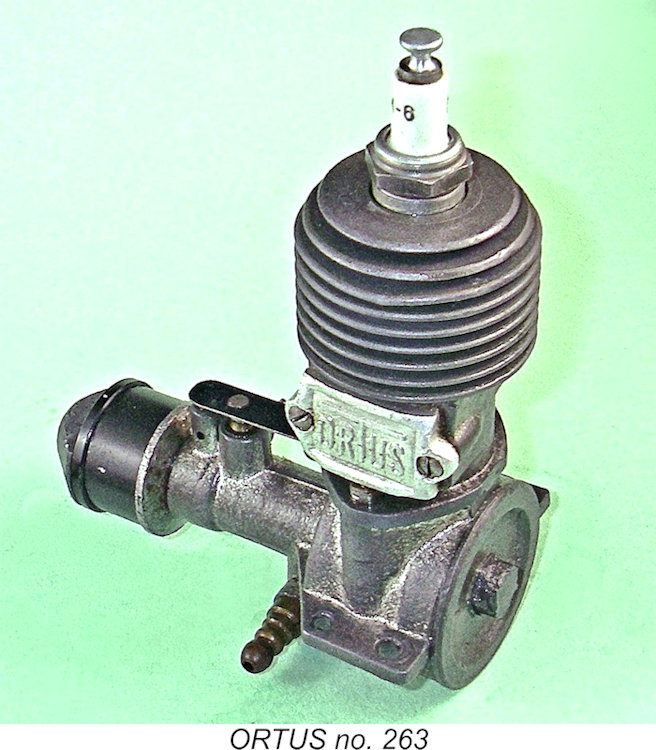
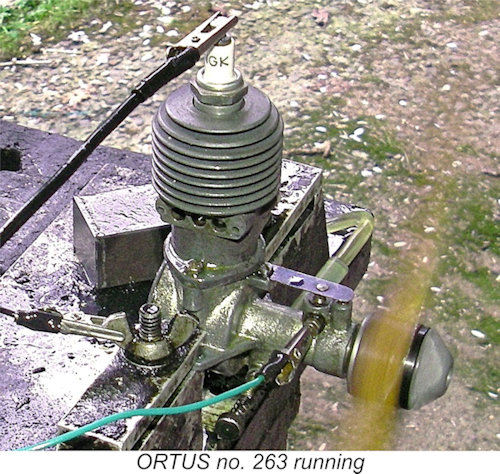
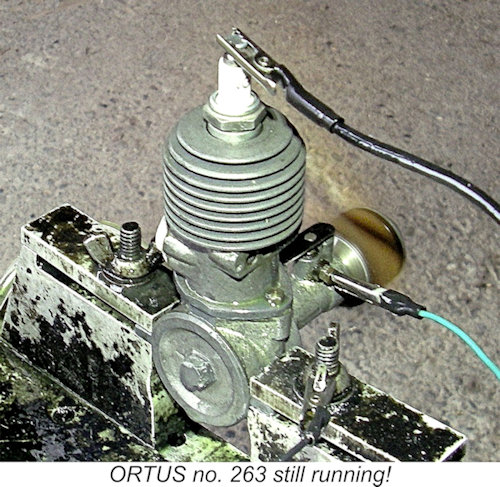
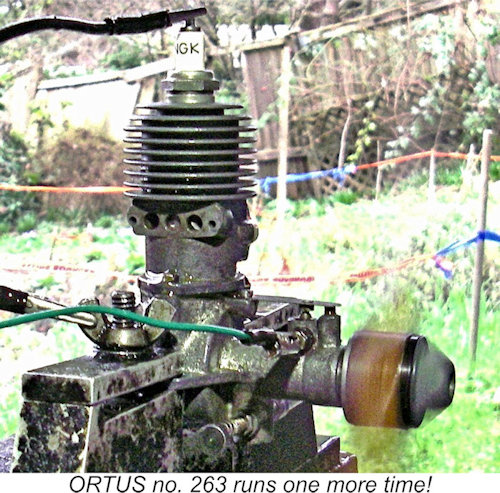 Once running, the needle could be closed a little from the starting setting to produce the best running. The ORTUS then ran the tank out very smoothly. Experiments with raising and lowering the tank showed that the engine had quite satisfactory suction, implying an appropriate throat area in the carburettor. Hot restarts were immediate using the running settings - when starting from cold, the engine appreciated the needle being opened half a turn or so.
 | |