
|
|
Italian Masterpieces - the Atomatic Diesels
I’ve always held the view that having the luck to acquire such a rarity places me under an obligation to share it to the extent possible. As always, I had no intention of confining any such efforts to a physical description of the engine – if anything, I’m even more interested in the personalities and circumstances surrounding its production. This article represents my attempt to summarize the full story of the Atomatic series of model diesels. Before getting started, I must acknowledge my sources. Foremost among these is Salvatore “Salvi” Angeloni, who possesses an amazing amount of Another invaluable source of information on the Atomatic engines, and indeed on classic Italian engines in general, is the very useful “Italian Engines” website. Established in 2007 by Carlo Gazzola of Genoa, this database covers Italian engines which were manufactured prior to 1960 or which were designed subsequently by individuals who were active in the design field prior to that date. This database is particularly helpful in narrowing down such factors as production dates, production figures and basic design characteristics. Anyone interested in classic Italian engines should have this resource at their fingertips – thanks, Carlo (and Rodolfo)!! Finally, I must pay tribute to the work of Dr. of Engineering Giacomo Mauro, whose outstanding 2006 compilation of plans for a variety of classic Italian diesels included a most informative summary of the history of early Italian engines in general, including several paragraphs on the Atomatic series. Very much appreciated! Thanks to my good mate Peter Valicek for bringing this invaluable resource to my attention and to Italian collector Pierangelo Quaglieri for making a copy available to me personally. With my sources duly credited, it’s time to share what I’ve been able to learn about this highly individualistic range of early model diesels. The Atomatic series – a Capsule History
In the early 1940’s, while still enrolled as a student at the University, Travalgi set up the Aviominima business, working from premises located on the ground floor of his home at 50A Via San Basilio in Rome. His timing could have been better - Italy’s entry into WW2 on June 10th, 1940 must have thrown a little sand into the bearings! The use of the Aviominima name for Travalgi’s business leads one into the realms of idle speculation regarding the possibility of some kind of personal connection between Travalgi and the improbably-named Swedish Regardless, while engaged in getting his model supply business up and running, Travalgi also somehow made time to serve as the Editor-in-Chief of the widely-read Italian model magazine “L’Aquilone” (The Kite). It comes as little surprise to learn that with all of these distractions, Travalgi never actually managed to complete his engineering studies at Rome University to the point of graduation!
Soon thereafter, Travalgi added the Antares 4 cc diesel made in Padova by Elios Vantini to his company’s portfolio, serving as Vantini’s main agent for southern Italy until early 1943, when production of the Antares engines appears to have ground to a halt, presumably due to the deteriorating wartime conditions in Italy. Antares production was resumed after WW2, but at a much-diminished level. Elios Vantini died suddenly of a heart attack in 1948. Following the Allied take-over of Rome in June 1944, the Aviominima shop quickly became a high-profile meeting place for Italian aeromodellers either resident in or visiting Rome. Even the odd US serviceman paid a visit, one of them being John Zaic, the younger brother of well-known American modelling personality and author Frank Zaic. At this point, Travalgi embarked upon the development of the first of his own “Atomatic” series of model diesels. He was assisted and encouraged in this endeavour by his close friend Giovanni (Ninetto) Ridenti, a very prominent Italian aeromodeller of the day.
What appears to be an example of one of these experimental engines came into my possession rather fortuitously in 2024. It was sold on eBay as an Antares, which it clearly wasn’t – as far as is known, Antares manufacturer Elios Vantini never made a beam-mount engine. However, it displays many Antares features while bearing an unmistakable imprint of Travalgi’s manufacturing style - the cooling jacket is particularly indicative, as is the use of a hexagonal keying section at the front of the shaft to lock the prop driver.
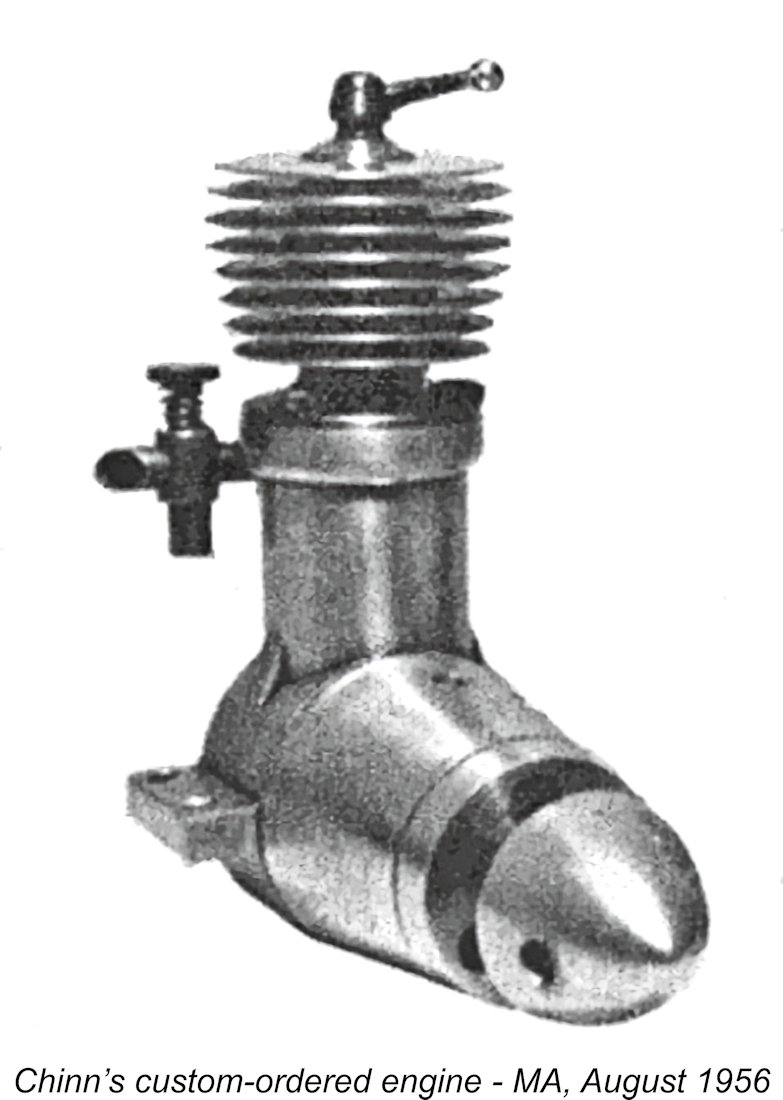
This particular engine appears to come with a story to tell! My eagle-eyed mate Gordon Beeby of Australia spotted an article by Peter Chinn entitled "Ten Years of Diesel Progress" which was published in the August 1956 issue of "Model Aircraft". In that article, Chinn included two photographs of an engine There's absolutely no question that the engine in Chinn's images is the one under discussion here. If it was indeed a custom-made engine produced to Chinn's special order, as clearly implied in his text, then this must be that very engine!! It seems that John Zaic was not the only serviceman with modelling connections to visit Travalgi's shop in Rome! The fact that my Italian contacts were unable to identify it is readily explained - there was only one example, and it went to England with Chinn! Further research on this engine has revealed a very interesting and unusual story which I considered to warrant its own stand-alone article. This article may be found elsewhere on this website. It includes a bench test of the engine. Although his initial experiments, including Chinn's custom design, evidently featured sideport induction along Antares lines, Travalgi was clearly attracted to the use of rotary valve induction. He also favored the streamlined styling of the Antares models with their wrap-around tanks surrounding the main bearing. The short overall length of the engine which the front tank made possible was clearly an attraction. After his experiments with beam mounting, Travalgi came down firmly in favor of the Antares’ radial mount configuration given the streamlined front-end which this system facilitated.
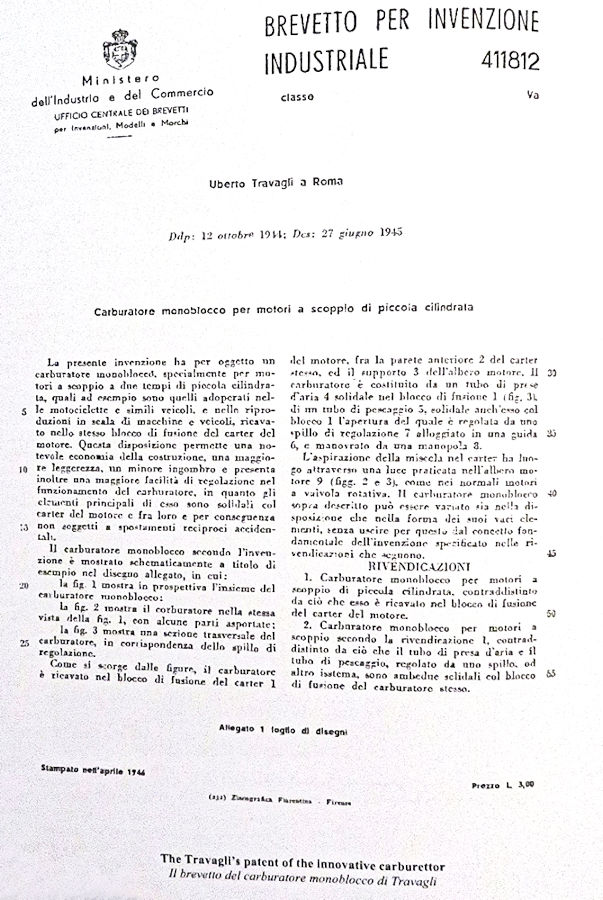
Travalgi developed this idea to the point where he applied for a patent on October 12th, 1944 for his in-tank carburettor concept, which he termed the “monobloc” carburettor. This patent (left) was finally assigned to Travalgi on June 27th, 1945.
Once he had developed his concept of an in- The Super Antares introduced the downward-angled exhaust stacks which were to become a defining feature of the Atomatic engines. At the time of writing, I’m unclear regarding the number of Super Antares engines produced. All I know is that it cannot have been large - the engine is vanishingly rare today. Travalgi continued to focus his main efforts on his front disc rotary valve Atomatic models.
The premises on Via San Basilio included just enough space to permit Travalgi to setup the small workshop in which the Atomatic engines were produced. The equipment included a lathe, a milling machine, a drill press and a fly press. In terms of their styling, the Atomatic engines were clearly influenced quite strongly by Elio Vantini’s Antares units which had formerly been marketed by Travalgi. Like the Antares, the fuel tank was a wrap-around affair mounted on the main bearing at the front. This imparted a strikingly streamlined look to the engines in addition to minimizing their length. The Atomatic compression screws were also very elegantly styled along Antares lines. However, the functional design of the Atomatic engines was highly original, owing nothing to the side-port Antares units and Travalgi prototypes which had preceded them. They used a front rotary disc valve which was driven by a forward-protruding pin installed in the centre of the crankpin. This system had been used previously by Edgar T. Westbury in his 5 cc Kestrel spark-ignition design of 1937. The Atomatic models also used an unusual fuel supply system featuring a fixed jet with a variable air intake to regulate the mixture. The same system was later used in some of the Pepperell diesels from post-WW2 New Zealand as well as appearing in slightly different form on the French Airplan and spin-off Airstar designs. It works well enough, but is somewhat less precise and certainly less efficient than the conventional fuel-metering needle valve arrangement with full-time wide-open air intake.
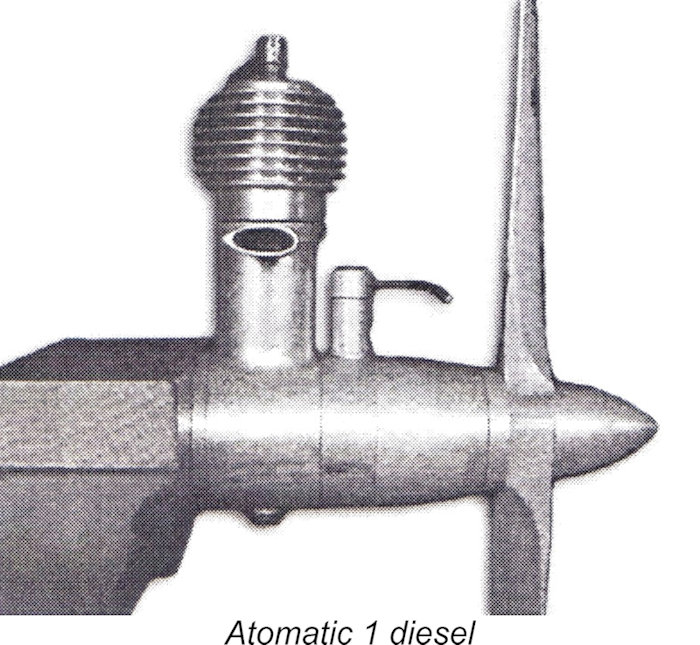
The Atomatic engines were built to very high standards, also evidently performing well by the standards of their day. Consequently, they seem to have sold as fast as The first Atomatic model was the Atomatic 4, which appeared in sandcast form in the latter half of 1944. Bore and stroke of this model were 15.5 mm and 22 mm respectively, yielding a true displacement of 4.15 cc. This engine featured twin horizontal exhaust stacks, one on each side. It was followed in 1945 by two further variants, the first of which introduced the twin downward-angled exhaust stacks which were to become a defining Atomatic feature, as seen in the accompanying advertisement. The last variant used permanent mold castings. While this variant retained the same bore of 15.5 mm, the stroke was increased to 24 mm, giving an increased The next model to appear was the 1.4 cc Atomatic 1, of which only some 20-30 examples were produced as field test prototypes in 1945. This unit was designed along identical lines to its larger sibling, but featured bore and stroke dimensions of 11 mm and 14.7 mm respectively for a calculated displacement of 1.40 cc. Like the original Atomatic 4, it had a sandcast case with horizontal exhaust stacks. However, it never made it into full production - the Atomatic 4 in its permanent mold form continued to serve as Travalgi’s “bread and butter” offering.
My example bears the serial number 1512. I doubt very seriously that this implies the production of at least 1512 examples – the engine is far too rare for that! A more credible interpretation is that this example comes from batch no. 1 of the Atomatic 5 design and this was engine no. 12 in that batch. The engine’s model designation “A5” appears in a raised cartouche at the front of the upper main casting above the intake structure. This offering was basically identical to its Atomatic 4 predecessor, but featured an increased bore dimension of 16.5 mm to go along with the unchanged stroke of 24 mm. This gave it an increased displacement of 5.13 cc. The revised model weighed in at a c
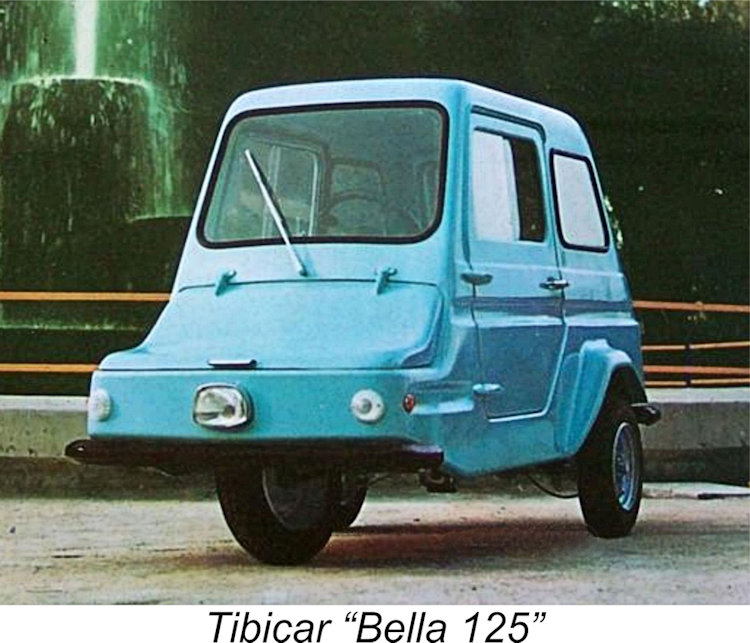
In fact, the Aviominima shop itself closed at that point, for reasons which remain obscure to this day. It eventually re-opened in the early 1950’s, at which point it branched out into the model boat, model railroad and tether car fields in addition to its continuing Uberto Travalgi moved into the production of various industrial prototypes using composite materials. One of his projects was the Tibicar "Bella 125", a 3-wheel mini-car intended for city use which made its debut at the 1978 Turin Motor Show and remained in production until 1988. This cute little vehicle was powered by a 123 cc 2-stroke engine developing an awesome 5.5 BHP @ 4,500 RPM! It could apparently stagger all the way up to 70 km/hr.
The Atomatic 5 - Performance I was frankly extremely reluctant to run my fine recently-acquired example of this very rare engine – why risk it? The engine appears to be new and unrun, and examples in that condition can't be thick on the ground, hence meriting preservation! Creating a suitable mounting for it would represent a hassle of considerable magnitude. Even if such a mount was created, a significant challenge inherent in any attempt to run this engine would be the fact that the inevitable anti-clockwise torque which would be generated by flicking the engine against compression would have the effect of unscrewing the engine from its mounting. It would therefore be necessary to apply pressure to the cooling jacket with the left hand to restrain any such tendency while flicking with the right hand. Of course, once the engine started, the resulting clockwise operating torque would have the desirable effect of tightening the engine on its mounting. Quite apart from the above considerations, this example would need to be run in to allow it to show its best on the test stand, and I could see no point in doing that given the fact that the engine would not be entering service, at least in my hands. This being the case, we're left with the manufacturer's claims. Among those claims was an operating speed of 14,000 RPM with a flywheel. Such meaningless claims were remarkably common during the early years, although what the claimants thought they proved apart from the engine's ability to withstand periods of extreme abuse is beyond me! Of far greater relevance, the manufacturer also claimed a speed of 5,000 RPM using a 30 cm (11.8 in.) prop of unspecified pitch. This figure is completely consistent with reported figures for other contemporary 5 cc diesels using 12 in. dia. props. The engine was said to spin a 22x35 (8.7x13.8 in.) airscrew at 8,000 RPM - presumably a C/L speed prop. Claimed peak output was 0.23 CV (0.227 BHP) at unspecified RPM, a claim which appears to me to be entirely consistent with the engine's relatively advanced design features as well as with reported performance figures for other contemporary 5 cc diesels. The Replicas
However, the Atomatic diesels have received the attention of several mega-talented replicators from outside Italy. The first in this field was former Motor Boys International member Les Stone, who built a superb rendition of the final variant of the Atomatic 4 model of 1945. Les had an incomplete example of the Atomatic 5 on hand to guide him in the preparation of Les’s successful efforts came to the attention of the mega-talented home constructor Ramon “Tug” Wilson, who advised Les of his intention to try his hand at building a replica of the Atomatic 5 model. Les responded most generously, providing Tug with a considerable amount of invaluable information relating to this project. The result was the creation of two superb Atomatic replicas. Both of them were tested by their constructors and found to run very well. Tug did his fellow home constructors a great favor by making a detailed photographic record of his efforts as they went along. Anyone interested in looking over the shoulder of a master craftsman at work is bound to enjoy this presentation – give it a look! Conclusion I hope you’ve enjoyed this look at a range of pioneering model diesels which had its origins to the early years of model diesel development and reflected great credit upon the design and manufacturing capabilities of its multi-talented creator Uberto Travalgi. His efforts richly merit our unqualified respect! __________________________ Article © Adrian C. Duncan, Coquitlam, British Columbia, Canada First published |
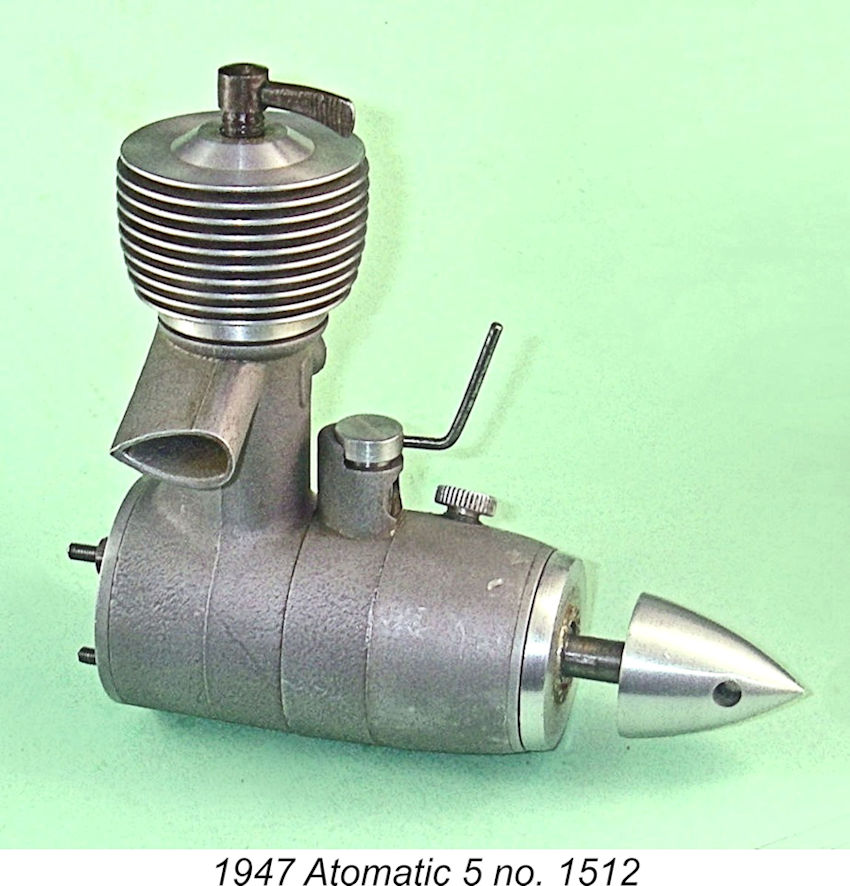 I’ve always found that good fortune is best appreciated when it’s shared. The good fortune that inspired this comment and this article was my completely fortuitous and quite unexpected acquisition of a near-pristine original example of the very rare 1947 Atomatic 5 diesel from Rome, Italy. Given the extreme rarity of the Atomatic engines, both the seller and I sincerely believed that this engine must be a latter-day replica, but exhaustive research among Italian contacts and sources has since confirmed that it’s an almost unused original example. Even in Italy, it's extremely rare in this condition.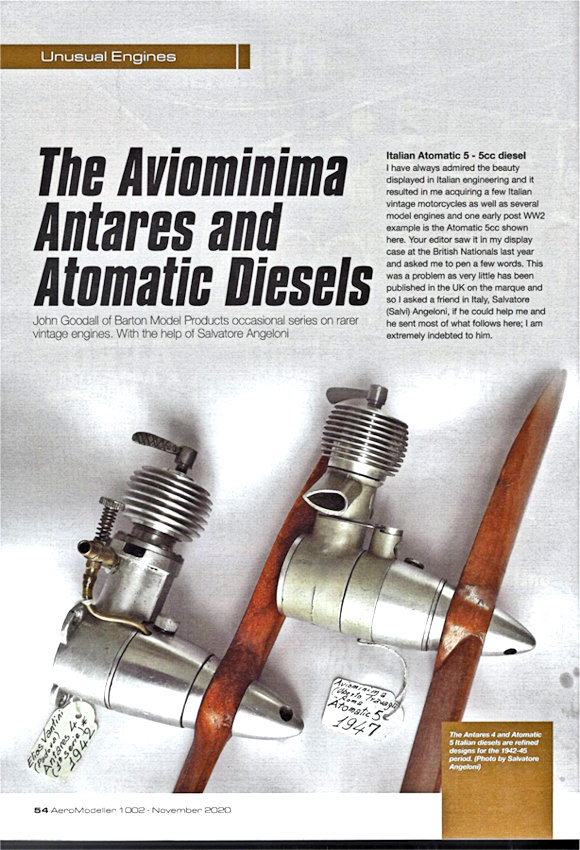
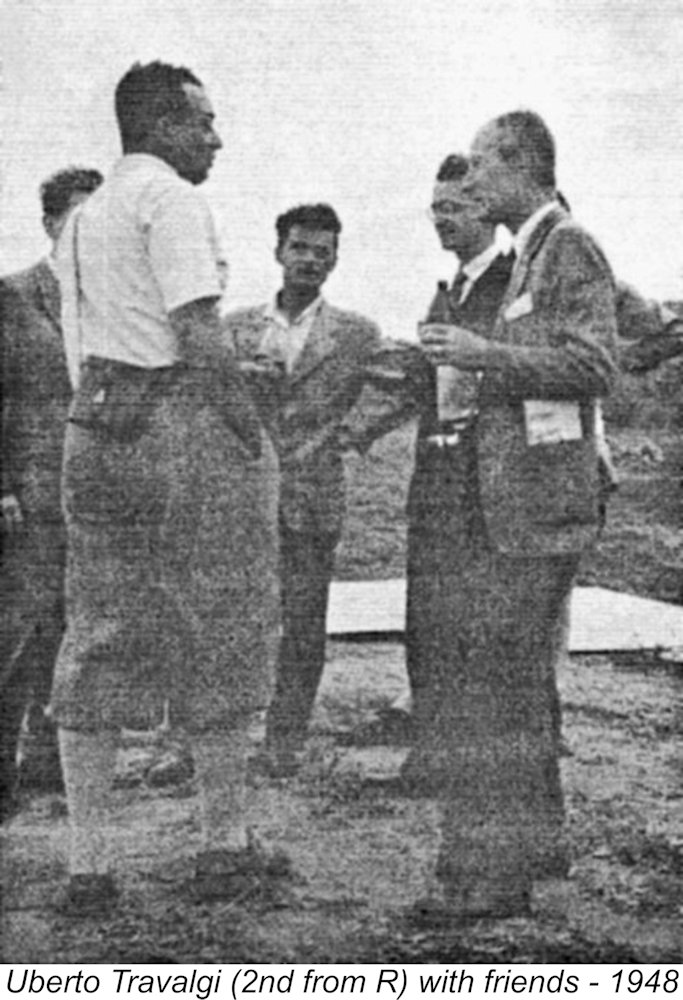 The engines in the Atomatic series were produced in relatively small numbers by Uberto Travalgi, working through his “Aviominima” model supply business in Rome, Italy. Born in 1920, Travalgi studied engineering at the University of Rome after leaving school. He was a keen aeromodeller from an early age, being well-known in Italy for his TR55 Wakefield design, which included such advanced features as retractable landing gear and a prop which varied its pitch in flight.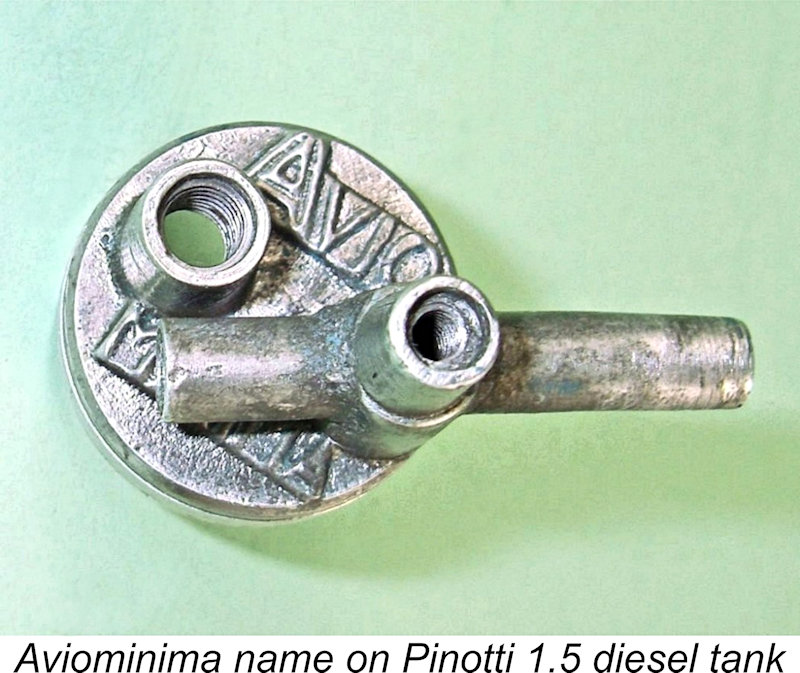
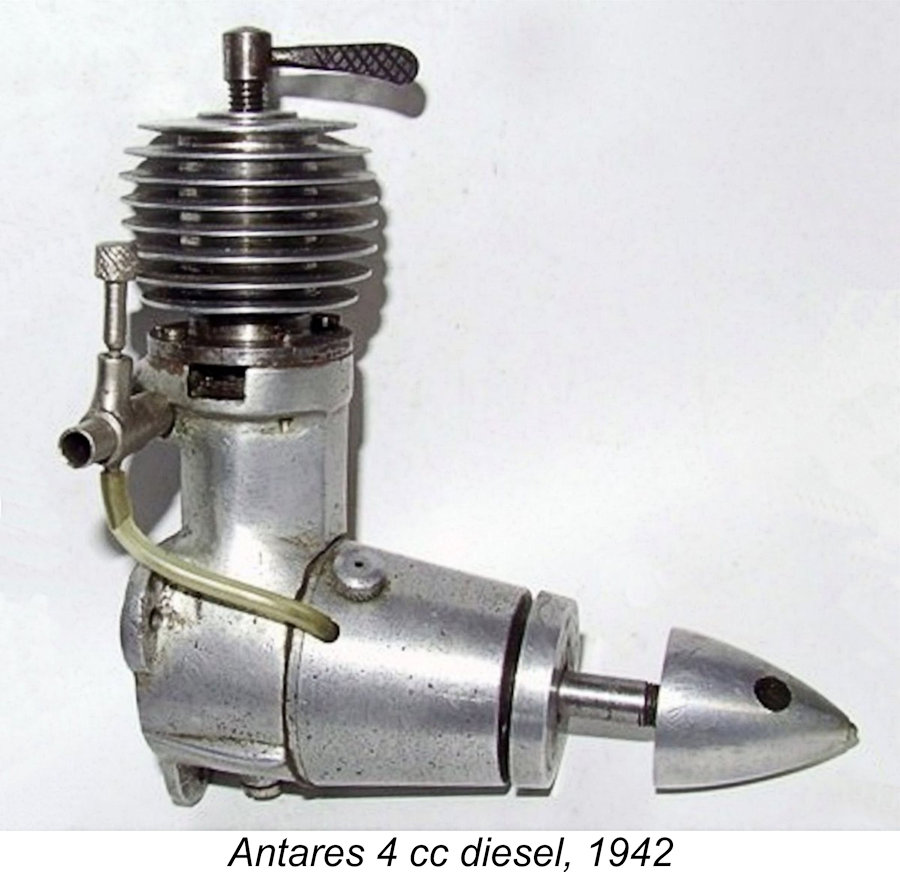 The Aviominima business supplied a range of modelling goods, including plans, construction materials and engines. Following the construction of a prototype in which he almost certainly had a hand, in early 1942 Travalgi began to sell drawings for home construction of an engine called the “Dinamite”. These drawings are reproduced in Giacomo Mauro's previously-cited
 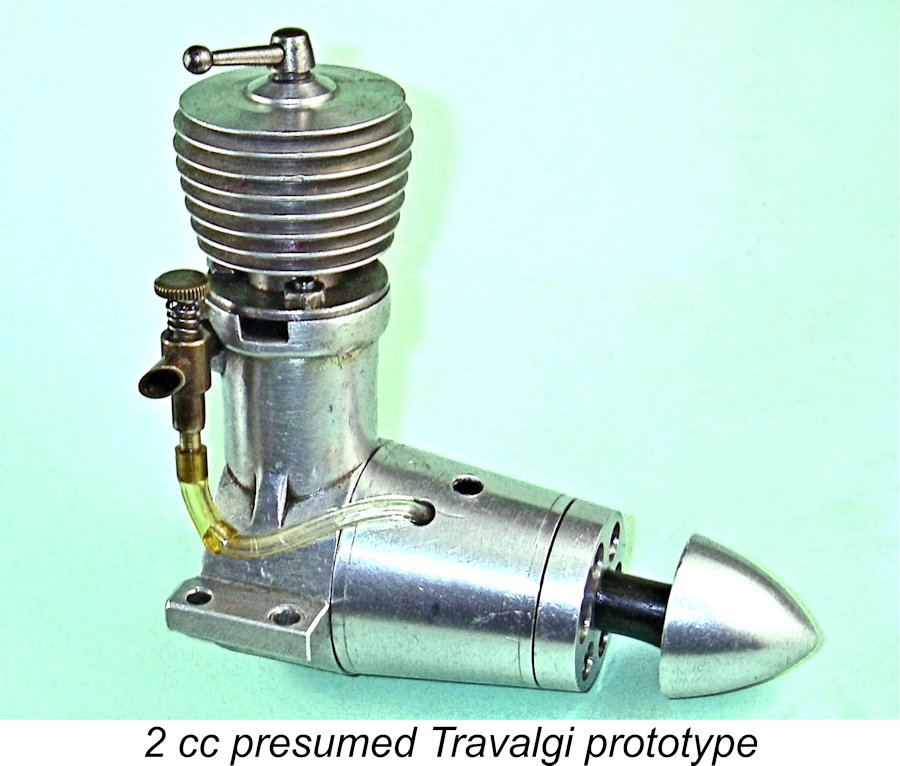 It’s clear that while selling the Antares diesels, Travalgi had been studying them and considering possible improvements. According to Carlo Gazzola, in 1944 he constructed a number of engines displaying many Antares features but testing some different peripherals. Among these were a few beam-mount units, some of which featured the Antares’ unique laterally-oriented sideport induction arrangement at the rear of the cylinder.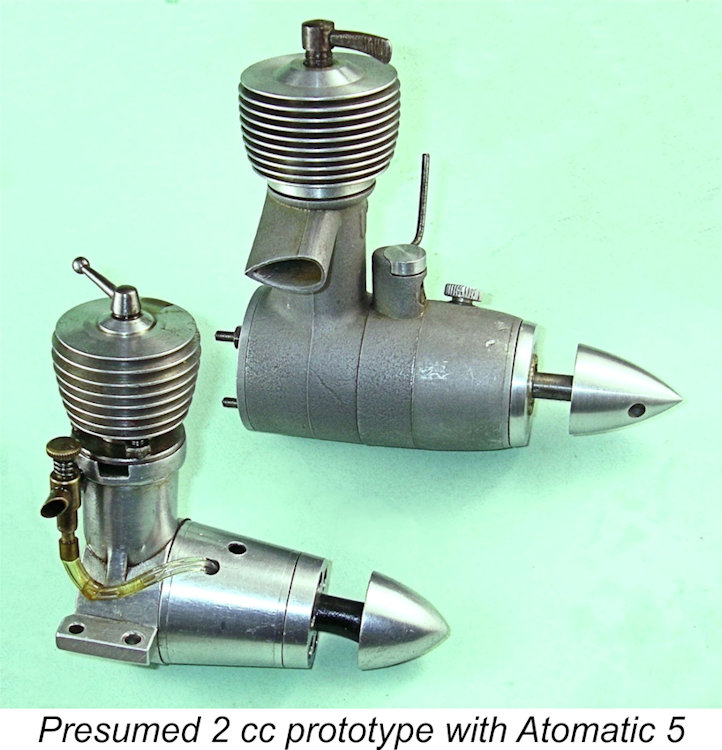
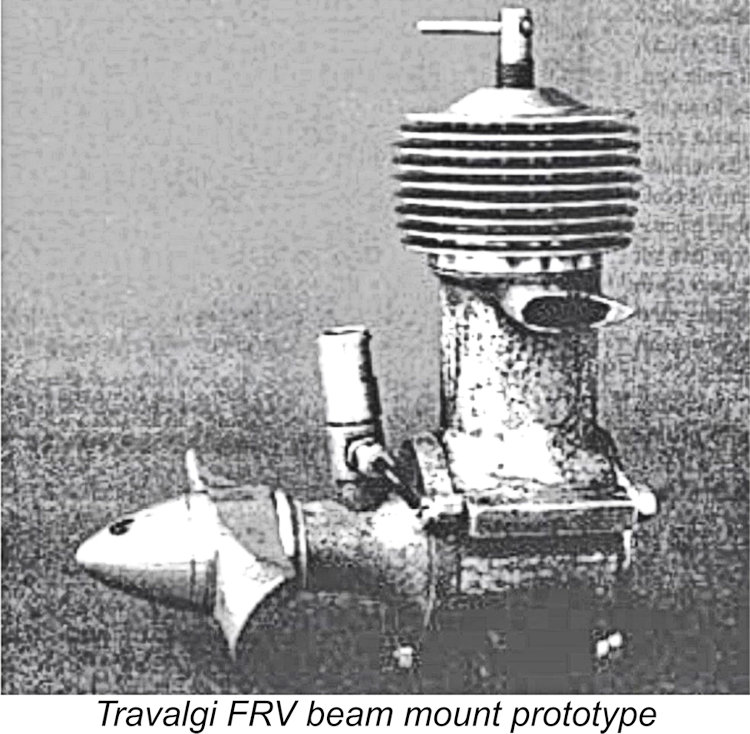 Travalgi’s first series-production engine, the Atomatic 4, utilized this concept in conjunction with a front disc rotary valve. It appeared in the latter half of 1944. However, Travalgi was clearly intrigued by the potential application of the concept to crankshaft front rotary valve (FRV) induction. To test this idea, he had previously produced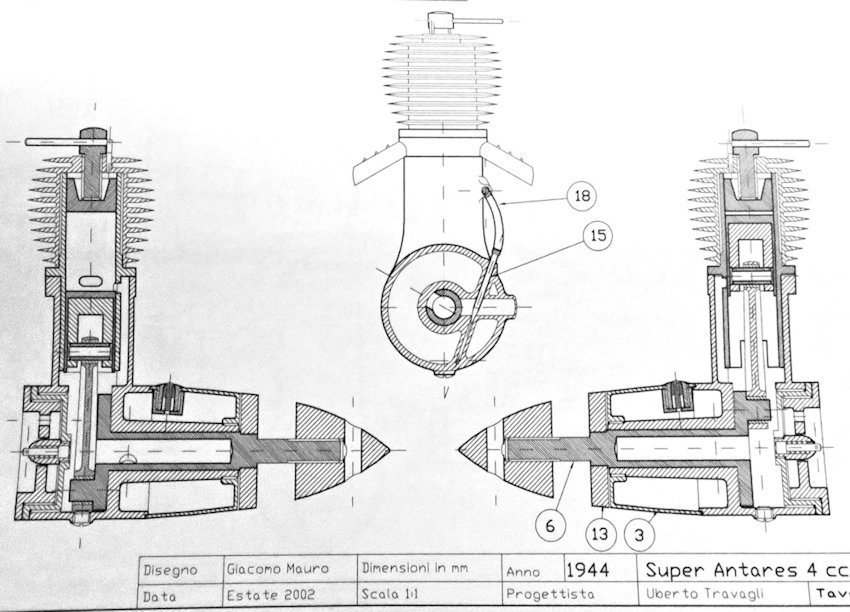
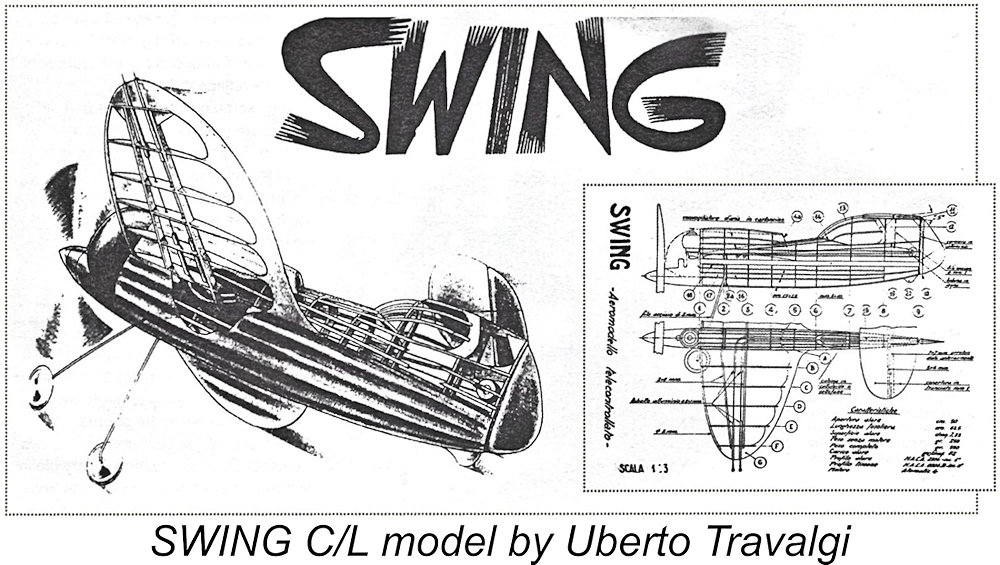 While pursuing these various engine developments, Travalgi also remained involved with model aircraft design, producing the first plans for a control line model to be published in Italy. Called the “SWING”, this model was designed in 1944 specifically for Travalgi’s first engine, the Atomatic 4 diesel. It was most unusual in having no bellcrank – the control wires were connected directly to the elevator, being re-directed by aluminium tubes inside the fuselage! Strong hinges ………. a sizeable portfolio of additional model designs soon appeared under the Aviominima name, as seen in the advertising spread which is reproduced below at the left.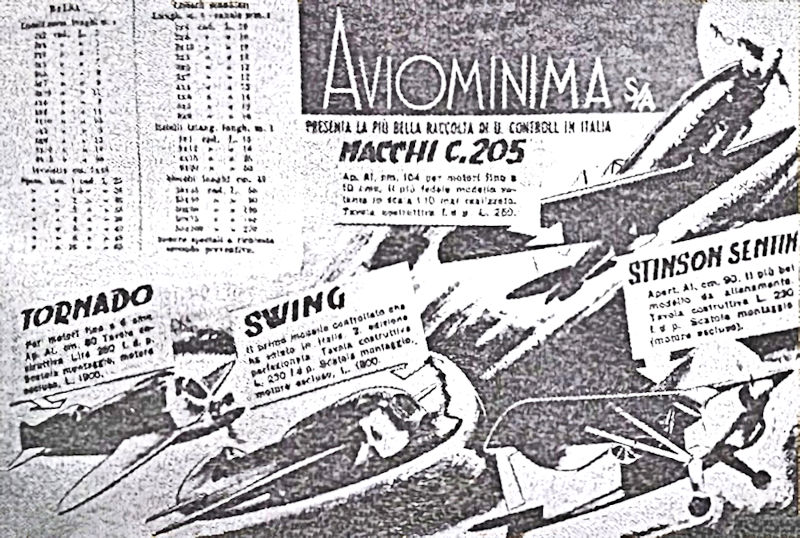
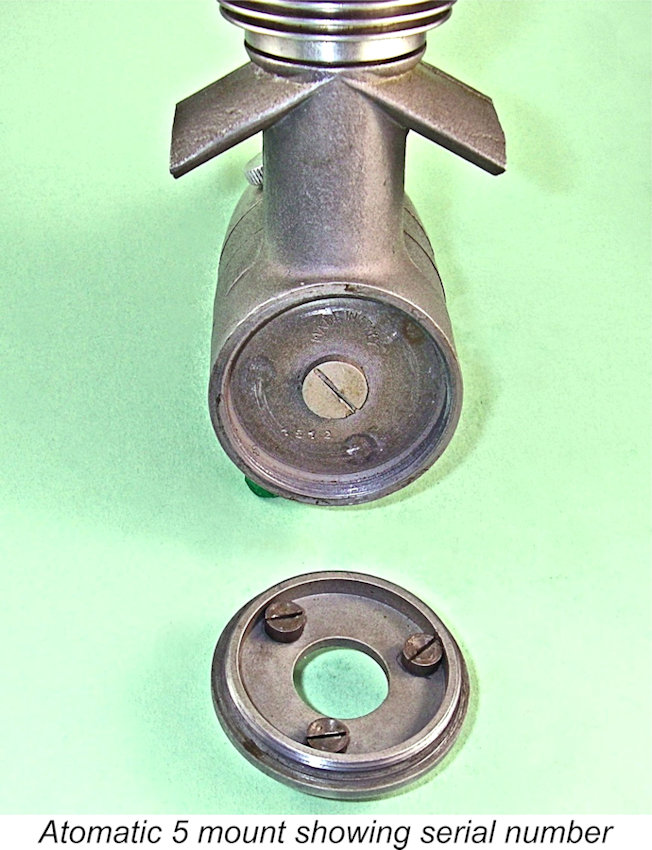
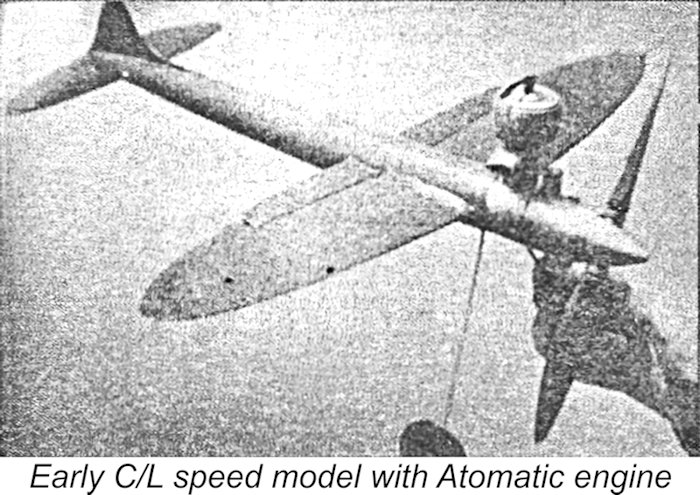 As if this wasn’t enough, all of the Atomatic engines featured a very strange mounting system. They were supplied with a separate disc-shaped backplate mount which threaded into a blind recess at the rear of the crankcase on a right-hand thread. The backplate mount was firmly attached to the model’s front bulkhead with three machine screws, after which the complete engine was screwed onto the backplate mount. Awkward, and the fact that the engine was timed to run in the conventional anti-clockwise direction (viewed from the front) required the operator to physically restrain it while starting, otherwise starting torque would cause the engine to unscrew from its mount. Once running, of course, the engine's operating torque would tend to tighten the crankcase onto its mount.
  The underlying idea was clearly to streamline the frontal area of the models in which the engines were used. The engine could actually form the entire nose of a streamlined model, as seen in the accompanying image. But while it certainly did result in a totally uncluttered mounting, the system undeniably presented some significant mounting challenges. Even so, the beautiful styling of the Atomatic models reflected the fact that Travalgi was as much an industrial artist as he was a model engine designer.
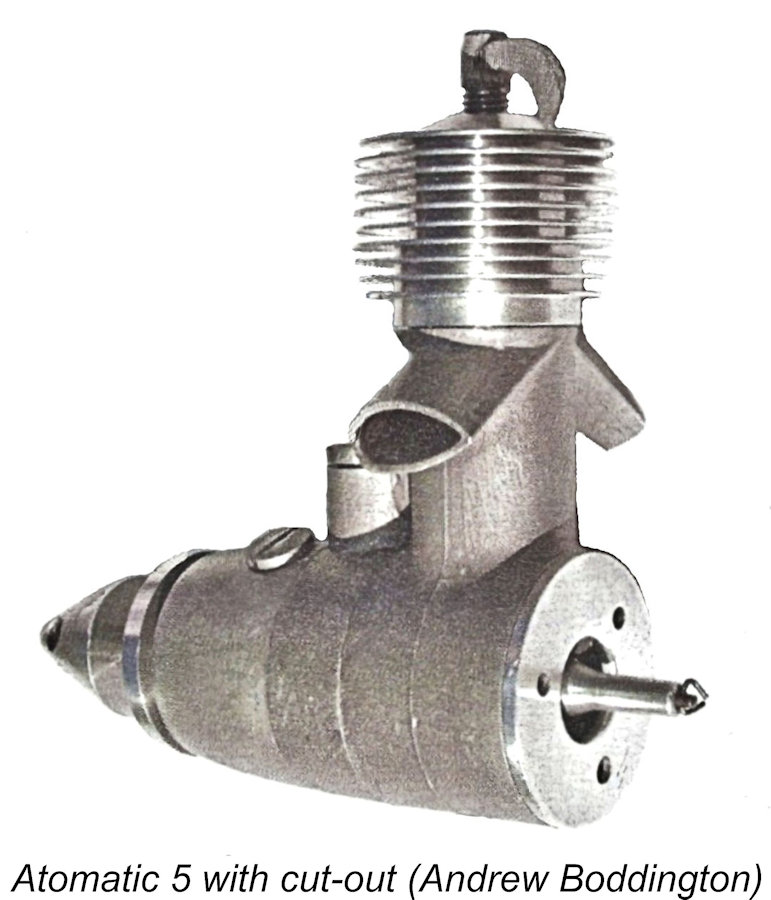 The actual working backplates of the engines were cast integrally with the main crankcase, forming the base of the threaded recess which accommodated the mount. The backplates were provided with a tapped hole at the centre. For control line applications this hole was plugged with a slot-head screw (as on my illustrated example), but for free flight use this screw could be replaced by an air bleed valve which served as a timer, stopping the engine by releasing the crankcase pressure. The serial number of the engine appeared stamped neatly into this backplate, along with the “Made in Italy” designation.
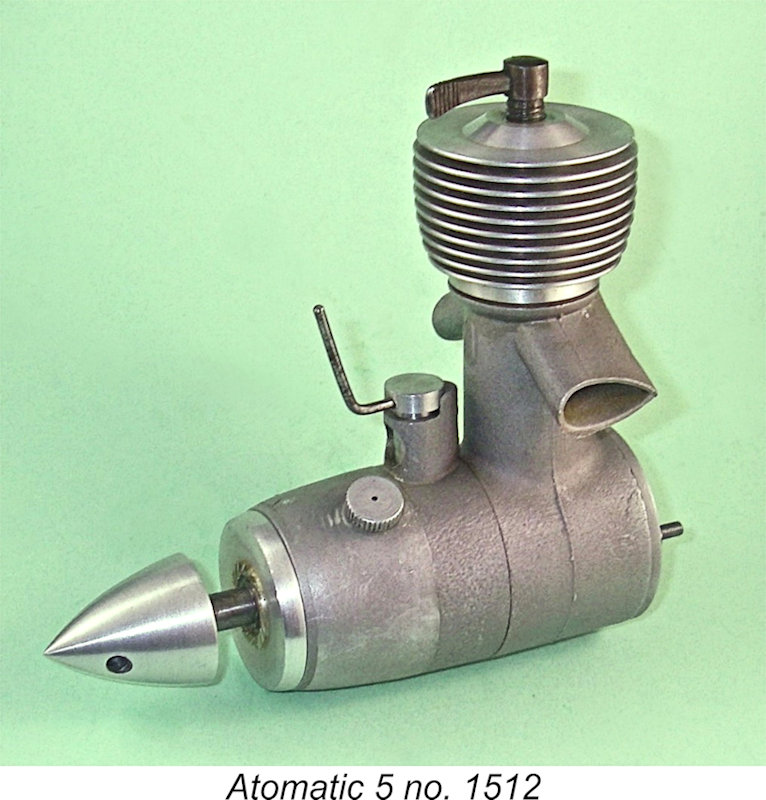 In 1947 Travalgi produced a few prototype examples of a 10 cc version of his design called the Atomatic 10, which was never put into series production. He also introduced a new 5.13 cc variant called the Atomatic 5. This model was intended as a replacement for the Atomatic 4 which was now into its third year in production. It is an example of this model which has come into my possession.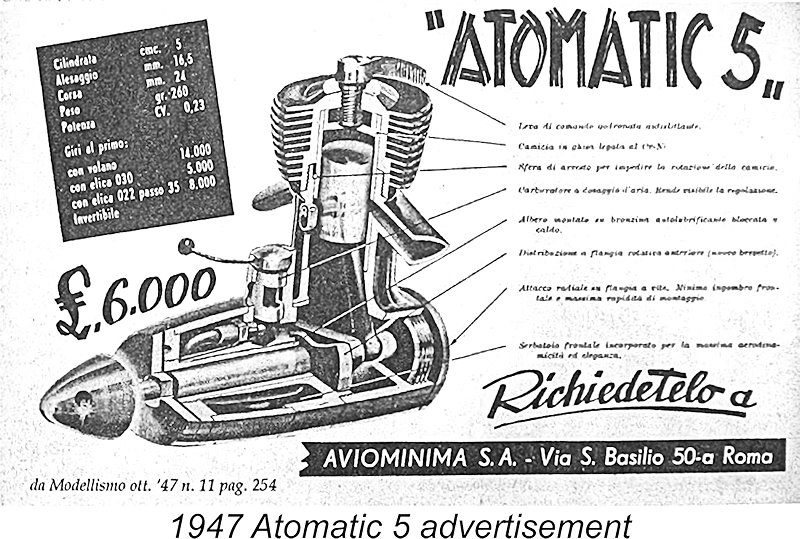
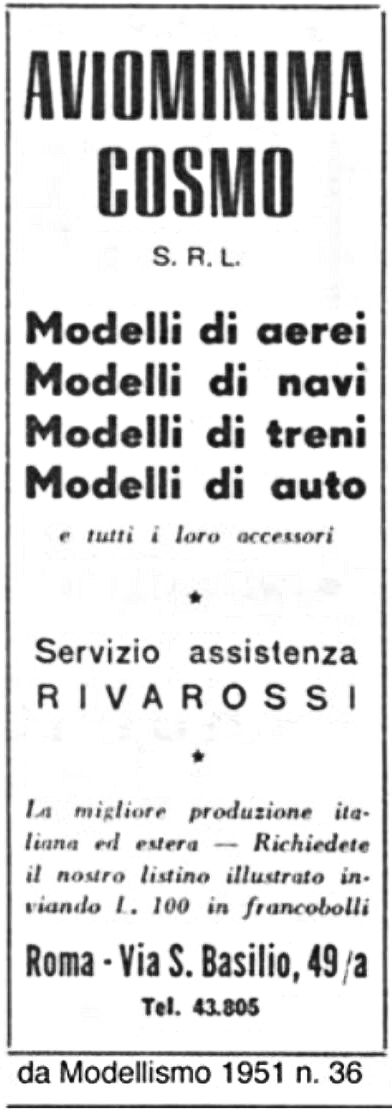
 involvement with aeromodelling. The accompanying advertisement seen at the left appeared in the Italian magazine "Modellismo" in 1951. No further engines were produced under the Atomatic label – the engines sold were all from other manufacturers.
 Travalgi died in 1993 at the age of 73 years, leaving his beautifully-styled and superbly-crafted Atomatic engines as testimony both to his technical capabilities and his design artistry. Surviving examples in good condition are very rare today – I was extremely fortunate!
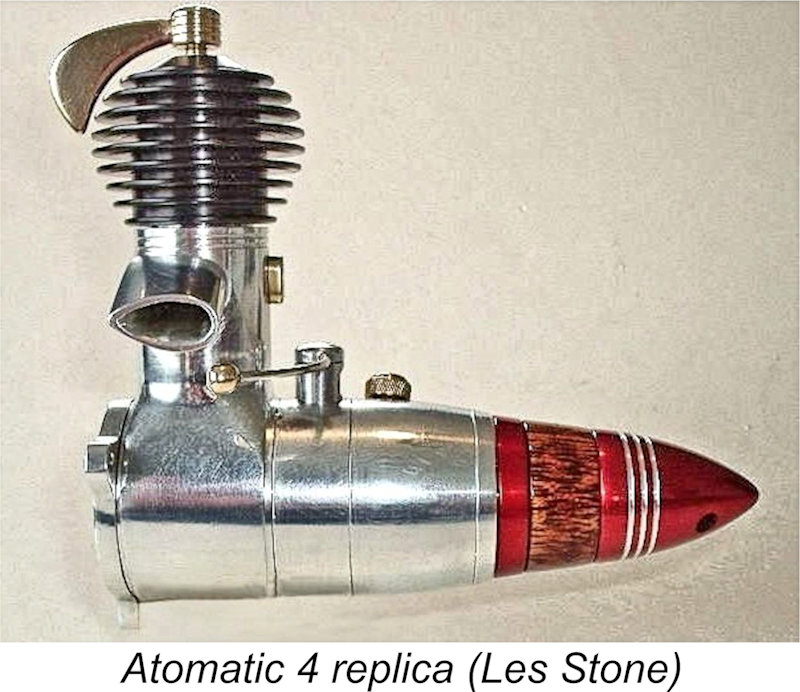 The beautiful styling, technical originality and relative rarity of the Atomatic engines have naturally combined to make them very attractive subjects for replication by a few of the talented home constructors among us. I noted earlier that when I acquired my lovely example of the Atomatic 5, I assumed initially that it must be a latter-day replica - I simply couldn't believe that such a pristine example could have survived down through the years. Somewhat to my surprise, my Italian contacts informed me that the Atomatic 5 is among the classic Italian models which has never been replicated, at least in its native Italy.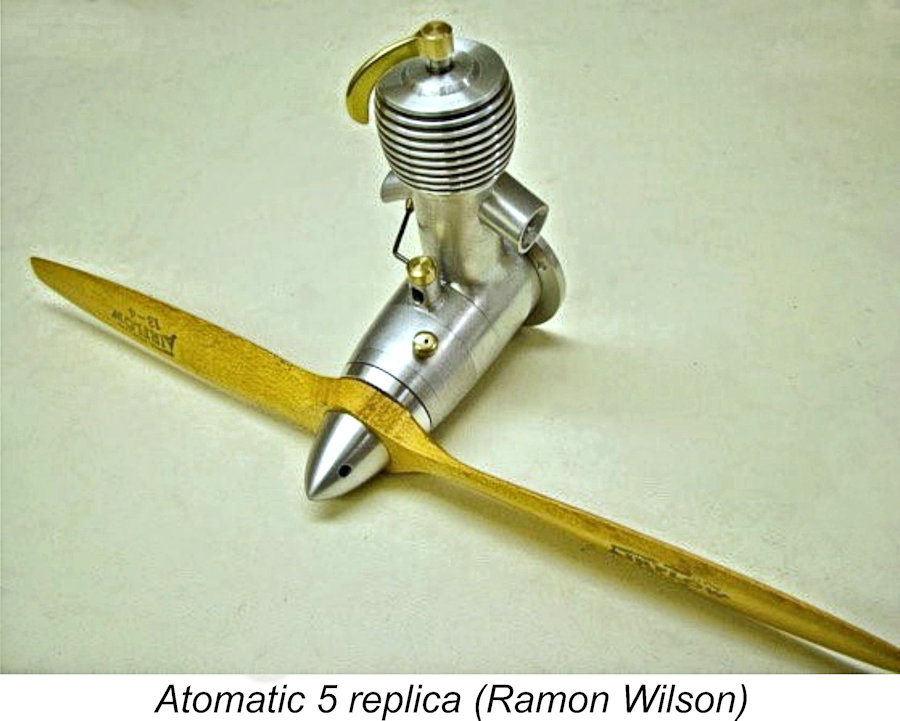
| |