
|
|
In the Beginning - the Genesis of the Model Aero Engine
In this article, I’ll attempt to draw back the curtain obscuring these early creations by shedding a little light upon the efforts of the early pioneers. Such efforts were by no means confined to any one country – during the course of this account, we’ll be visiting Great Britain, the USA, France and Germany, while recognizing that similar contemporary developments doubtless took place in other countries for which documentation is unavailable to me. That having been said, this article will concern itself first and foremost with engines of British origin since, as we shall learn, that country undoubtedly saw by far the highest level of well-documented activity in the early development of the commercial model aero engine. Most present-day model aero engine enthusiasts seem to subscribe to the view that the commercial manufacture of such engines began in the early 1930’s with the appearance of the Brown Junior and a few other contemporaries. Many enthusiasts will be astonished to find that in reality an amazing variety of small engines specifically intended for model aircraft use were offered commercially in various countries both prior to and during WW1! It's my intention here to shed a little long-overdue light on these pioneering efforts.
Secondly, I'll confine my attention to engines which were produced specifically for use in model aircraft. A considerable number of engines were produced during the period of interest which were intended for model boat applications. The field of pioneering marine engines has been covered in great detail on the wonderful and highly-recommended Onthewire website maintained by my friends Lynn and Hugh Blowers - there's no need for me to reprise that effort here. Thirdly, I intend to focus for the most part upon pioneering efforts to market model aero engines commercially rather than to merely produce individual one-off examples, although I will of course mention the latter insofar as they undoubtedly form part of the story. And finally, I’ll approach my subject chronologically, noting the various engines as far as possible in the order of their appearance. My intention is to tell a story, not merely present a list! With my study parameters established, it remains for me to summarize my main sources before diving into the article itself. Sources It’s actually a little surprising that no-one seems to have made a previous attempt to present a comprehensive chronological history of model aero engine development during the early pioneering years, because there are a number of very useful sources from which a great deal of information may be gleaned with a little effort. Here I’ll list the primary sources which I’ve consulted during the preparation of this article.
This article is a commendable attempt by its author to set out the story of the early pioneering model engines. It deals primarily with engines of British origin, although the achievements of a few American pioneers are included. An essential reference, for which the author is to be commended!
This article focuses more or less entirely upon British engines of the pre-WW1 era. The coverage is incomplete, but this is nonetheless a very useful reference, for which Alan Denham deserves great credit. It was reading this article that sparked my own interest in this topic!
Model aircraft topics, including the development of model aero engines, were covered regularly from January 1909 onwards in two contemporary British aeronautical magazines - “FLIGHT” and “The AERO”. Both of these publications are preserved in readily-accessible on-line archives. They contain both articles and advertisements which together do much to document early model aero engine developments in Britain from a contemporary perspective. In connection with these particular sources, I’m deeply indebted to my Aussie friend and colleague Gordon Beeby of Australia, who spent countless hours trolling through the pages of both magazines to find relevant references. Such assistance is greatly appreciated - I couldn't have written this article without Gordon's help! Thanks, mate!!
This excellent article is focused primarily on the later development of model engines from the early 1930’s onwards, but it does include a useful section on the engines of the early pioneering era, including a few photographs.
Although its coverage extends to French model engines of all eras, this book contains a useful illustrated summary of pre-WW1 model engine developments in France. The information is presented in both French and English, making it readily accessible to many readers.
This German-language book covers German engines of all eras, but it does include information on pioneering German initiatives in this field. One admission that should be made here is the fact that the majority of the illustrations associated with this article fall well short of meeting my usual standards. I make no apology for this - surviving examples of the engines to be discussed here are vanishingly rare or non-existent, leaving me with no choice but to use scans of century-old illustrations culled from the above sources. I hope you'll agree that any illustration is surely better than none! Now, having listed the main sources consulted, let’s see what they have to tell us! First Steps
Perhaps the first individual to rise to that particular challenge was the Yorkshire-born designer of lace-making equipment John Stringfellow. In around 1840, Stringfellow formed an association with his fellow lace-making technician William Henson, who shared his combination of mechanical skills and an inventive mind. They became fascinated by the concept of developing a self-propelled flying machine.
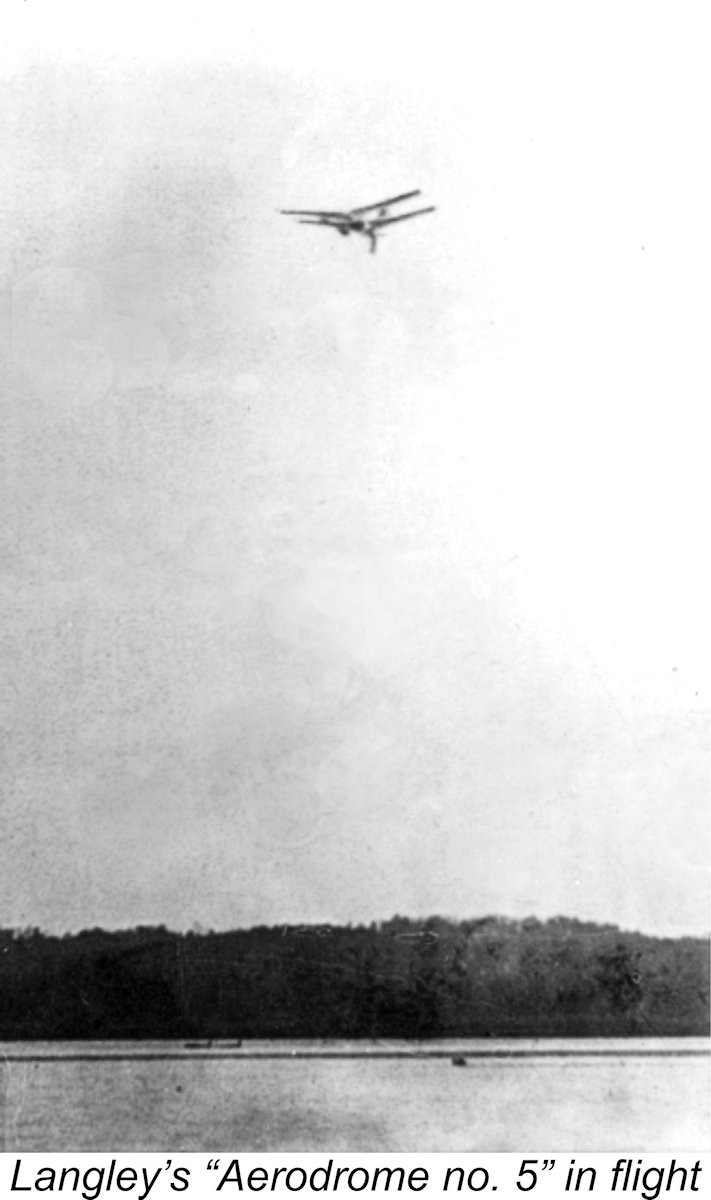
In the absence of obvious alternatives at the time, it was clear that steam power offered the only practical means of propulsion. Since the steam engines of the day were massive and ponderous affairs, Stringfellow recognized that the development of the Ariel’s design would be most readily pursued through the construction of models. To that end, he created a series of beautifully-constructed and increasingly miniaturized high-speed steam engines to power the development models which he considered to be necessary. Stringfellow’s efforts were crowned with success in 1848, when he used a steam-powered model having a 10-foot wingspan to achieve the world's first-ever powered flight of a model aircraft. However, the distance covered in flight was only some 30 yards. Moreover, it had now become obvious that full-scale heavier-than-air aviation would not be possible until a more efficient form of powerplant was developed. As a result, the Ariel concept was not pursued further at that time. Although the concept of an internal combustion engine had been under consideration since the late 18th Century, it was not until 1876 that Nicolaus Otto of Germany patented the “modern” compressed-charge four-stroke engine. This was followed in 1879 by Karl Benz’s patenting of the two-stroke principle. The However, that development did not happen overnight. In the interim, experiments using steam power continued. On July 1st, 1894 the American-born British resident Hiram Maxim made a short flight of 920 feet in a full-sized steam-powered aircraft of his own design and construction. However, that flight was both unintentional and completely un-controlled, hence not Perhaps the most notable exponent of the use of steam power in a model aircraft was the American scientist Samuel Pierpont Langley, who was the Secretary of the Smithsonian Institution. On May 6th, 1896, Langley's steam-powered Aerodrome No. 5 flew over the Potomac River for a reported 105 seconds, thus eclipsing Stringfellow's “short hop” accomplishment, although Langley’s model had to be catapult-launched from the roof of a houseboat! This flight was witnessed by the famous telephone inventor and part-time aeronautical experimenter Alexander Graham Bell, who took the accompanying photograph of the model in flight. Despite Maxim's near-miss and Langley’s success, it was now obvious that the development of the internal combustion engine into a form suitable for aero applications, both model and full-sized, was a prerequisite to the further advancement of the concept of heavier-than-air flight. Among those who clearly recognized this imperative were the Wright brothers Orville and Wilbur of Dayton, Ohio, USA. At the time of their early experiments with heavier-than-air flight, commercially-made engines of a size suitable even for full-sized aero use, let alone models, were simply unavailable. Consequently, the brothers were forced to design the engine for their Wright Flyer themselves, passing its actual construction over to their employee Charlie Taylor, who was a shop mechanic in the brothers’ bicycle business. The Switch to Internal Combustion
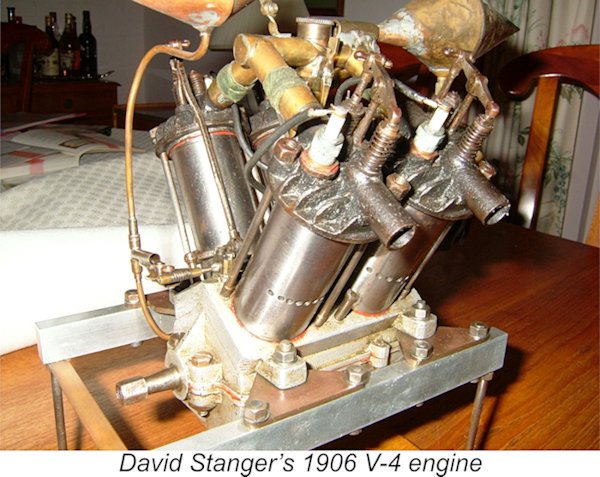
The first imperative to be met in order to make the construction of powered model aircraft possible was the development of suitable engines. Enthusiasts in both Britain and America wasted little time in getting to grips with this challenge. One of the first individuals to tackle this problem successfully was the English automotive engineer and aeromodelling enthusiast David Stanger, whose full story may be found elsewhere on this website. In 1905, Stanger designed a 120 cc four-stroke V-four engine weighing 5½ lbs. which was expressly intended to power model aircraft. This engine was constructed in 1906 and tested successfully, after which Stanger began working on the design and construction of a suitable airframe for the engine.
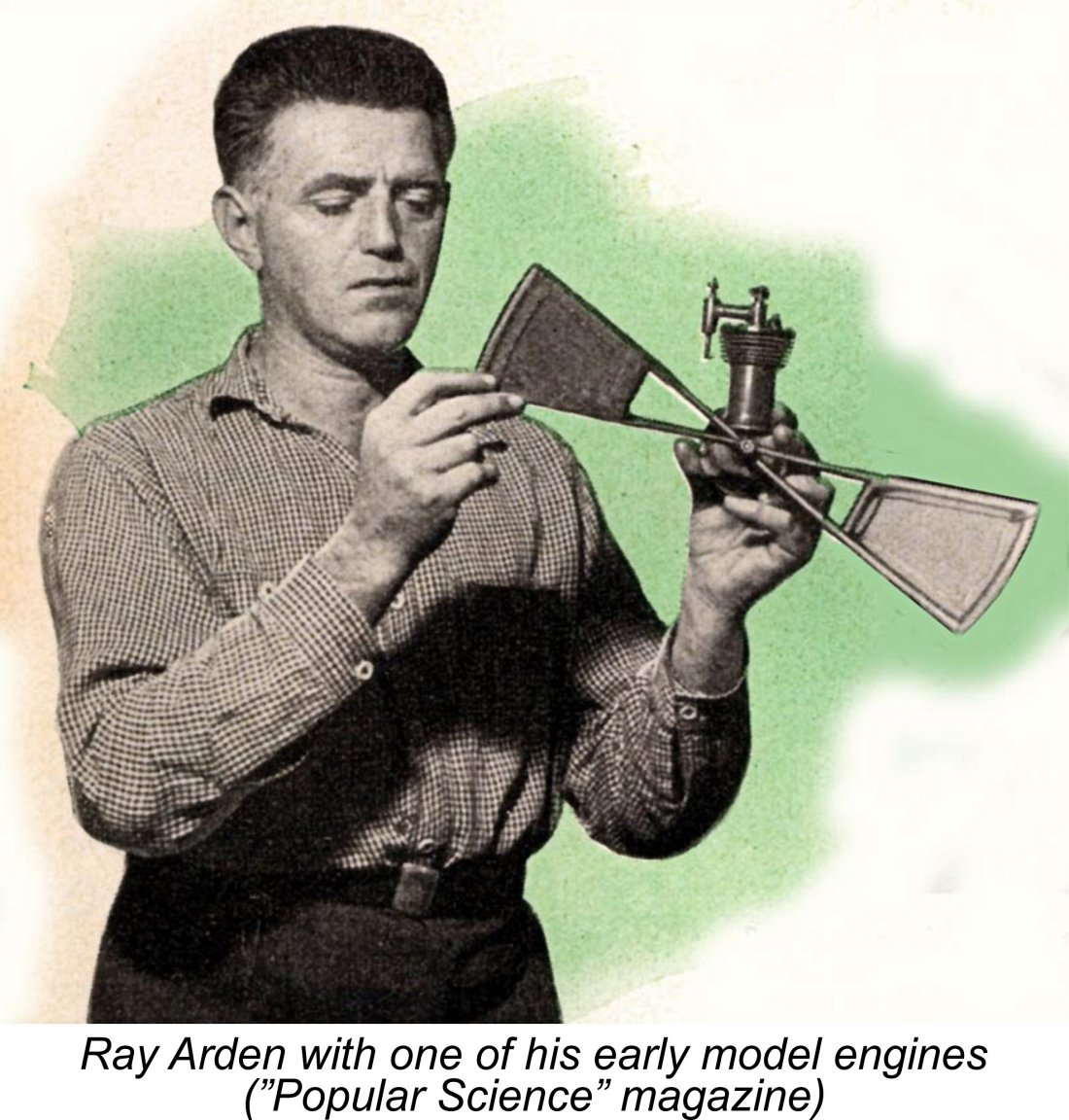
After subjecting his engine design to further development during the winter of 1907/08, Arden turned a few heads with the refined unit which emerged from his workshop in early 1908. This was a single cylinder four-stroke engine which weighed an amazing one pound and turned its matching airscrew at 3,000 RPM. In the summer of 1908, Arden used this engine to fly a 6-foot wingspan model for a distance of 100 yards. Alexander Graham Bell was impressed by Arden and his little engine, but almost nothing seems to have come of it - Arden was seemingly a voice crying in the wilderness in his own country.
This engine was said to produce 3.2 BHP at 1,800 RPM and to weigh 15 lbs., including its carburettor. The bore and stroke were 2 in. apiece, giving a combined displacement of 206 cc (12.6 cuin.). Sounds more like a motorcycle engine than a model powerplant! There’s no record of any model aircraft being flown with this massive engine serving as the powerplant. Lambert soon came up with a smaller 2.45 BHP engine which weighed just 10 lbs. – a move in the right direction, but still pretty heavy! The cylinders were steel, with only the heads having cooling fins; the crankshaft was of nickel steel. The ignition system consisted of a single coil and distributor for the two cylinders, while the carburettor was of the spray type. This engine was doubtless a worthy accomplishment by the standards of the day, but its bulk and weight would have scarcely encouraged its use in “model” aircraft! Once again, there's no record of its successful use in a model.
Stanger appears at lower left, having just released the model. The rough ground evidently made an athletic hand-launch necessary on this occasion! This model’s best performance was claimed to be a flight covering 600 feet at an average speed of 16 MPH. This would require the aircraft to stay airborne for at least 26 seconds, assuming that it flew in a dead-straight line. At this early stage, the models constructed by early pioneers such as David Stanger, Augustus Herring and Ray Arden were large and clumsy by modern standards, while their engines were bulky, heavy, slow-turning and lacking in power output. However, they were without a doubt the distant forebears of the efficient designs which we take for granted today. Moreover, they began appearing only two years or so after the Wright brothers’ ground-breaking full-sized debut flight. Power aeromodelling is almost as old as aviation itself!
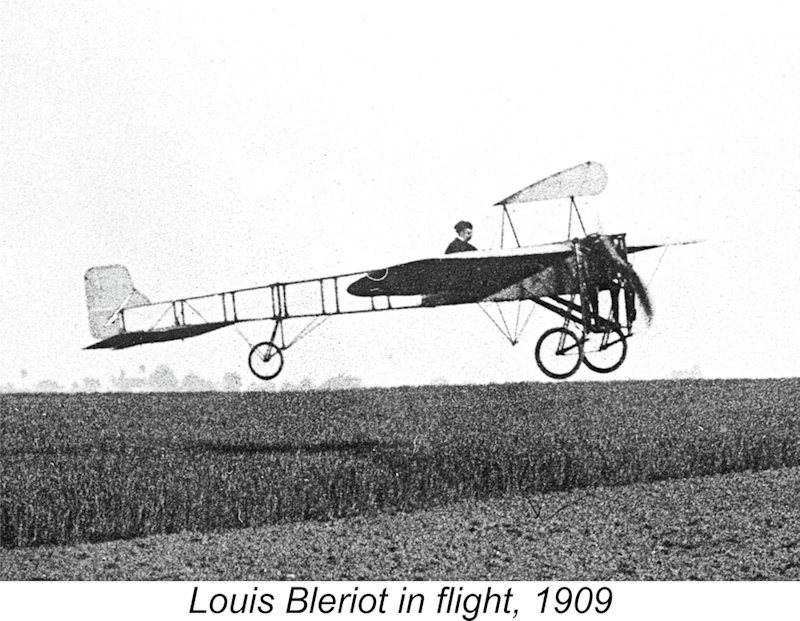
David Stanger’s early flights actually preceded the first flight by a full-sized powered airplane in Britain - a power model beat the full-sized aircraft into British skies! Stanger’s initial flights came in March 1908, while the first accredited full-sized flight in Britain was put up in October 1908 by transplanted American Samuel Franklin Cody (namesake but no relation of Buffalo Bill!), who flew the first full-sized airplane to make an accredited flight in England, travelling almost 1,400 feet before crashing! Cody's aircraft was the Army Aeroplane No. 1, which Cody was developing on behalf of the British Army. Louis Bleriot’s iconic cross-Channel flight which ended in England didn’t take place until July 1909.
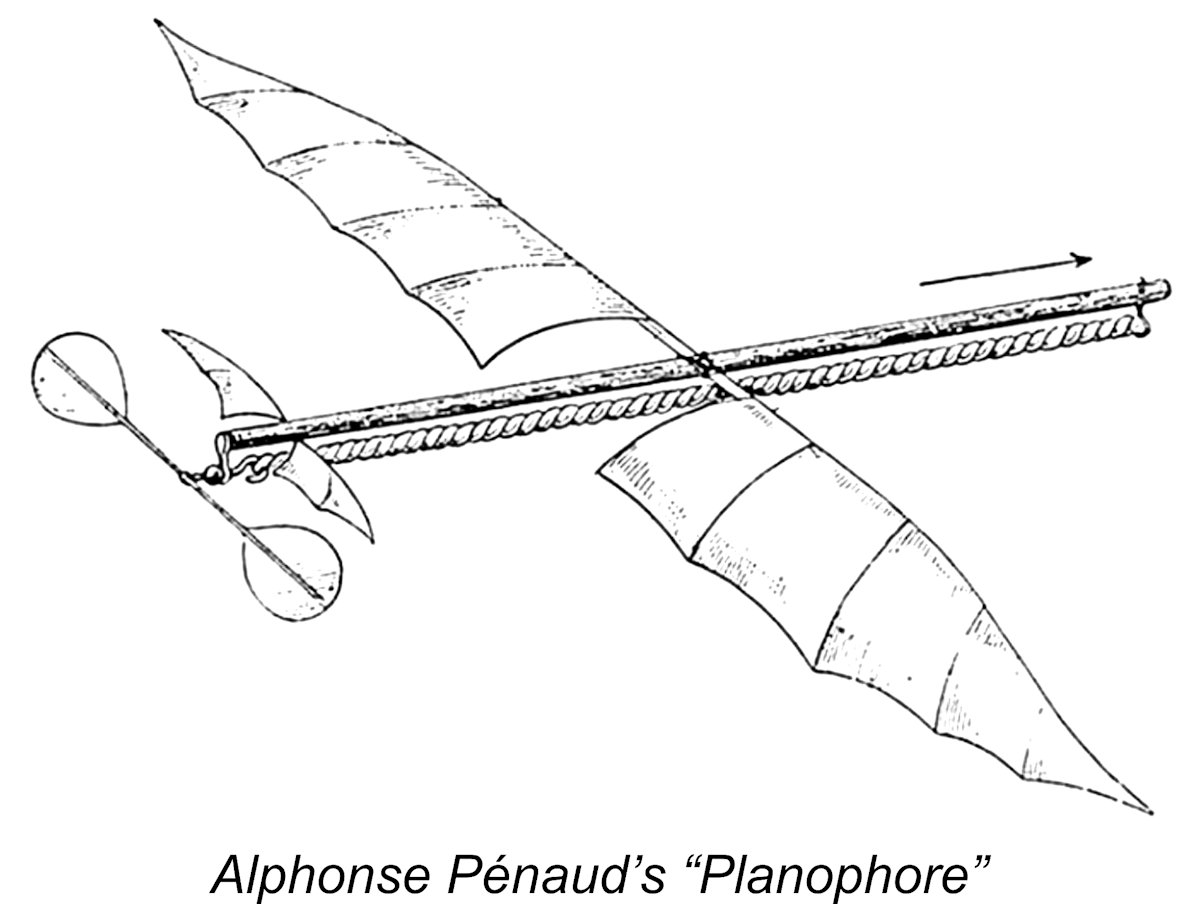
This began to change as the first decade of the 20th Century drew on. There was already a sizeable community of individuals engaged in the flying of kites, gliders and rubber-powered models. The latter type of model went all the way back to Alphonse Pénaud’s “Planophore” of 1871. These early rubber-powered models had popularized the flying of powered model aircraft – the issue was now the form that the powerplant should take. An increasing number of aeromodelling enthusiasts began to take note of the efforts of the early model gas engine designers. However, few of them possessed either the equipment or the skills necessary to construct their own powerplants. Consequently, the better-heeled enthusiasts developed a growing willingness to pay someone else to make their engines for them. The stage was set for the birth of the commercial model engine manufacturing industry. Aeromodelling Becomes Organized
Along with this development went a significant increase in the level of media coverage of the aeronautical movement in general. Prior to 1909, such coverage had appeared in two separate magazines, “Flying” and “The Airship”. In 1909 these two publications were combined under a new name – “The AERO”. In addition, an entirely new magazine called simply “FLIGHT” published its first issue on January 2nd, 1909, characterizing itself as the official journal of the Aero Club of the United Kingdom (later the Royal Aero Club). The appearance of these publications greatly increased the availability of information about this exciting new field of activity, further stimulating public interest. More significantly from the standpoint of present-day historical researchers like myself, they created a permanent contemporary record of the accomplishments of the pioneering exponents of both full-sized and model aviation. Both magazines are preserved in on-line archival form today. All of these events stimulated a major increase in the level of public interest in participation in the aeronautical movement, at least in unmanned model form. Conditions were now such that the production of model engines on a commercial basis might be seen as being economically viable. The stage was set ………… The Dawn of Commercial Model Engine Production
Ripault's main line was the French "OLEO" spark plug range which was produced through to at least the end of WWI. The Ripault engine offering was actually a French product made by the motorcycle manufacturers Herdtle & Bruneau. It was a massive single cylinder 215 cc engine (65 mm bore and stroke) which weighed 10½ lbs., hence being too big and heavy to be considered realistically as a suitable powerplant for model aeroplanes. Ripault also offered a V-twin-cylinder HB engine (430 cc?) which was displayed at the 1910 Olympia Aero and Motor Boat Exhibition and mentioned in the report of the 1911 event. In about April 1909, another gas-powered model appeared in England, being similar in design to the Voisin biplanes then leading the way among European full-sized aircraft. Builder J. D. M. Tinline reportedly used some kind of two-cylinder engine to power this model, which was claimed to be the smallest power model to fly up to that point in time. Later in 1909, one C. Burkitt produced a reduced-scale Bleriot-type monoplane which was powered by a 1 hp engine cited as a Kingdom unit. This may be an indication that someone was already offering such engines commercially under the Kingdom trade-name. If so, the engine referred to by that name did not survive long in production – it was never mentioned again.
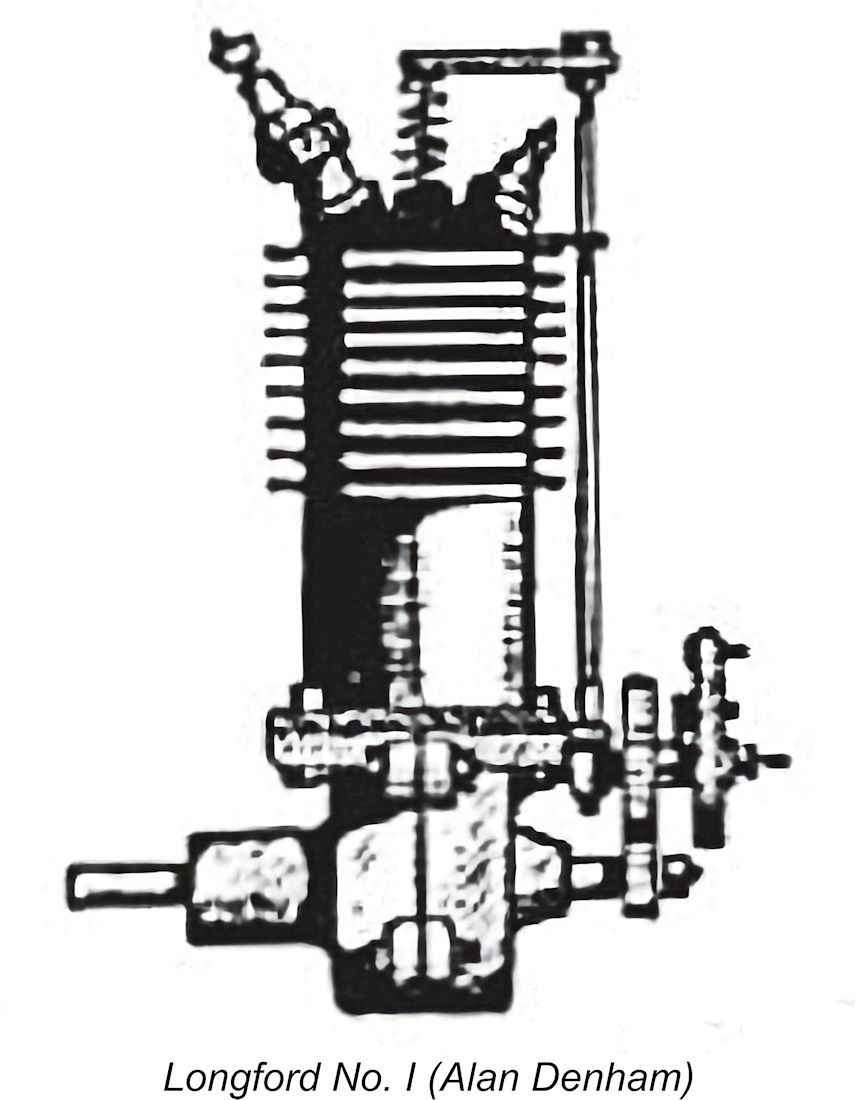
Although contemporary documentation is somewhat scanty, it’s clear from the record that some level of commercial model engine production did indeed get underway in Britain during 1909. My valued friend and colleague Gordon Beeby of Australia found references to a surprising number of commercial engines during the latter part of that year, including offerings from:
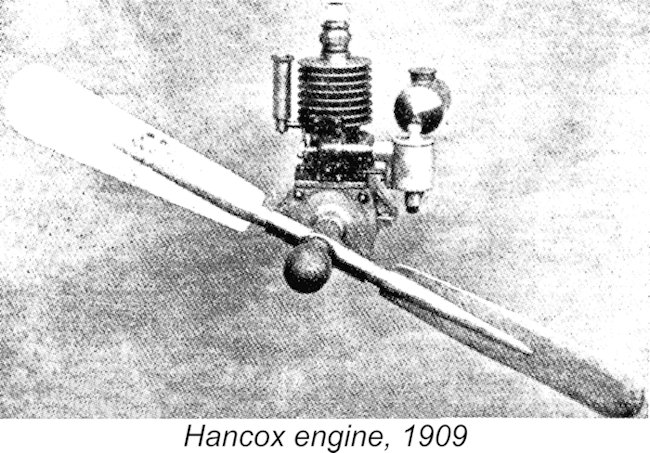
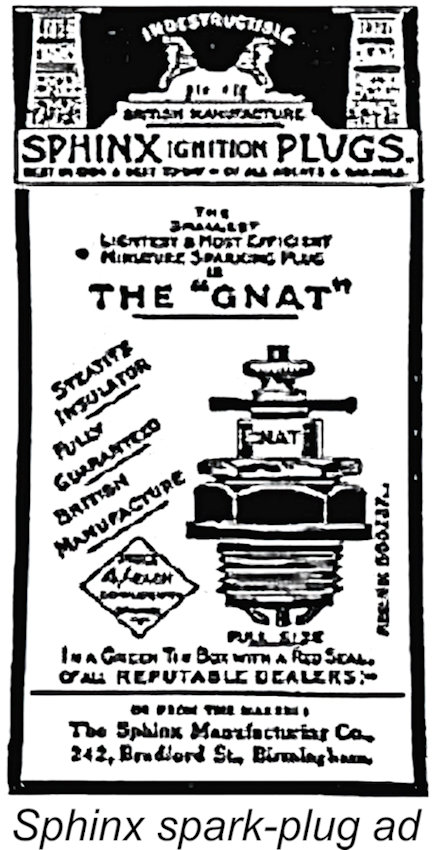
Hancox’s engine was a single-cylinder two-stroke model of undisclosed bore and stroke, weighing a claimed 7 lbs. and turning a 25 in. dia. airscrew of unspecified pitch at 2,200 RPM. It was said to be equipped with a “special high-speed check valve” (presumably that odd vertical tube at the side), the function of which is unclear. An output of ¾ horsepower was claimed. One challenge which all developers of model I/C engines had to face during this period was the selection of the necessary spark-plugs. Since no miniature plugs were available during the early stages of such developments, the constructors of these pioneering engines either had to use full-sized plugs, which often dominated the engines in which they were used, or make their own reduced-scale plugs. David Stanger was one constructor who followed the latter course. The plug supply situation was eventually relieved by the commercial appearance of small spark plugs such as the Gnat plug manufactured by the Sphinx Manufacturing Co. of Birmingham. By 1911 Gamages were listing spark plugs for model engines in their catalogue. British Model Engine Manufacture Takes Off
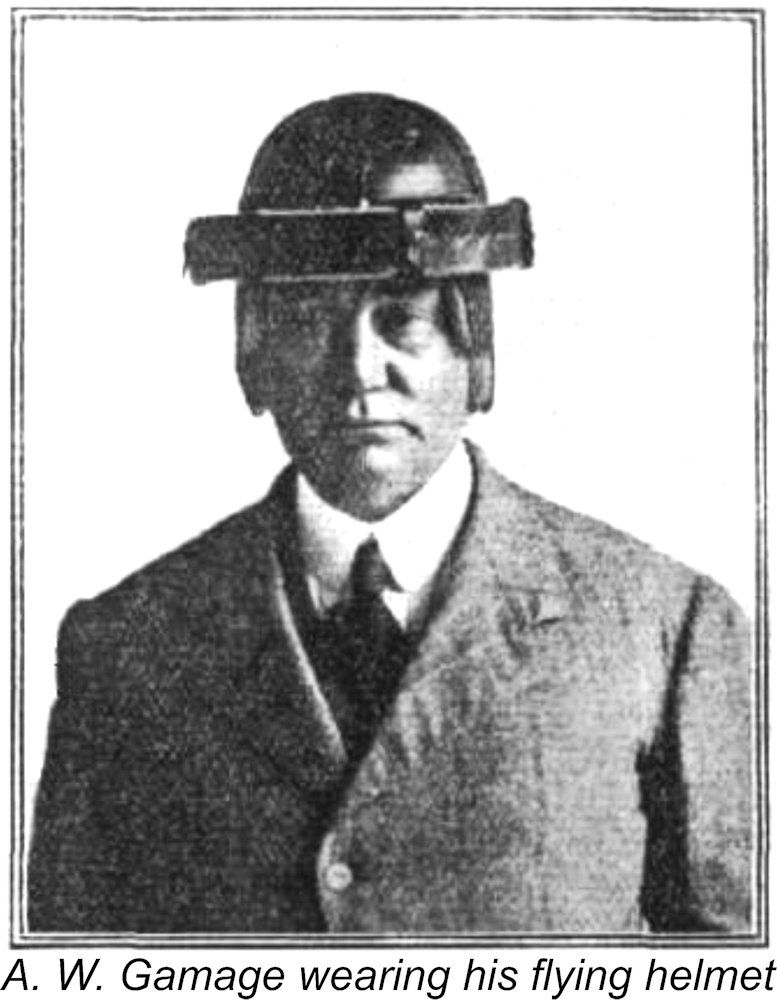
A. W. Gamage was an early promoter of aeromodelling – in 1910 he inaugurated the Gamage Challenge Cup (later simply the Gamage Cup) and began presenting various medallions to competition winners. I couldn't resist including the attached 1910 photograph showing A. W. Gamage himself wearing a "non-concussion" flying helmet which he had designed himself!
The engine's weight was cited as being 7 lbs. Claimed power output was ¾ hp, with an operating speed of 2,700 RPM. This engine continued to be advertised throughout 1910. It gave Gamages the honour of being the first firm in England to market a two-stroke model engine, thus leading the way towards much of the future. Most of the previously-mentioned manufacturers were still advertising during 1910 and were now joined by quite a few new competitors. The 1910 Aero and Motor Boat Exhibition held at Olympia, London during March of 1910 included displays of engines by:
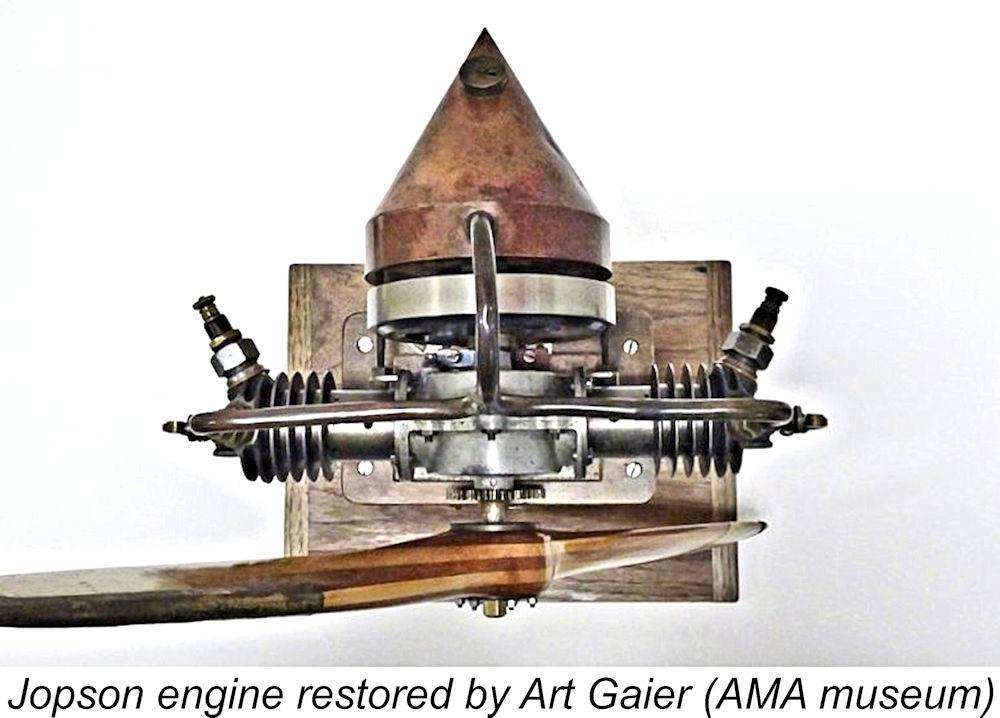
Another new manufacturer who entered the field at this time was Cook & Co. of Altrincham, Cheshire, who manufactured two distinct models, displaying them at a meeting of the Manchester Aero Club in September 1910 as reported in both "FLIGHT" and "AERO" magazines. One of their offerings was the 55 cc four-stroke opposed twin-cylinder unit designed by W. G. Jopson, who may well have been an employee of the company. Arrangements were made with the aeronautical supply company of T. W. K. Clarke of Kingston-upon-Thames to have Clarke act as the London-area distributors for Cook & Co. The story of the Jopson engine has been recounted in detail elsewhere on this website.
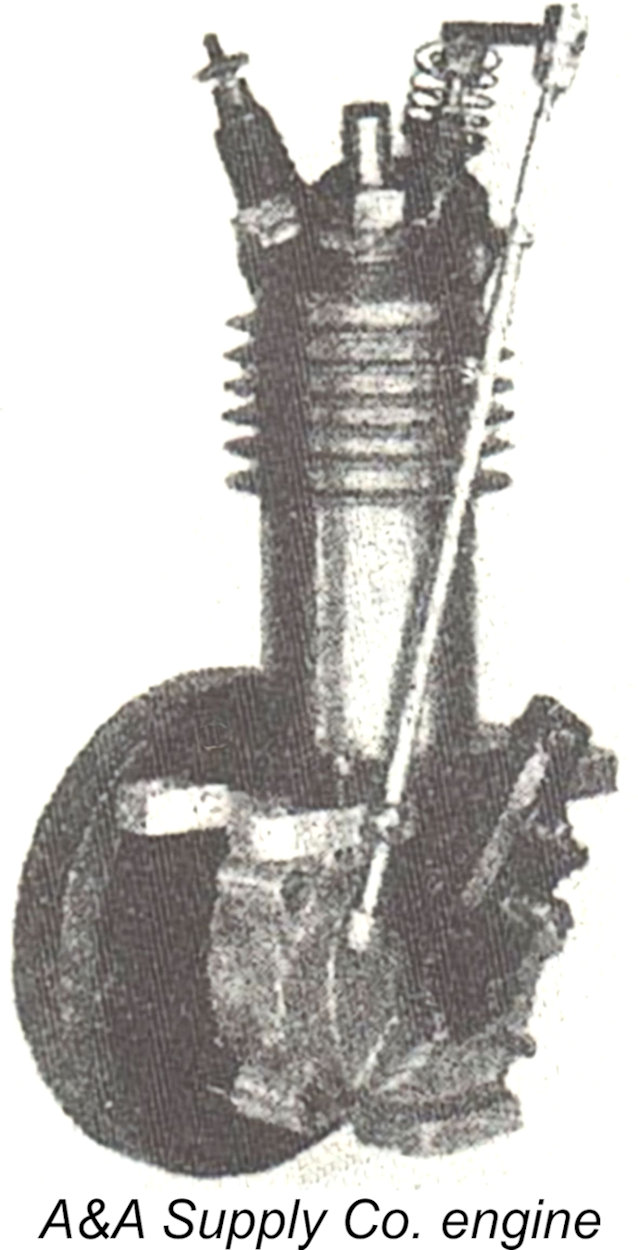
Among the best-known model engines at this time came from the Automobile & Aerial Supply Co., which offered three different four-stroke powerplants from stock. The smallest of these was a 12.9 cc single-cylinder design which was rather optimistically claimed to develop ¾ hp from its bore and stroke dimensions of 1 in. apiece. It reportedly weighed 4 pounds complete with the large flywheel which was generally considered to be necessary at this time due to the low operating speeds of the engines. The larger single-cylinder engine featured a 1 in. bore and a 1½ in. stroke for a displacement of 19.3 cc. It weighed 6 lbs. and supposedly put out 1½ hp. Finally, the two-cylinder engine reportedly developed 2 hp from its displacement of 51.5 cc derived from bore and stroke figures of 1 in. and 2 in. respectively. I must say that the claimed performance figures seem wildly optimistic to me! All models were four-strokes which used atmospherically-activated inlet valves and mechanically-activated exhaust valves. A very similar line of engines was marketed by the previously-mentioned Cochrane Co., who listed ¼ hp, ¾ hp and 1½ hp singles, and a 3 hp twin. The smallest single-cylinder unit had bore and stroke dimensions of 1½ in. apiece for a displacement of 43.4 cc (2.65 cuin.). It was said to weigh 4½ lbs. and to develop a somewhat more believable ¼ hp. These engines were known for displaying very high-quality machining both inside and out. In a 1910 enhancement, Cochrane added phosphor-bronze bearings to support the crankshaft in the cast aluminum crankcase.
Regardless of their respective designers’ ingenuity, all of these early model internal combustion engines produced rather marginal outputs in reality, despite all claims to the contrary. As a result, some potential was still seen for the use of the small steam engine
An article on model topics which appeared in the August 14th, 1916 issue of the American "Aerial Age Weekly" (AAW) magazine included a fairly detailed account of ongoing experiments with steam-powered model aircraft still being pursued in England by H. H. Groves and G. Harris, both of whom had used Groves-designed flash steam powerplants to achieve a number of successful flights. Groves had achieved a flight covering a distance of 450 feet, while Harris had reportedly managed "several good flights" of unspecified duration or distance. V. E. Johnson, Model Editor of "FLIGHT" magazine, had reportedy succeeded in making the first-ever rise-off-water (ROW) flight by a model float-plane using a Groves-type steam powerplant.
A characteristic which these engines all shared was significant weight. The weights of these units were all measured in pounds rather than the ounces which are more familiar to us today. All of them called for airframes which we would consider to be in the behemoth category - wingspans in the region of 10 – 12 feet were not uncommonly encountered! Constructing, storing and transporting these monsters would have been no small undertaking! Neither would paying for the required construction materials……………power aeromodelling was a rich man's game at this time. Regardless, it wasn't long before there was enough interest among gas model aficionados to justify the marketing of standard model designs. In early 1911, the first-ever set of plans and building instructions for a power model aircraft was published. Designed by E. Temple-Robins, the model was a near-scale Bleriot monoplane, much like the airplane in which Louis Bleriot had gained immortality by flying across the English Channel in 1909. The model was ¼ the size of the real aircraft …...... and you thought that Quarter-Scale was a relatively recent development!
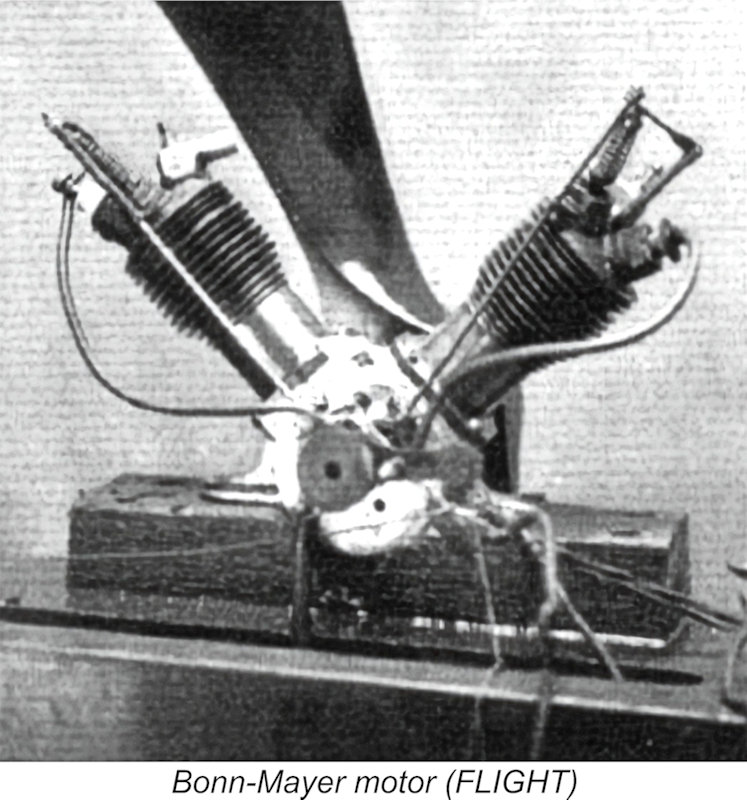
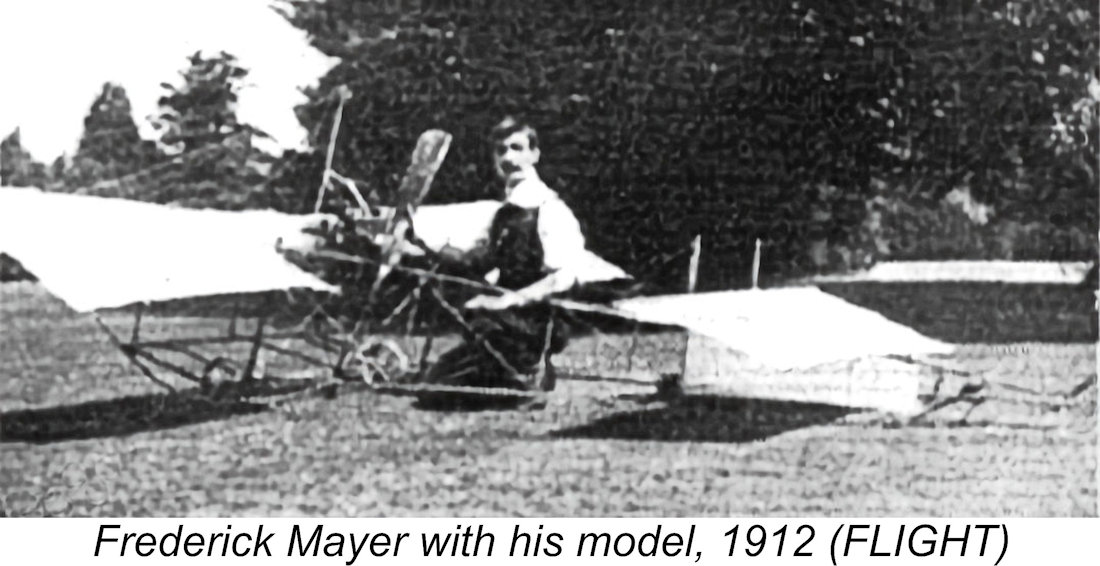
By late 1911, the aerodelling movement had attracted so much attention that “FLIGHT” magazine intiated a weekly column on the subject, though its editor, V. E. Johnson, seemed to have grave and probably justifiable doubts about many of the claims concerning gas models having been successfully flown by various people. He gave David Stanger full credit for his well-documented achievements, but doubted that anyone else had flown, even though at least one other model had impressed him with its airframe and engine. Johnson was soon set straight by J. Bonn & Co. of London, who wrote in to say that their general manager Frederick Mayer had built a gas model that had made more than 50 flights in 1911. It used several different sets of wings ranging from 9 ft. to 14 ft. span, with airscrews from 32 in. to 40 in. diameter and from 24 in. to 54 in. pitch. This resulted in flying weights ranging all the way from 36 to The attached image of Mayer with his model is instructive in that it shows how large these "models" really were - Mayer is kneeling on the ground inside the model's open-frame fuselage in the engine starting position! This model had reportedly reached an altitude of 35 feet and had flown for distances of up to 2,000 feet. Such performance claims were commonplace but were rarely confirmed authoritatively. Power model contests as we know them today were quite unknown during the period which we are now discussing. The goal of I/C-powered modellers in those days was first to persuade their models to fly and then to recover the model approximately intact in readiness for another attempt! The actual flight parameters appeared to be of no particular consequence; at least, no-one bothered with getting their flights observed by qualified officials. Consequently, although there were numerous claims for distance, altitude and duration, they could never be verified.
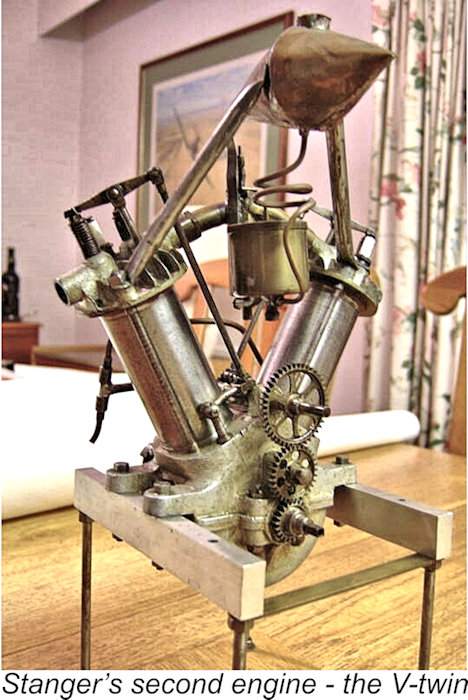
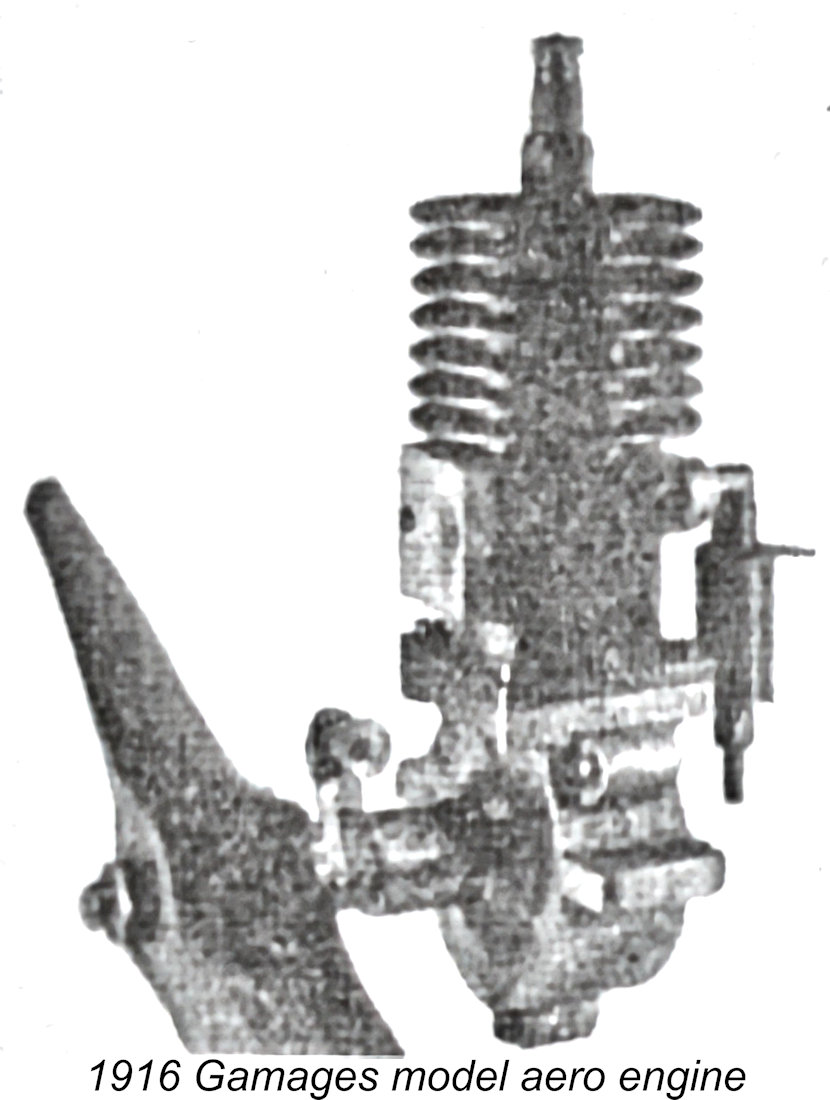
This model was powered by a V-twin engine which Stanger had constructed as a development of his further-improved and still-operational V-four. While others may have done better in succeeding years, Stanger's record remained on the books as the officially-attested figure until 1932! The V-twin engine still survives today, as does its V-four predecessor. Records of one sort or another were certainly claimed but seemed to be perennially disputed. However, in general terms it seems safe to say that by and large the British modellers were now in the lead, at least in terms of their sheer numbers! The very rapid growth of the hobby in Britain is reflected by the astonishing increase in the availability in Britain of small gasoline engines advertised for model use. The number of such offerings clearly confirms the existence of a viable market for such powerplants. The January 27th, 1912 issue of “FLIGHT” included another article by V. E. Johnson in which he wrote-off single cylinder engines as unsuccessful. However, Johnson's attitude wasn't fixed, as he later wrote positively about the single-cylinder Sharp engine subsequently offered by Gamages (see below). During 1913 and thereafter, the pace slowed noticeably, with a substantial drop in the level of coverage of model engines - only the relatively prominent units like Jopson, Stanger, Cochrane and Bonn-Mayer continued to draw occasional notice. This was probably due to the market having become saturated by the number of engines already on offer – the foregoing account names a total of 21 commercial manufacturers, most of whom offered more than one model. Seemingly, few of these remained in the model engine business for any length of time. It's probable that many of their engines were constructed in very small numbers in home workshops, primarily to special order. Nevertheless, some progress continued to be made. A major step in the right direction came from Gamages at some point prior to June 1914, when they introduced a substantially-revised two-stroke engine weighing only 1 lb. 15 oz. - a very significant reduction from the 6¼ lbs. cited for the previous model of 1911. A commentary which appeared in the July 10th, 1914 issue of "FLIGHT" stated that "now that a petrol engine weighing under 3 lbs. has been produced, it is hoped that several modellists (sic) will enter for the handsome trophies offered by Sir John and Lady Shelley...." Of course, the onset of WW1 in August 1914 put a severe crimp in any such intentions.
A review of the aero version of this engine appeared in the September 7th, 1916 issue of “FLIGHT”, with F. N. Sharp being cited specifically as the designer. It's unclear who the manufacturer was - it certainly wasn't Sharp, who never appears to have entered the commercial model engine manufacturing field at any time. This review prompted a reader inquiry which was published in the January 25th, 1917 issue of "FLIGHT" - a further indication of continuing interest in aeromodelling despite the concerns of the day. It's interesting to note the degree of development embodied in this model. For one thing, the displacement had been reduced quite significantly to achieve the cited weight reduction. The engine's height had also been reduced to around 6 in. Bore and stroke of this engine were cited as 13/8 in. (34.92 mm) apiece for a displacement of 33.5 cc as opposed to the 78.8 cc of its predecessor. Moreover, the engine now featured beam mounting and a vertically-split crankcase. Overall, it had been considerably "tidied up", beginning to look like something which we would recognize today as a legitimate model engine. It will have become readily apparent from the foregoing that the model engine field in Britain had been predominantly four-stroke up to this point in time. This may come as a surprise to many readers who have always seen the four-stroke model aero engine as a development of the 1970's and beyond. Gamages appear to have been the only firm to market two-stroke engines during this early period. All of the two-stroke engines produced up to this point in time had been sideport designs in which the timings of the induction, transfer and exhaust phases were all controlled by the piston. This form of porting At the conclusion of the war, the British model aero engine manufacturing industry was more or less moribund, not to commence a steady rebound until 1930 or thereabouts, as described elsewhere on this website. In 1921 the assets of the Kite and Model Aeroplane Association were taken over by the London Aero Models Association (LAMA). However, model flying was now catching on throughout Britain and was far from being London-centric. In recognition of this, the LAMA name was changed in 1922 to the Society of Model Aeronautical Engineers (S.M.A.E.) which assumed responsibility for the organization and regulation of aeromodelling in Britain under the oversight of the Royal Aero Club. Activity in America While all this was going on in Great Britain, by 1910 Ray Arden had further refined his engine and airplane to the point where he was making flights of over one mile. The fact that this engine used a very early form of one of Arden's most famous contributions to the modelling world, the glow-plug, is often overlooked. However, Ray’s efforts passed almost un-noticed - as late as 1912, a major American aviation magazine offered an impressive trophy for the winner of a contest for powered model airplanes, adding that they would be driven by either rubber or clockwork mechanism, since "no other type of motor" was known! The first-ever contest for gasoline engine-powered models in the USA reportedly took place in 1913.
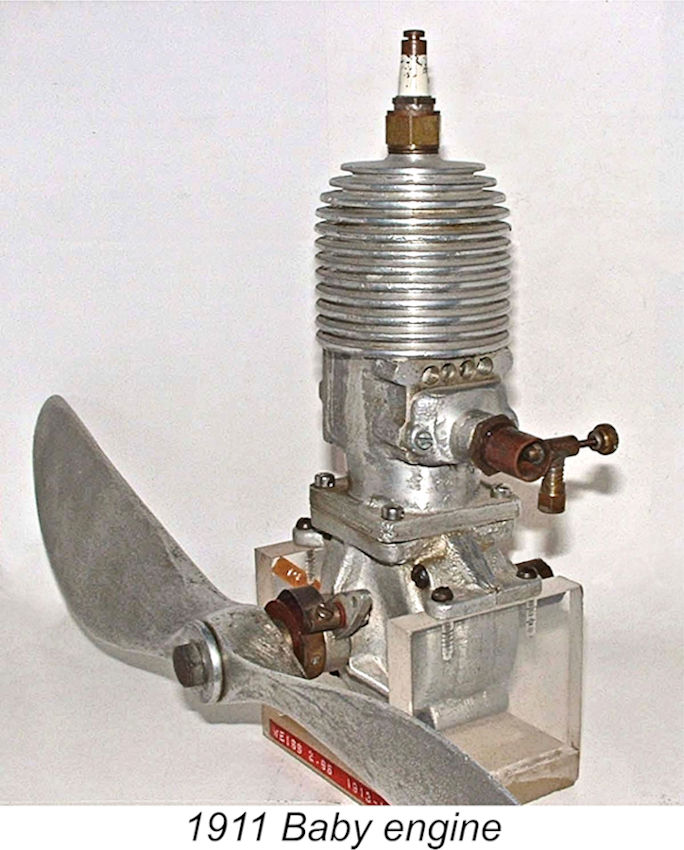
The first American model aero engine to do so was the Baby engine, which appeared in 1911. This engine was designed and initially manufactured by the Eckert Brothers of Stanford, Connecticut. One of the brothers, Whitney Eckert, had previously taken out two 1909 Patents relating to carburettor design. The Baby was a large two-stroke engine with a 2.67 cuin. (43.75 cc) displacement. It weighed 3¾ lbs. with its 18 in. dia. x 13 in. pitch aluminum propeller and gas tank. It was advertised as developing ½ hp, swinging that big airscrew at 2,300 RPM. The Baby put in an appearance at the 1912 New York Fair, where orders for 15 examples were reportedly secured. An engine bearing the serial number 117 was said to be in the hands of a contemporary collector. At a whopping price tag of $35 in 1912 US dollars, it's hard to envision mass sales of this engine. It seems likely that the serial numbering started at 100. The Baby was ultimately also made available in inline two, three and four-cylinder configurations. It used a bronze-bushed vertically-split aluminum crankcase; a cast-iron cylinder bolted to the top of the case; a three-ringed aluminum piston; a carburetor with a float; and side-port induction. This arrangement was typical of smaller internal-combustion engines of the day. The Baby featured a spark ignition system with a By 1917, the manufacture of the Baby engine had been taken over by the Weiss Mfg. Co. of New York - the accompanying image of a Weiss Baby engine mounted in an all-steel model appeared in the April 9th, 1917 issue of Aerial Age Weekly magazine. Wonder how if it flew......!! Weiss continued to produce the engine all the way up until 1929, at which point they developed a far smaller 0.331 cuin. model to replace the massive Baby. Look carefully at the Baby and you'll see a clear foreshadowing of the subsequent Loutrel and G.H.Q. designs of the 1930's.
Several sources attribute the design of the Midget Gasoline Engine to one H. W. Aitken. However, the image of this engine which accompanied the AAW article (reproduced at the left) shows that this engine was either a clone of the Baby unit illustrated earlier or was in fact the same engine being promoted under a different name, possibly following a change of manufacturer. Either interpretation is possible - at this distance in time it's impossible to settle this matter.
According to the late Tim Dannels, writing in his indispensable "American Model Engine Encyclopedia" (AMEE), the Gil was offered under the successive designations of Gil Aero Ace, Gil Aero Lite and Gil Aero Midget, the latter being the final name by which the engine was marketed. These appear to have been minor variants of basically the same engine - Tim reported that muliple variants of the basic Gil design were known. He also stated that manufacture continued until 1933, by which time the Gil had been overtaken by smaller and lighter models such as the Brown Junior, Loutrel and Knight offerings, among others. A distinct paradox seems to emerge from the above account. American craftsmen clearly had the ability to produce model engines to a very high standard, while the best of their designs, such as those of Ray Arden, were undoubtedly superior to anything yet seen in other countries. The previously-cited AAW article of 1916 stated that "numerous model constructors in America are experimenting with model gas motors", with the Midget Gasoline Engine (possibly the Baby engine masquerading under a different name) then being viewed as the most satisfactory to date. However, America was surprisingly slow to take up commercial model engine manufacture as a viable industrial enterprise. In that area, the British enjoyed a commanding lead in the pre-WW1 years. Activity in Europe
Logically enough, Blériot himself saw research in the model aviation field as offering an excellent low-cost opportunity to gain further insights into the design of full-scale aircraft. Accordingly, he engaged in a number of model-scale experiments in support of his rapidly expanding full-sized aircraft manufacturing business. The previously-mentioned French-made unit advertised by Leo Ripault & Co. in the January 23rd, 1909 issue of the British “FLIGHT” magazine cannot really be viewed as a legitimate model aero engine on account of its 215 cc displacement and its weight of 10½ lbs, although it was promoted as such - it was more like a lightweight motorcycle engine. The first legitimate French model engine to enter production about which I've found some information was an opposed twin-cylinder two-stroke engine of 16 cc displacement manufactured by the long-established firm of Radiguet & Massiot. This engine was specifically intended for model aircraft use.
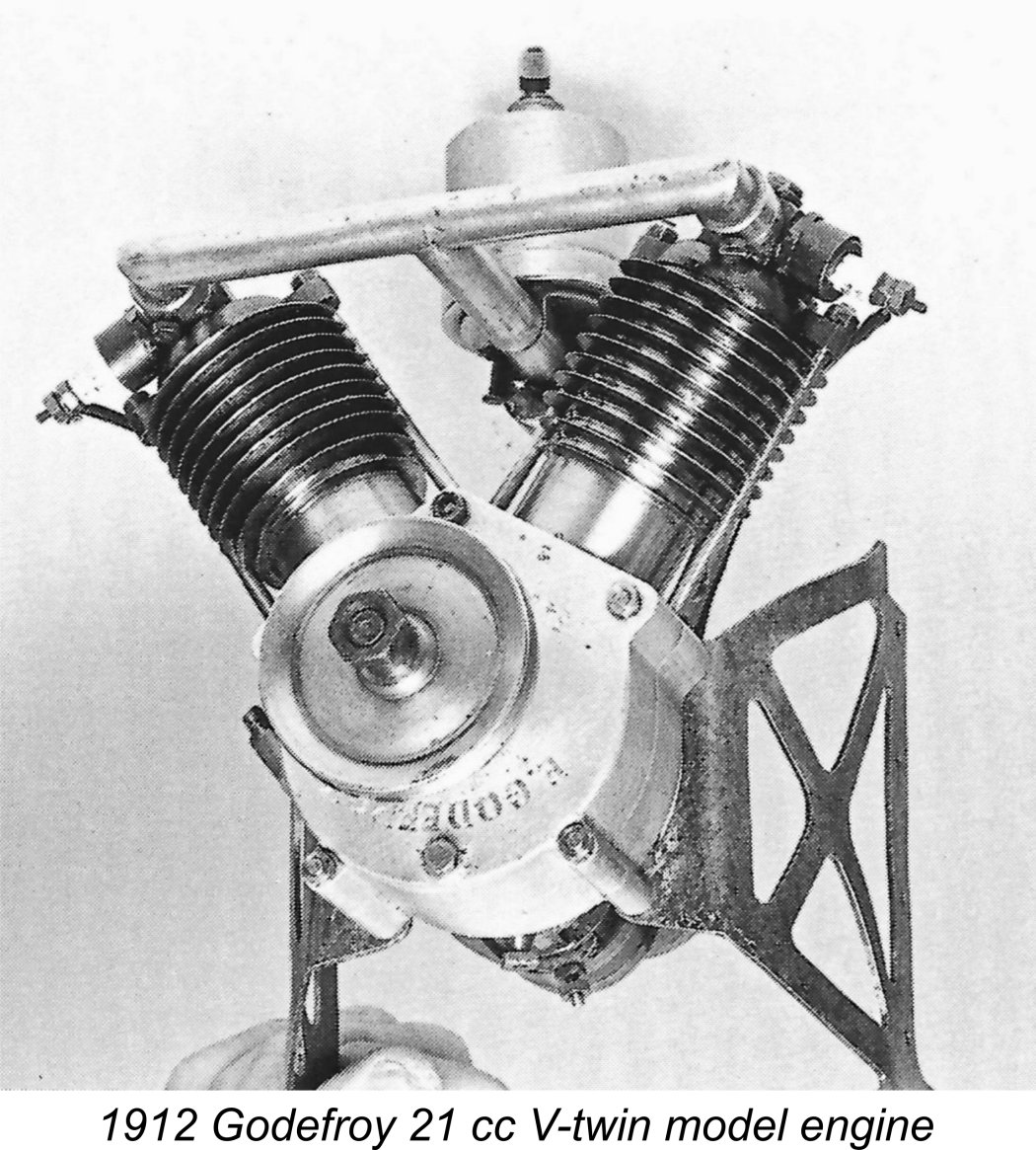
Radiguet & Massiot were soon joined by the Galiment company, which introduced a series of one, two and three-cylinder four-stroke model aero engines in 1912. The Godefroy brothers soon joined in the fun, producing a very fine V-twin four-stroke model of 21 cc displacement in 1912. This design proved to be very successful.
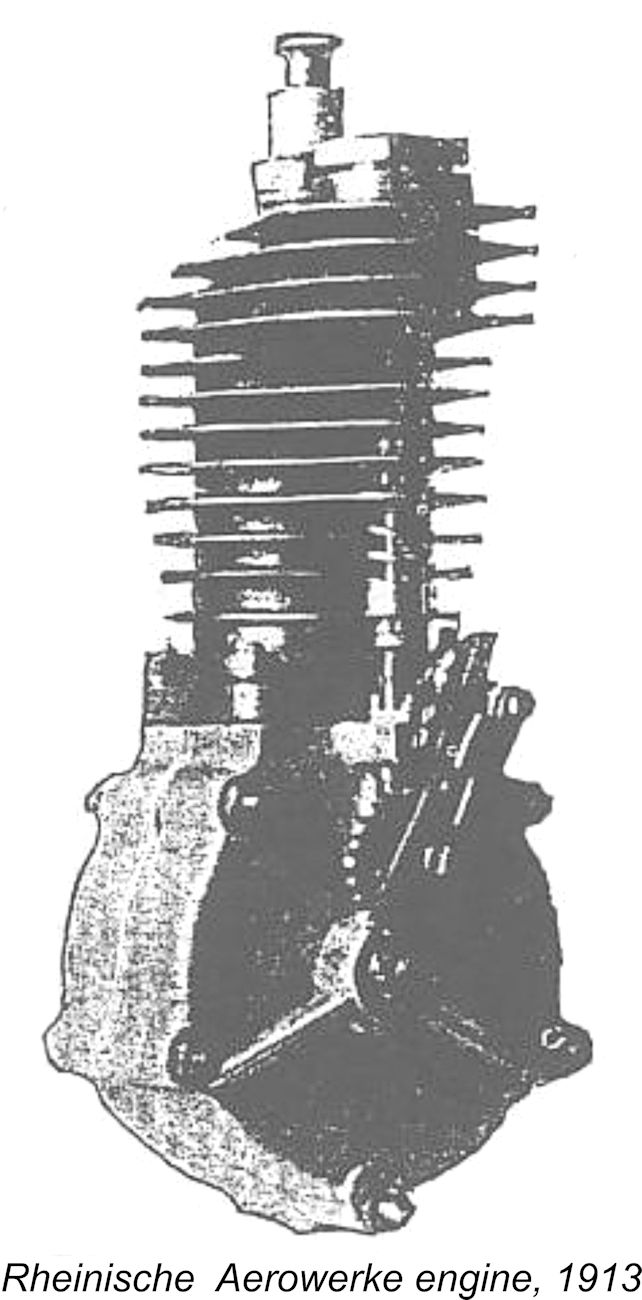
However, there was an ominously dark storm cloud looming on the horizon in the form of World War 1, a tragic and (in hindsight) completely unnecessary conflict which engulfed Europe in general and France in particular beginning on July Combined with the equal devastation of the 1919 worldwide influenza epidemic, the human and economic impact of this conflict gave rise to conditions in which the resumption of model engine manufacture was the last thing on anyone’s mind. A very few model engines were made in France by talented amateur enthusiasts during the 1920’s, but for the most part these were model boat powerplants. Commercial model aero engine manufacture was not to resume i Looking now at the parallel situation in Imperial Germany, perhaps the earliest model engine to appear commercially in that country was the Ellehammer compressed air engine of 1904. It was not until around 1912 that the commercial development of German I/C model aero engines really began to gain ground. From 1912 onwards, a surprising number of German manufacturers and individual constructors became increasingly active in the model I/C engine field. Perhaps the most notable of these were Max Braune, August Beyer, Fritz Saran, Sirius, Rheinische Aerowerke and W. Josef Zenker.
Between them, the makers listed above began offering model engines commercially during the 1912-1914 period. They were soon joined by other small-scale producers such as Helmut Wagenseil and Ludwig Köhler. Production continued until 1916, after which the course of the war caused a re-focusing of attention away from model engines.
At this stage, neither Britain nor America could boast of anything even close to this level of involvement in the model engine manufacturing industry! However, the 1929 Wall Street crash and the subsequent Great Depression hit Germany particularly hard, putting the brakes on these activities very decisively. It was not until the mid-1930's that model engine manufacture in Germany really began to recover through the activities of Walter Kratzsch and Gustav Eisfeld. There can be no doubt that parallel developments were also taking place in other European countries, but linguistic considerations coupled with a lack of source material prevent me from presenting any information on such activities. Summary and Conclusions It should be clear from the above account that Great Britain was the country in which the early development of the model internal combustion engine was pursued with the greatest vigor. The main challenger to the British experimenters was the mega-talented Ray Arden of America, whose accomplishments clearly overshadowed those of his trans-Atlantic counterparts from a technical standpoint. However, Ray was working pretty much in isolation in America, where his efforts received little attention and were completely unknown in Britain or Europe. Only a couple of manufacturers entered the model engine field in America prior to WW1. By contrast, Britain was blessed with an astonishing number of individuals who saw the possibility of pursuing model engine manufacture as a viable commercial enterprise. The above account names no fewer than 21 British individuals or companies who became involved prior to WW1 in the commercial manufacture of model engines, with varying degrees of technical and commercial success. This number almost certainly eclipses that of their counterparts in all other countries combined! Indeed, it's doubtful that this number of competing manufacturers over a five-year period was ever equalled in Britain at any time in the future, a finding which may surprise the reader as much as it surprised me! These engines may appear to us today to be almost comically primitive in design terms, but they testify to the creative spirit and the dogged determination possessed by their creators, who were after all taking the very first tentative steps down a very long road. They were conceived and constructed only a few years after the initiation of the air age in late 1903, with no precedents to guide their designers. The successors of those pioneers have had over 120 years to refine their designs into the latter-day marvels which are so familiar to us. I'm sure that the talented individuals mentioned in the preceding article would have done at least as well given that amount of time! So hats off to those early developers of the model internal combustion engine! They laid a very solid foundation upon which the further development of such engines could be based. The designers and producers of the latter-day units which we all know and love stood firmly on the shoulders of these pioneers! _________________________ Article © Adrian C. Duncan, Coquitlam, British Columbia, Canada First published June 2026 |
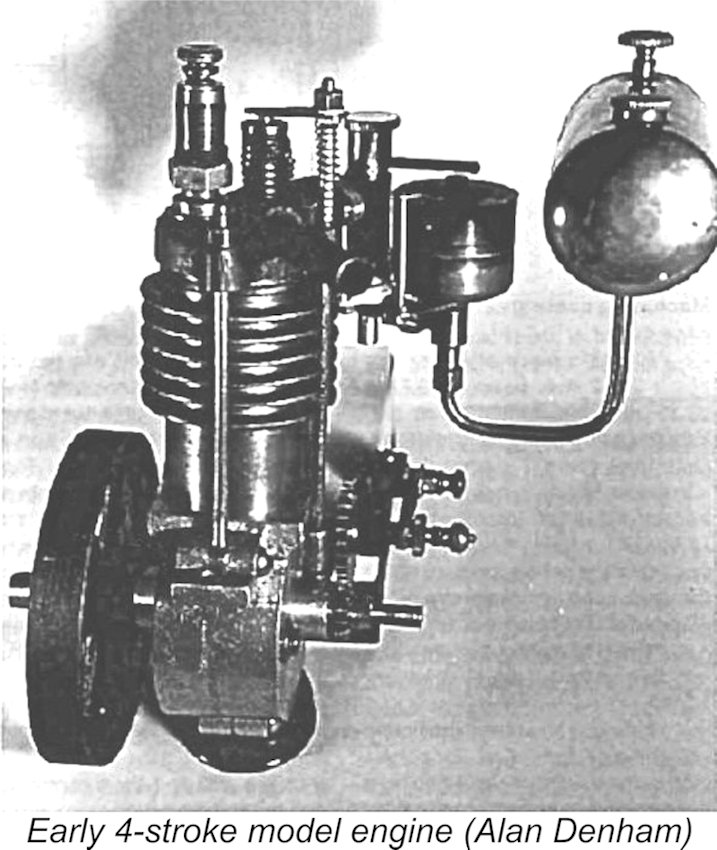 The stories of the more notable model aero engines of the vintage, classic and post-classic eras have been told in a myriad of books and articles - I’ve been guilty of writing a few of those myself! However, the concept of creating small internal combustion engines suitable for use in model aircraft goes back way further than that – all the way back to the birth of full-sized powered heavier-than-air flight, in fact. The story of those very first steps towards the development of such engines has been sadly neglected by comparison with that of their later descendants.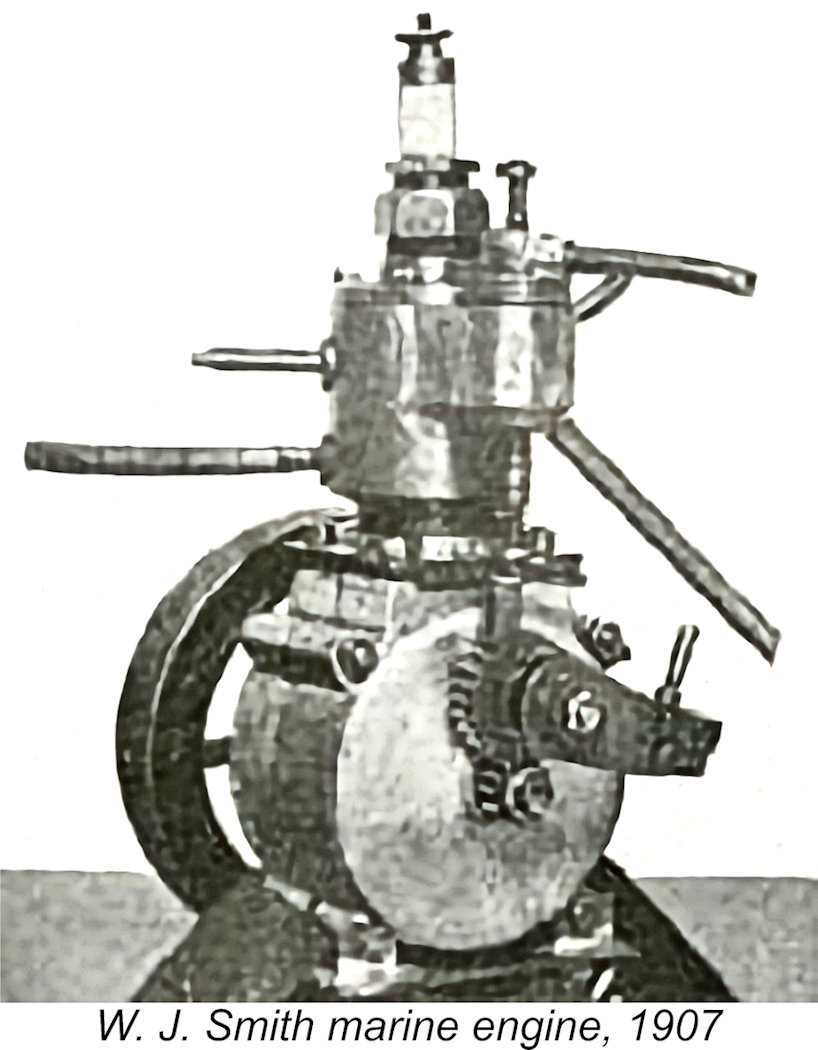
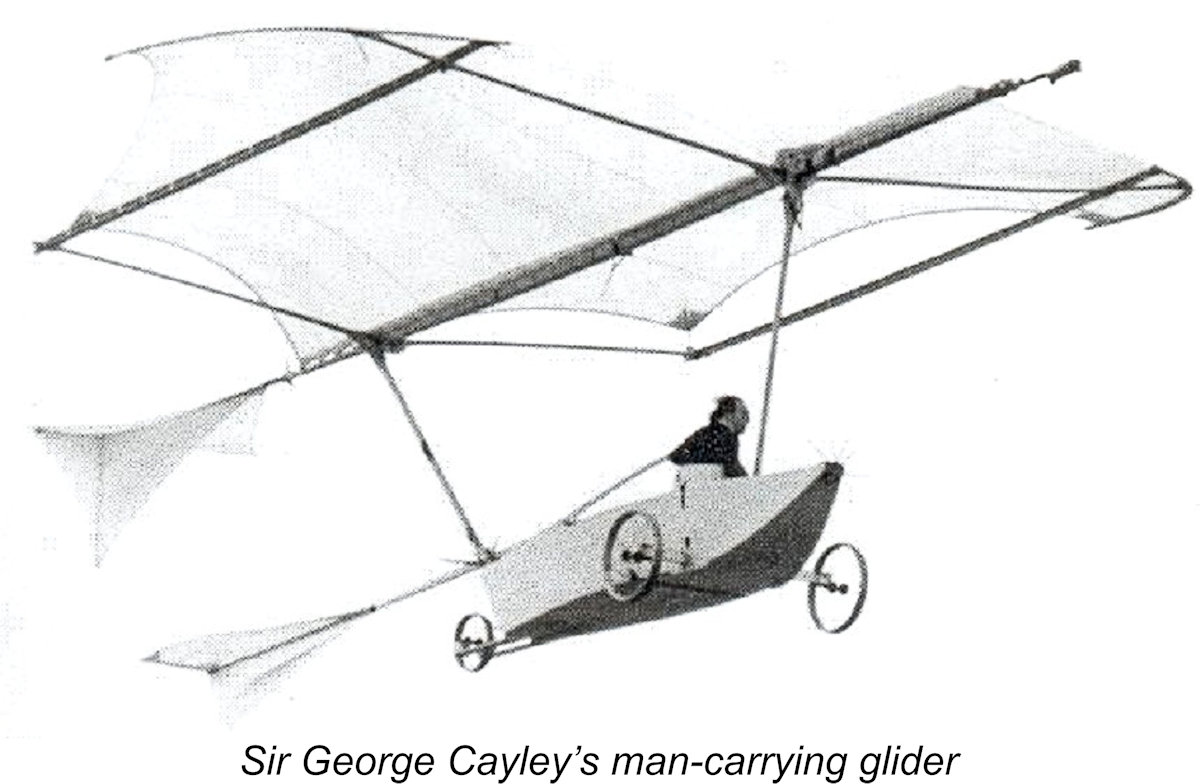 Amazingly enough, the construction of flying model aircraft goes way back to a point in time long before the invention of the internal combustion engine and its development into a form suitable for aircraft use. Although there may be some debate on this point, credit for the construction of the first successful heavier-than-air model aircraft to fly is generally given to the English inventor
 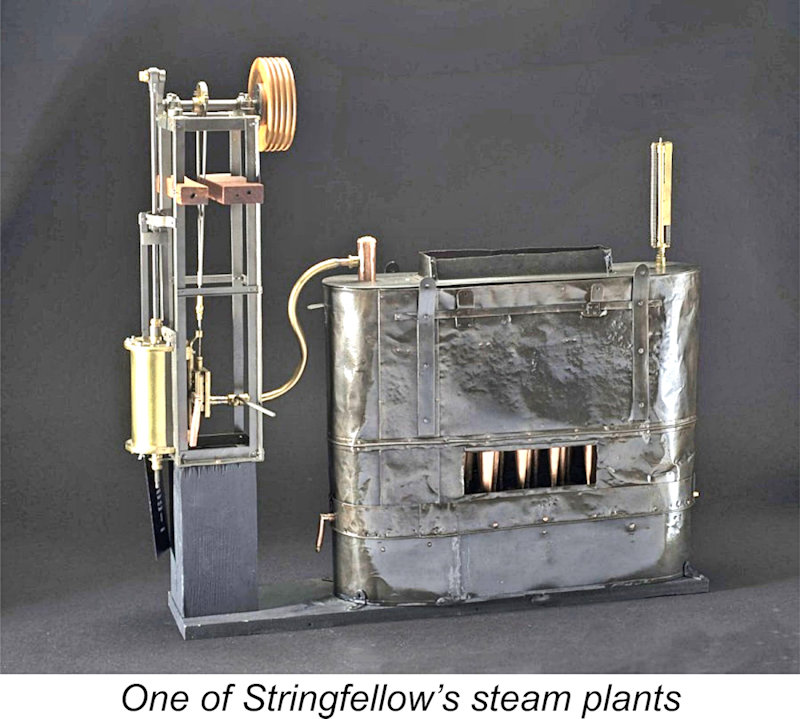 From the outset, Stringfellow and Henson had the goal of creating a full-scale man-carrying aircraft which they dubbed the “aerial steam carriage” and christened the Ariel. Their basic design was patented jointly in 1842. Their very ambitious goal was to develop the Ariel into a full-sized form having a wingspan of 150 feet and capable of carrying 10 passengers over a distance of 500 miles.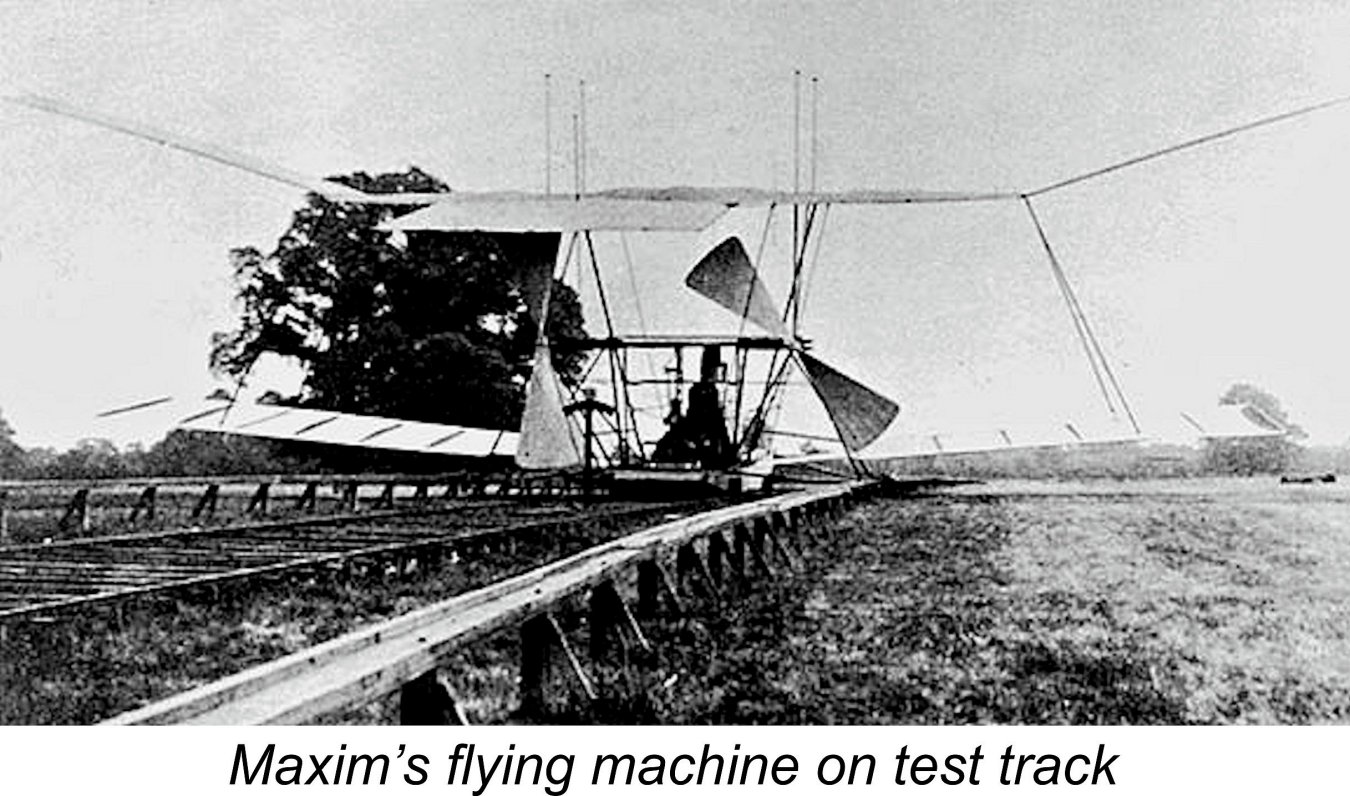
 On the other side of the Atlantic, 1906 found
 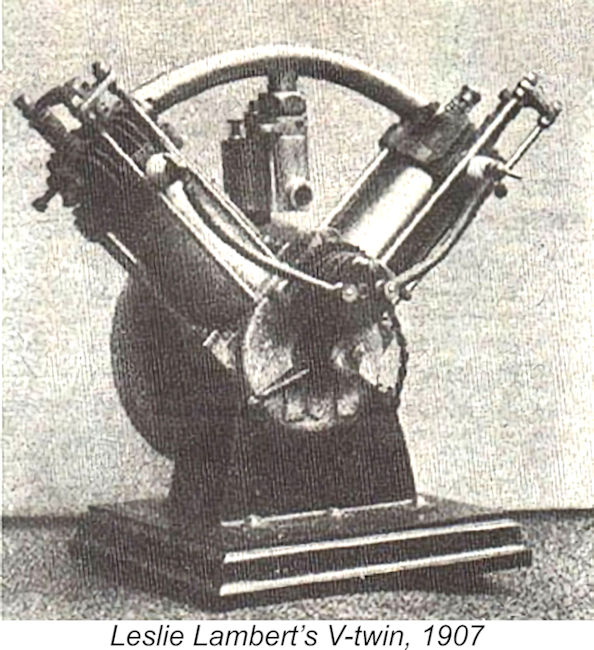 Back in England, the English public had received its first hint of a gas-powered model aircraft in the Aeronautical Section of the 1907 Cordingley's Motor Car Exhibition, held at the Agricultural Hall in Islington. Most of the aeronautical display consisted of balloons and their equipment, with flying and static models taking second place. However, a V-twin gas engine supposedly suitable for models was displayed by its builder Leslie Lambert.
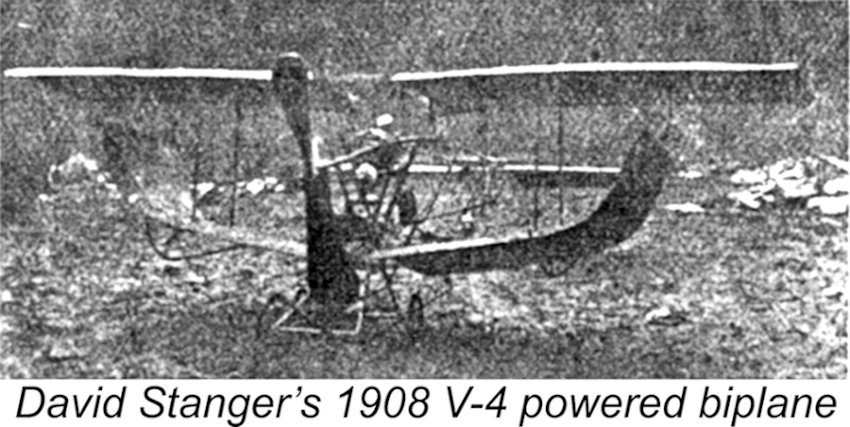 David Stanger
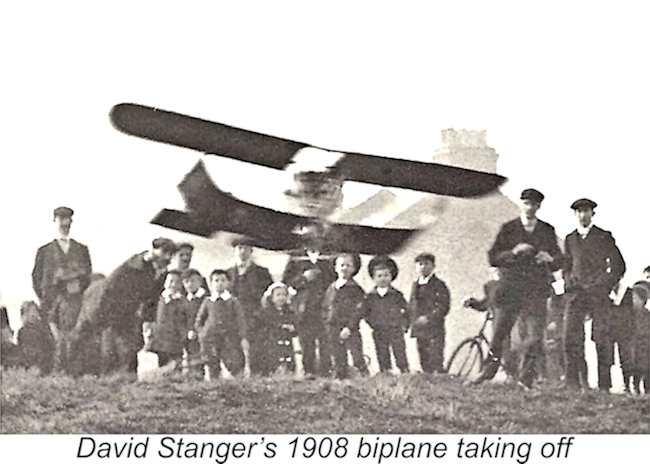 Beginning in March 1908, this model and its V-4 powerplant made a series of successful flights, a number of which were both photographically and anecdotally confirmed. Unlike Samuel Langley's steam-powered Aerodrome no. 5, Stanger's model was capable of taking off from smooth ground, with a take-off speed estimated by Stanger to be 16 MPH. Its success made Stanger the first person in England to achieve photographically-confirmed open-air ROG free flights with a petrol engine-powered model aircraft. Look at the wonder expressed by the numerous children on hand to watch this novelty perform!
 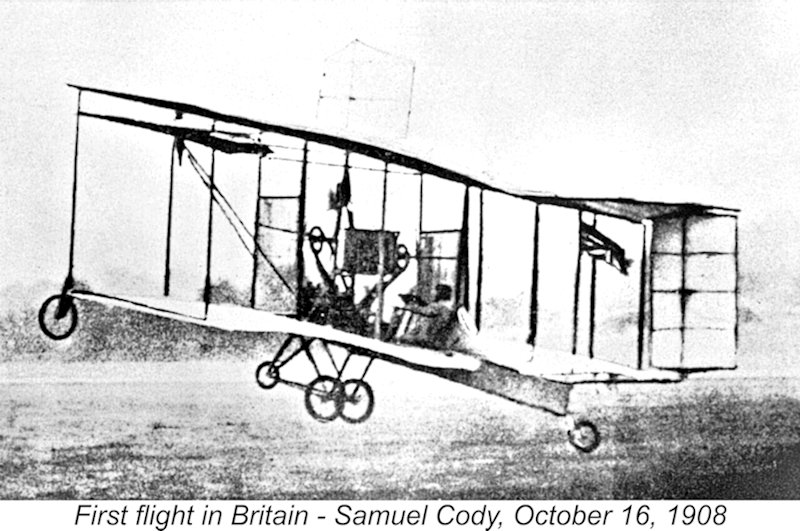 These early gasoline-powered model aircraft were more-or-less scale models of full-size designs. This was not a reflection of the age-old human fascination with making small-scale replicas of full-sized originals (today known as Scale Modelling), but rather due to the reasoning that since the full-sized designs had somehow managed to stagger into the air, smaller-scale renditions of those same designs just might do likewise!
 Up to this point, none of the model aero engines mentioned above had been designed with commercial production in mind – they were all one-offs. The reason for this was simple – there was no market. The only people engaged in the construction of power model aircraft were those very few talented individuals who possessed both the enthusiasm and the wide range of skills required to create what amounted to reduced-scale renditions of the primitive full-scale aircraft of the day. Like their full-scale counterparts, those individuals accepted the fact that they had to build their own engines.
 British interest in model aviation, and indeed in aviation in general, was given a huge boost by
 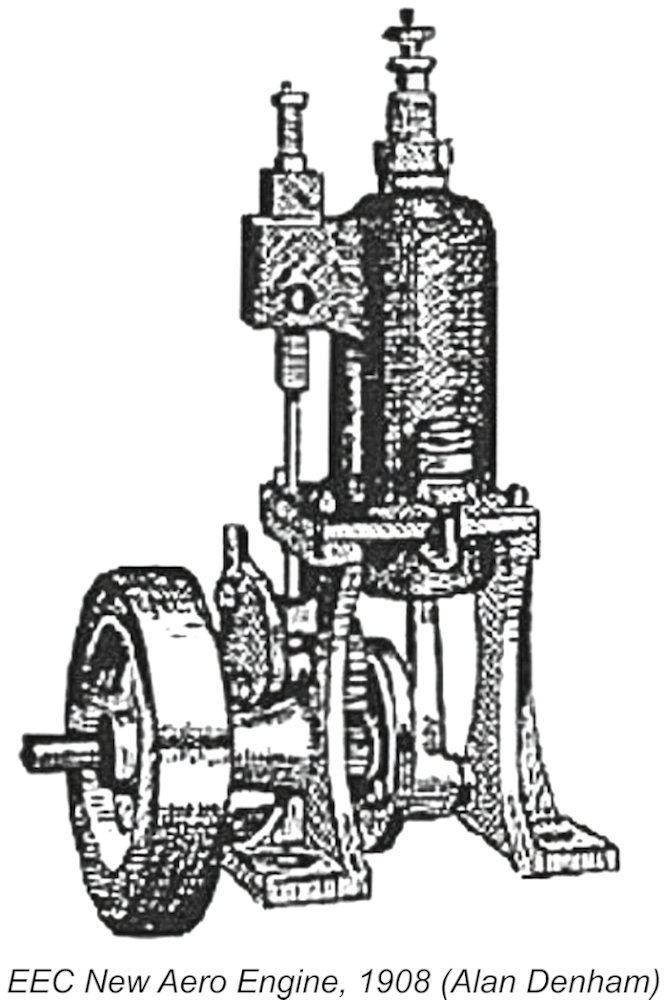 The first commercial offering of an engine which was specifically claimed by its manufacturers to be suitable for use in model aircraft was the four-stroke “New Aero Engine” promoted in 1908 by the Economic Electrical Company “in response to the great interest now being taken in the construction of aeroplane models”. This oddity had far more in common with the industrial/agricultural coal-gas engines of the day with its exposed crank and large flywheel. With bore and stroke dimensions of 1.375 in. and 2.5 in. respectively, it had a displacement of 60.84 cc (3.71 cuin.) Weight with flywheel was claimed to be 3½ lbs. Needless to say, this aberration evidently fell by the wayside very quickly, vanishing without trace.
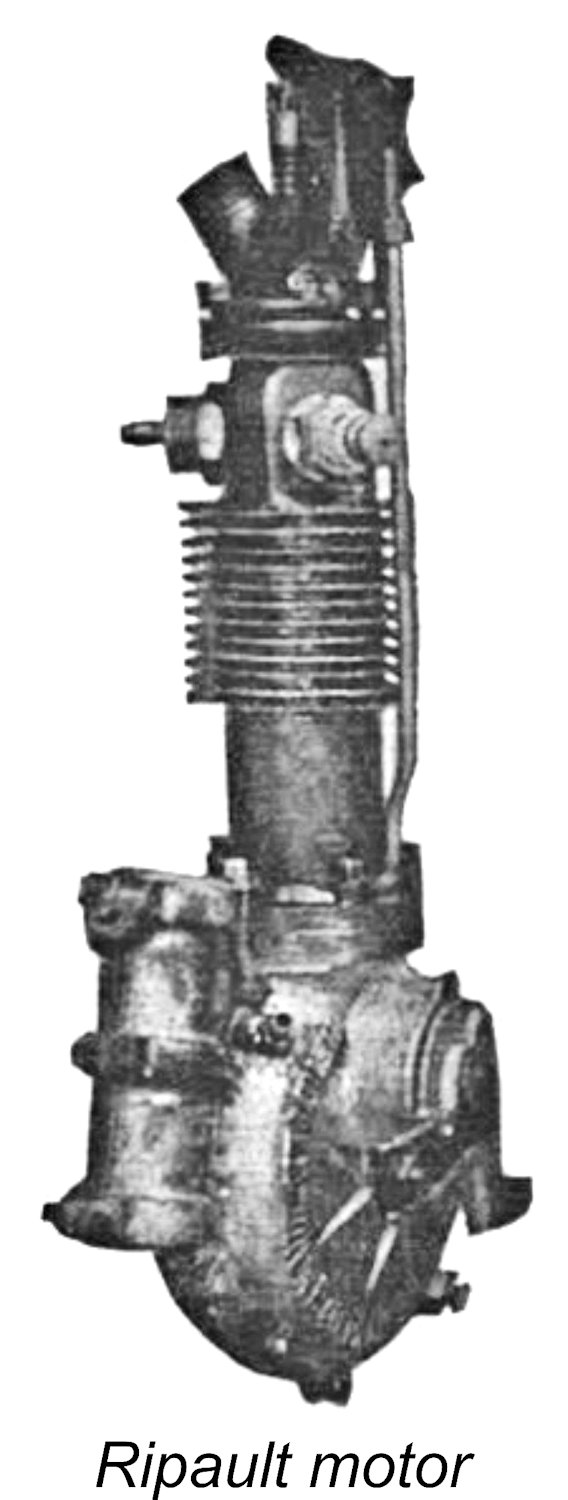 The next mention of a commercially-available "light motor" which was claimed to be potentially suitable for models is to be found in an advertisement placed by Leo Ripault & Co. in the January 23
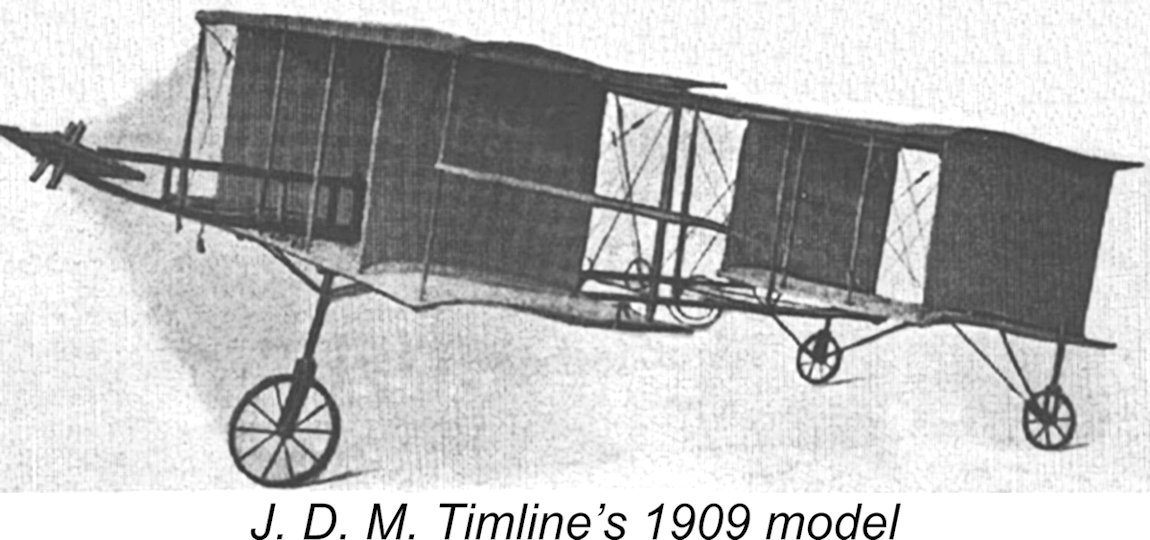 The tricycle undercarriage is decidedly forward-looking! However, the claim that the model had actually flown was unconfirmed. I must say that the motor mount looks decidedly "shaky" to me!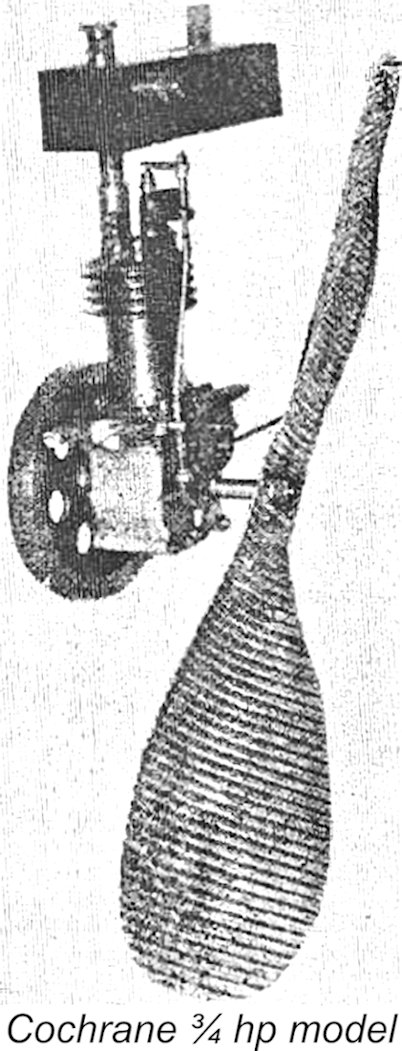
 interested parties.
  The year 1910 was clearly the Big Year for the establishment of commercial model engine manufacturing in Britain. Perhaps the big news in that year was the entry of the famous London department store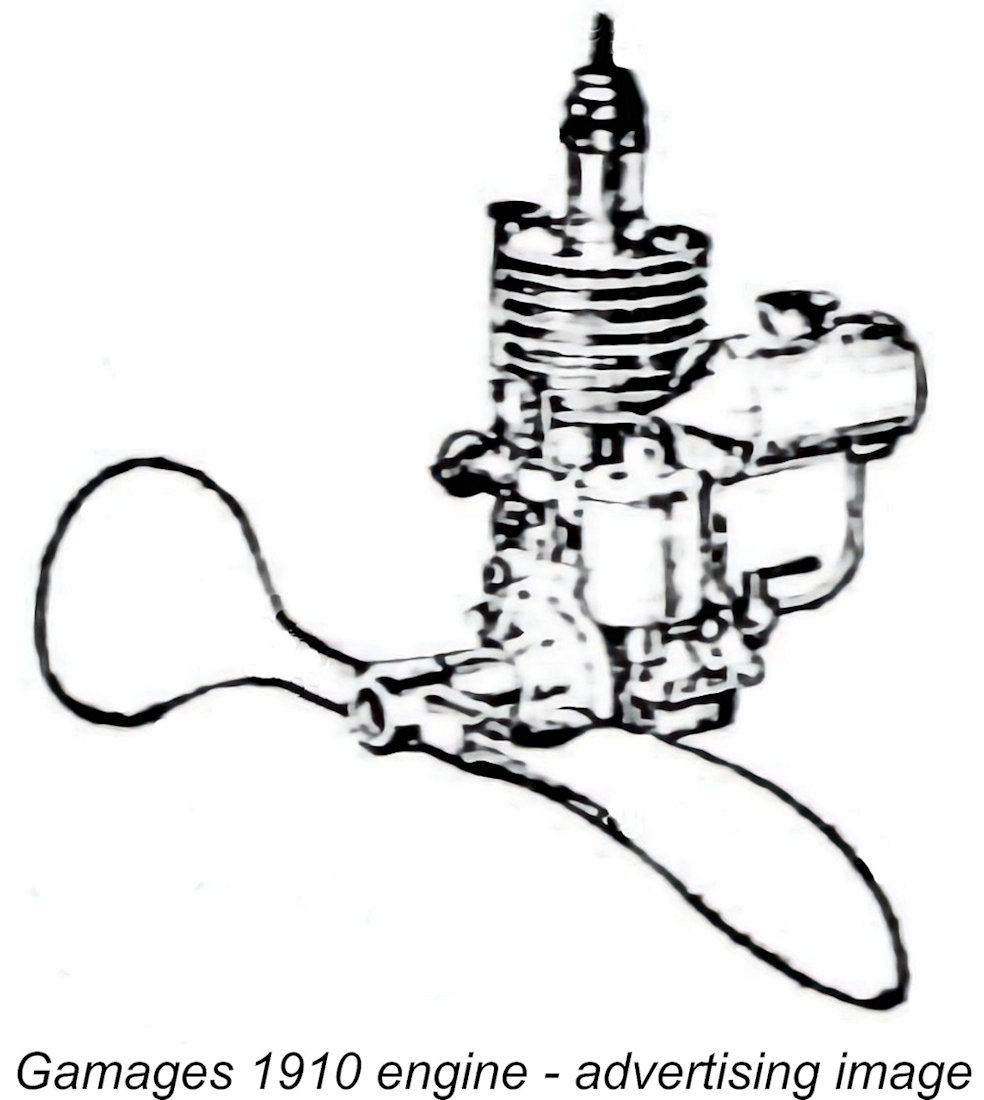
 The November 12
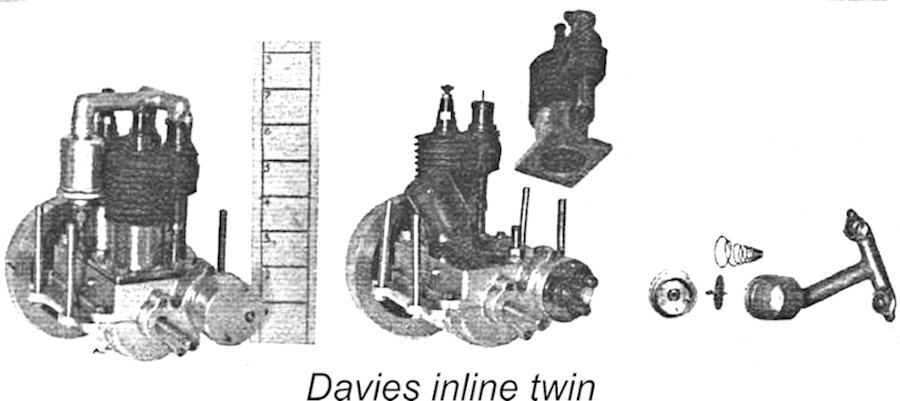 The Davies in-line twin-cylinder four-stroke engine constructed by J. Davies of Rugby was the smallest of the multi-cylinder designs, being only 7 in. tall and weighing just 4¾ lbs. With a bore of 1.3125 in. and a stroke of 1.375 in., it had a displacement of 60.98 cc (3.72 cuin.). Claimed output was a somewhat more credible ½ hp. The iron cylinders were individually cast, while the two-piece crankcase was made of aluminum.
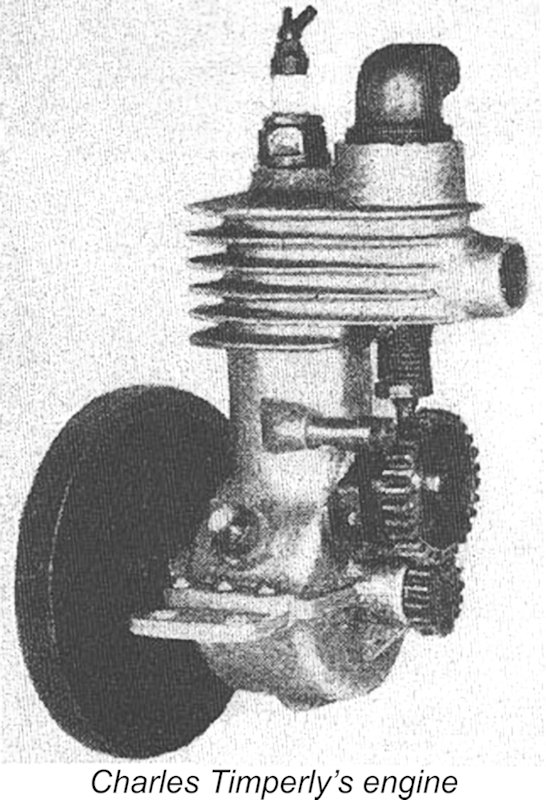 While most of the popular engines were designed to run at no more than 2,000 RPM, thus needing heavy and bulky flywheels, at least one showed some relatively original thinking. Charles B. Timperly built a very tidy-looking single-cylinder four-stroke engine that weighed just over 4 lbs. and developed a claimed ¾ hp at a sprightly 3,200 RPM. To keep the weight down, he used an aluminum cylinder with a thin steel liner, also employing side valves in place of the usual overhead valves to keep the engine's height down. Another innovation with this engine was the use of a ball-and-socket small end bearing on the conrod - possibly the first appearance of this later-common feature in a model engine.
 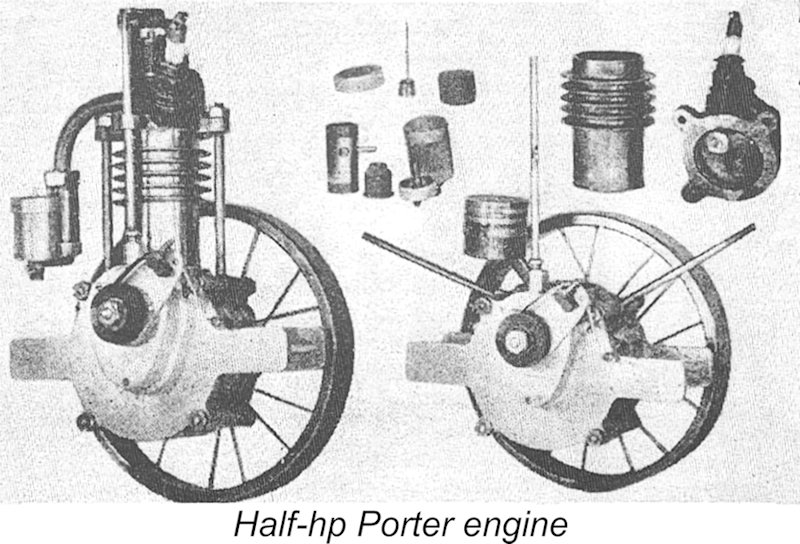 The most extensive series of engines then on offer was produced by H. W. Porter, ranging from single-cylinder models producing ½ or ¾ hp, to twin-cylinder ones putting out 1 or 1½ hp. Only two different cylinder assemblies were used to create all models, both dimensioned for 2 in. strokes, with optional bores of 1¾ in. and 2 in. All-up weights including flywheel ranged from 11 to 15½ lbs. All had float-type carburetors, while the twins had high-tension distributors along with a single ignition coil. The Porter engines were notable for their use of a spoked flywheel.
 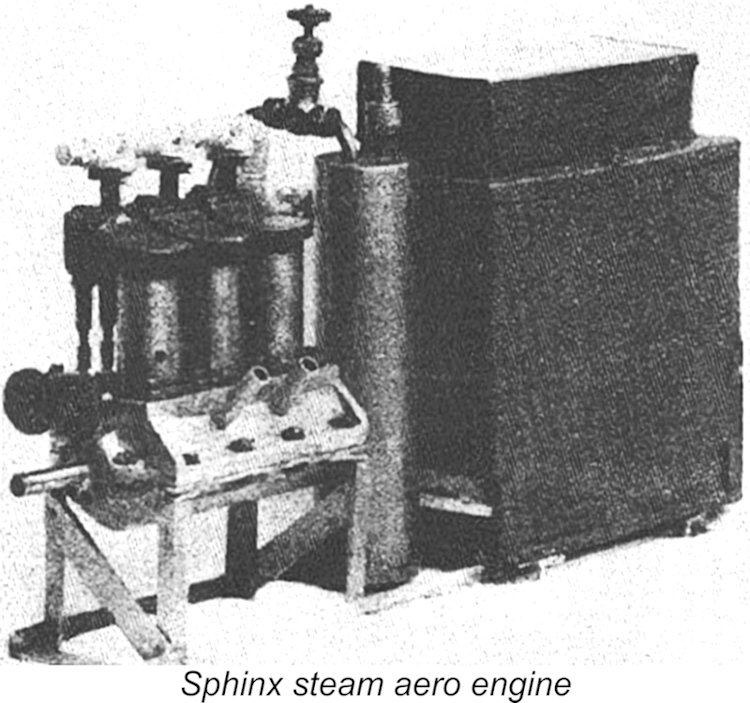 at this time. The Melton Aeroplane Co. offered their "Sphinx" steam engine of a claimed ½ hp, which weighed 4 lbs. 2 oz. including fuel and water. It was said to be capable of turning an 18 in. dia x 31½ in. pitch airscrew at 1,400 RPM. Its little charcoal-fired boiler could produce steam at a pressure of 250 lbs./sq. in., and could run for 1½ minutes with its two fluid ounces of water. The engine itself resembled a gasoline type, with three cylinders in line and mechanically-operated valves in each head.
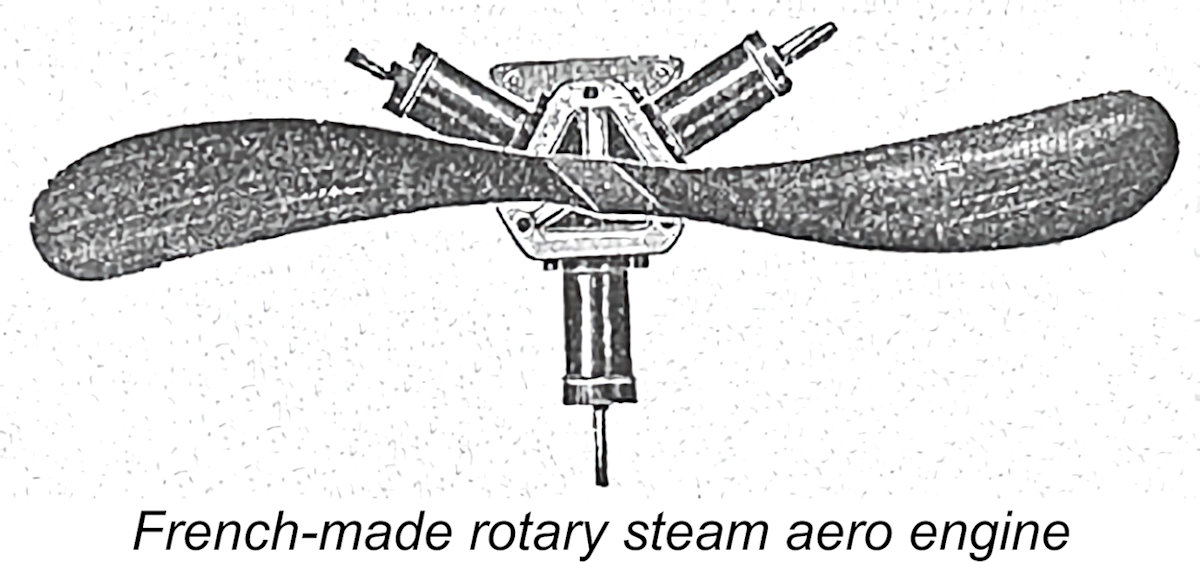 In addition, Gamages’ 1911 catalogue included a lightweight three-cylinder rotary steam engine expressly designed for model aeroplane use. This engine had been developed in 1910 by an un-named French engineer and had been awarded the Special Prize at the prestigious August 1910 Concours Lépine inventors’ exhibition in Paris. It reportedly drove its matching airscrew at 2,000 RPM. All-up weight complete with boiler and heat source was cited as 18 ounces, of which only 4¼ ounces was attributable to the engine itself.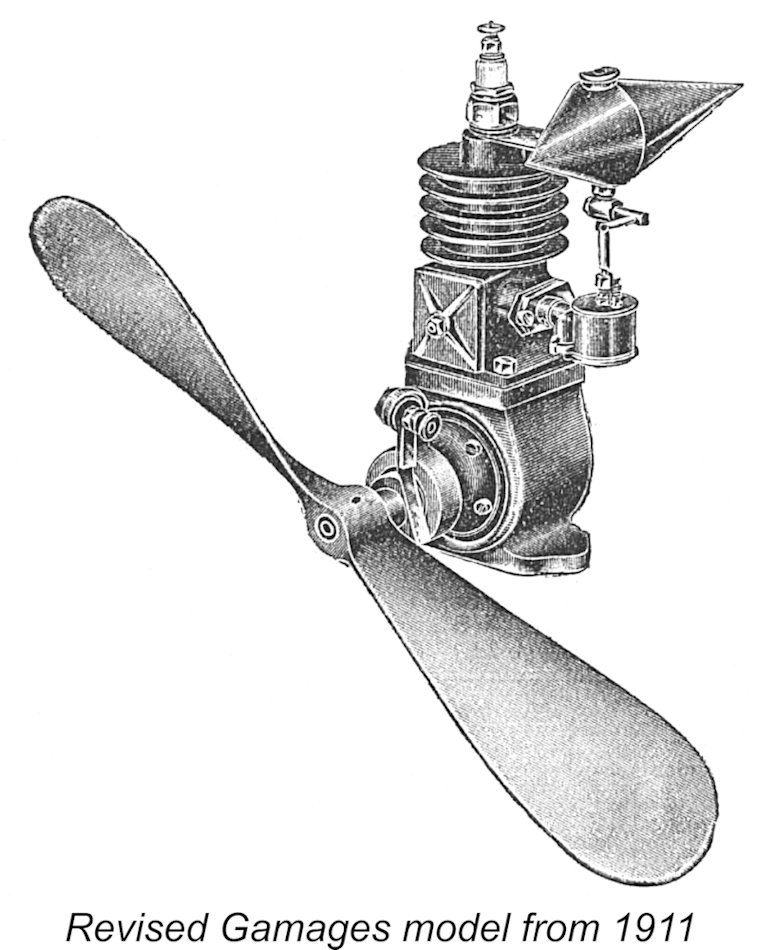
 As far as is known, the first flight to be officially confirmed through independent observation according to established criteria came in April 1914, when
  That unhappy event naturally impeded progress, although some aeromodelling activity seems to have continued. Gamages' lightweight two-stroke engine evidently remained on the market - the report on the Gamages Christmas Bazaar and Christmas catalogue in the December 3
 was to remain predominant all the way up to the mid-1930’s and even beyond. This being the case, it’s interesting to note that in his 1916 book entitled “
 Ray’s 1910 engine was a two-cylinder unit which weighed in at a mere 14 ounces, placing him at the top of the list of model aero engine designers of the day worldwide, almost none of whom even knew that he existed! Sadly, the deserved fame did not come to him for several decades, probably due in large part to the fact that none of his pre-WW1 engines ever reached production status.
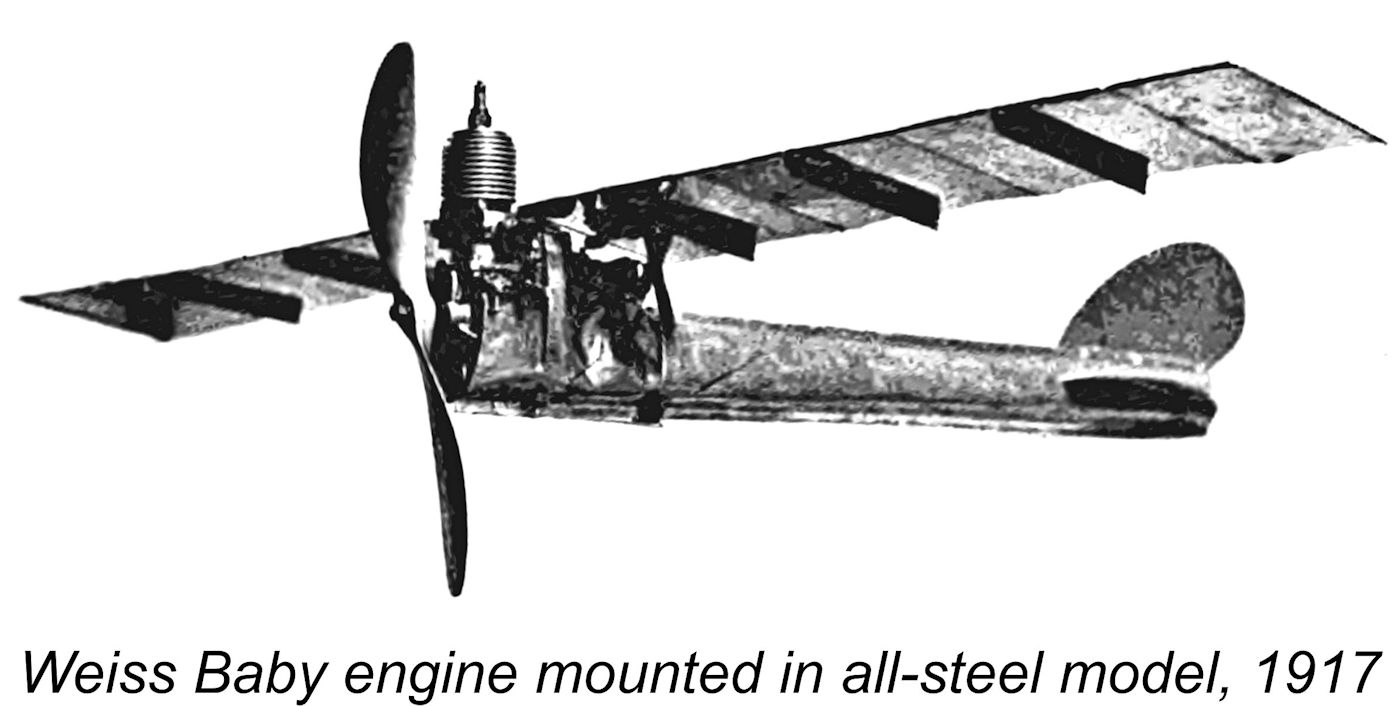 5/8-inch Rajah spark plug; a set of engine-mounted breaker points that were adjustable for advancing/retarding the ignition timing; and a coil, condenser and battery mounted in the airplane.
 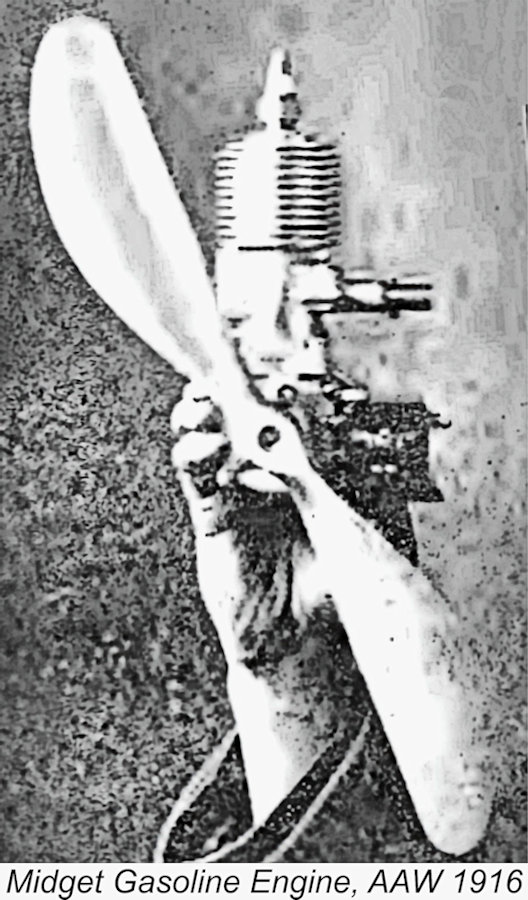 The August 14
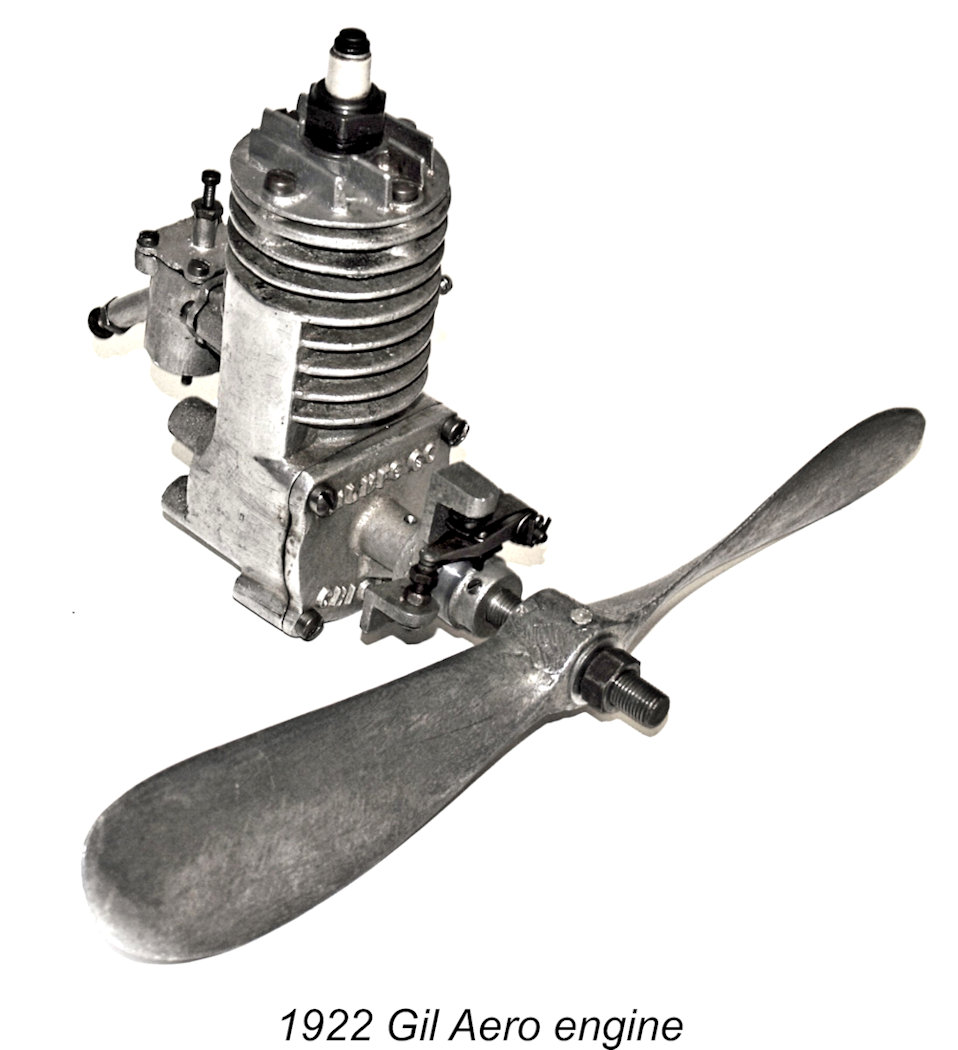 A few years after the conclusion of WW1, the Gil Manufacturing Co. of Chicago, Illinois made its entry into the model engine manufacturing field. The Gil offering was a relatively small two-stroke sideport unit having a displacement of 19.34 cc (1.18 cuin.). According to the advertisements, it weighed only 16 ounces and developed 0.4 hp at 2,500 RPM. It was a surprisingly “modern” looking unit with its aluminum crankcase, automotive timer and detachable cylinder head and front end. It was supplied with a supposedly-matching 12 in. dia. aluminium airscrew.
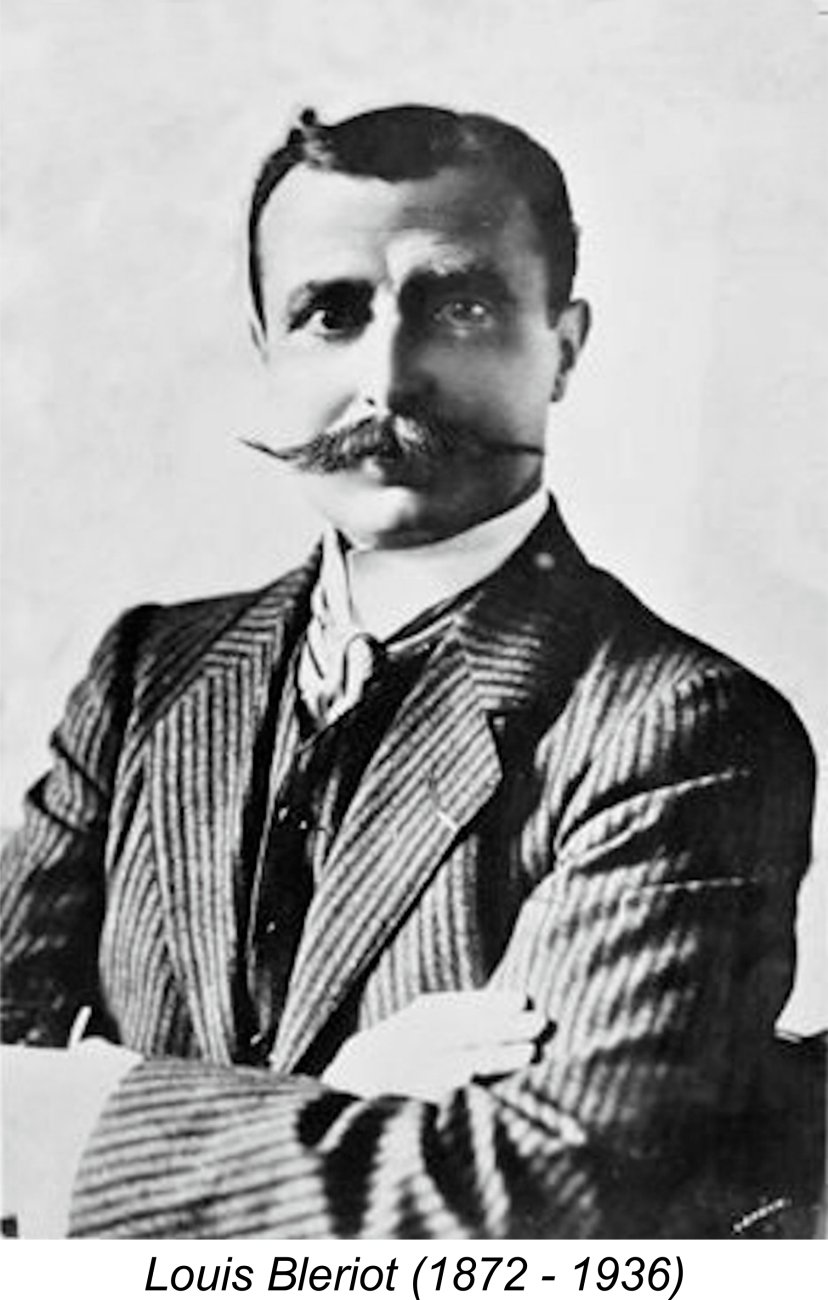 The French were not far behind the British in commencing the commercial manufacture of model engines. The 1909 achievement of pioneering French aviator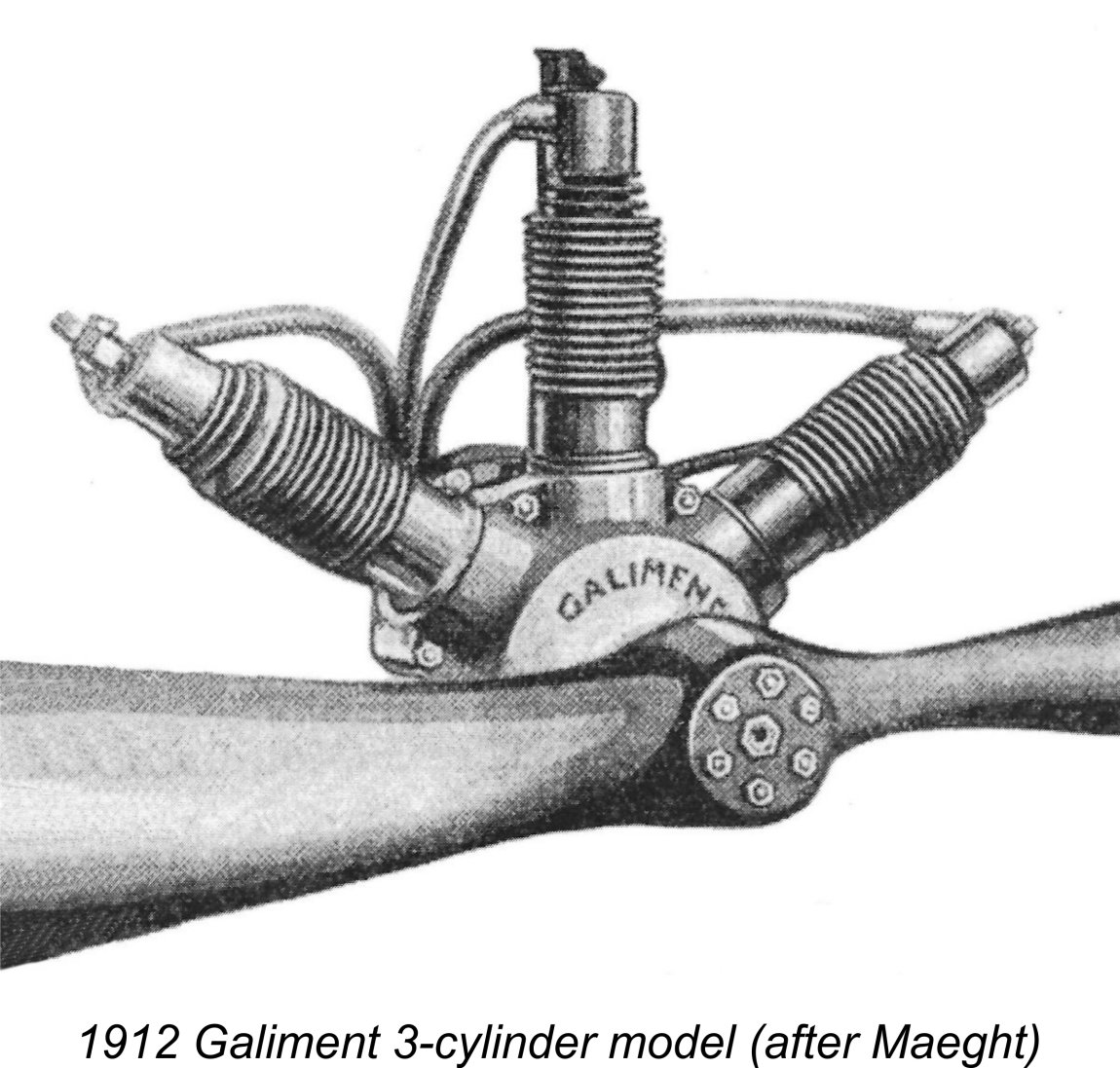
 At this stage, French model engine designers were clearly poised to move ahead of their competitors in most other countries. This encouraged the L’Auto organization to inaugurate a model-scale version of the famous Gordon Bennett air races, thus providing the new French model engine manufacturers with a perfect showcase for their products. Commercial model engine manufacture in France was evidently off to a very good start!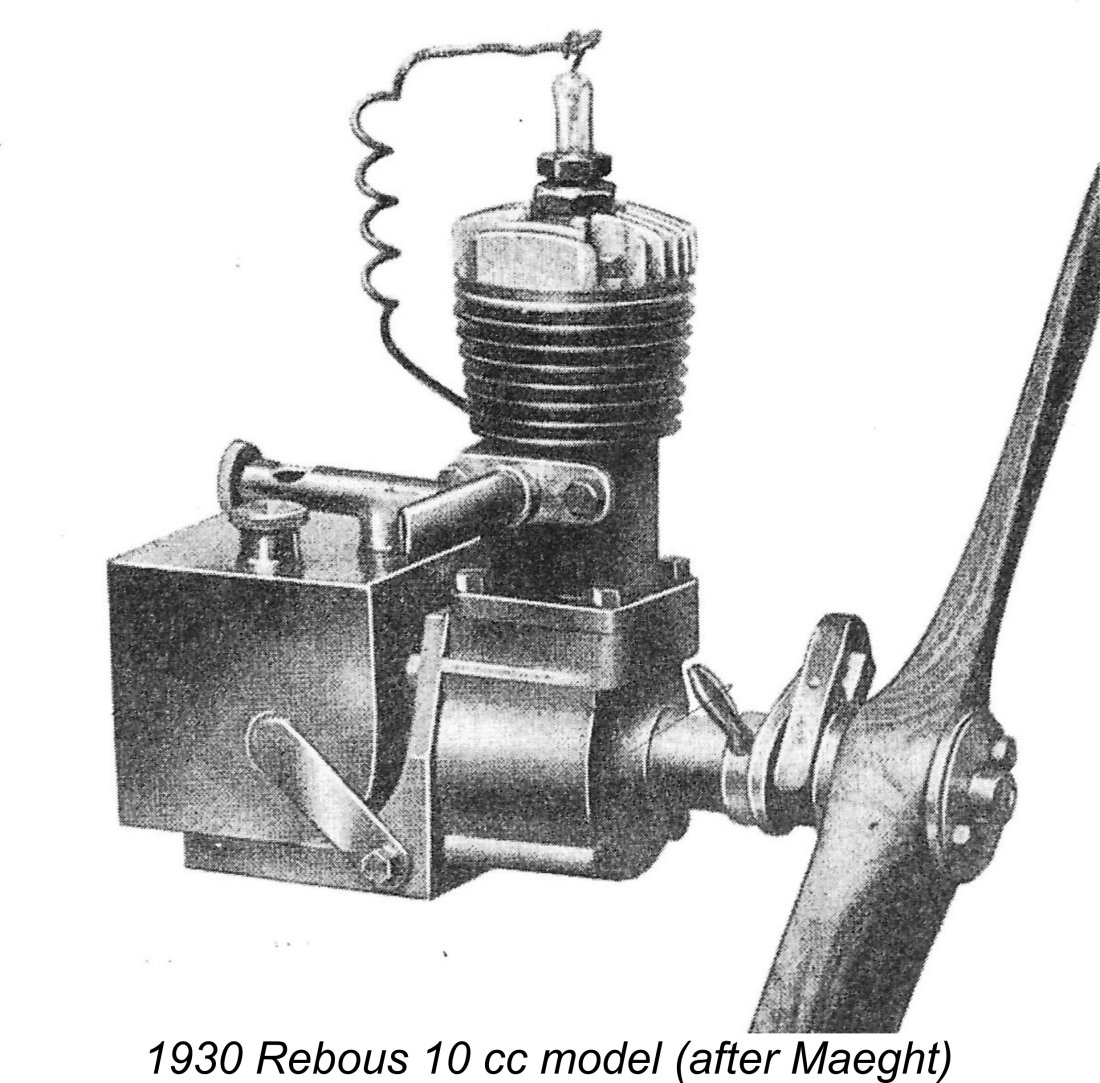

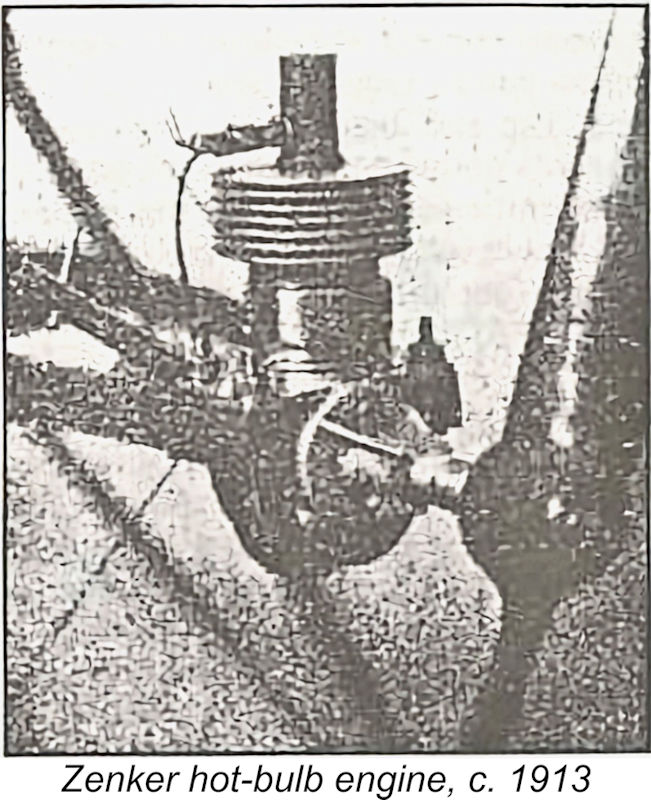
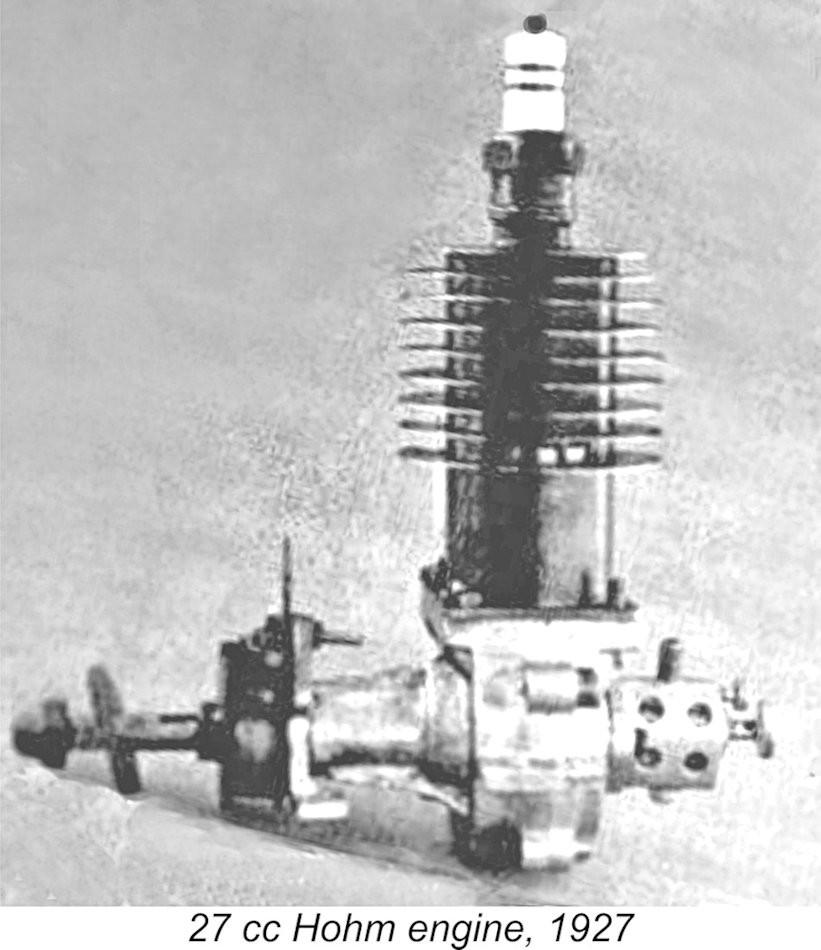 However, model engine production in Germany re-commenced remarkably quickly after the war, with the first engines from Schnell and A. Felgiebel appearing before the end of 1918. During the 1920's, Germany was among the most active countries engaged in the manufacture of model engines, with continuing involvement on the part of previously-established makers such as Max Braune, Fritz Saran, Helmut Wagenseil and A. Felgiebel along with the appearance of new manufacturers such as Ernst Romen, Trümpelmann, Ernst Schalk, Curt Möbius, H. Schramm, Flugsport, E. Höhm and Alfred Mentzen.
 | |