
|
|
Kondo Klassics - the K.O. Diesels
The correct rendition of the engines’ two-letter trade name is open to some debate. In the present article, I’ve chosen to render it as K.O. (with periods) because the name represents the initials of the makers. Moreover, that’s how it’s rendered by the manufacturers both on the box labels and in their literature. The engines themselves split the difference by rendering those letters as “K.O” (omitting the second period) on their crankcases. In both cases, the intention is evidently to encourage the pronunciation of the name as “kay-oh” rather than “koh”.
The company appears to have spent the subsequent two or three years focusing on the further development of their R/C equipment while maintaining production of the .099 cuin. glow-plug model and working on the development of their soon-to-be-released diesel series. The .099 glow-plug unit was featured in Peter Chinn’s most informative summary of model glow-plug engines for 1954/55 which appeared in the May 1955 issue of “Model Aircraft”. However, it was the sole K.O. model listed at that time - the companion table of model diesels included no K.O. models, while the .15 cuin. new-generation K.O. glow-plug model had evidently yet to appear. It seems to have been at some point during the 1954-1955 period that the K.O. company embarked upon the production of the model diesel engines for which the marque is best remembered today. It is those engines which form the central subject of this article. References Writing an article on these engines is a challenging assignment, since very little of substance has previously been written about them. They were never the subject of an article in the late Tim Dannels’ wonderful and greatly-missed “Engine Collector’s Journal”, for example. The late David Owen wrote a few paragraphs about them in the November 1997 issue of "Model Engine World" magazine, but those paragraphs provided little information on the history of the engines. My valued Aussie mate Gordon Beeby was indefatigable in searching out the few references to the K.O. diesels that do exist. The first mention of the series that he was able to find appeared in the November 1956 issue of "Model Airplane News" (MAN). Peter Chinn's article entitled "Made in Japan" (obviously written in mid-1956) included a reference to K.O. diesels being available in displacements of .049, .099 and .15 cuin. as of his time of writing. Most interestingly, Chinn made specific reference to the fact that the .15 cuin. (2.5 cc) model had been introduced "last year", seemingly confirming that the K.O. diesels had first appeared "under the radar" in 1955 or possibly even 1954 - we can't be sure, but in any case the implied date is far earlier than seems to be widely believed. A ball-race version of the .15 model was also said to be available at this early stage.
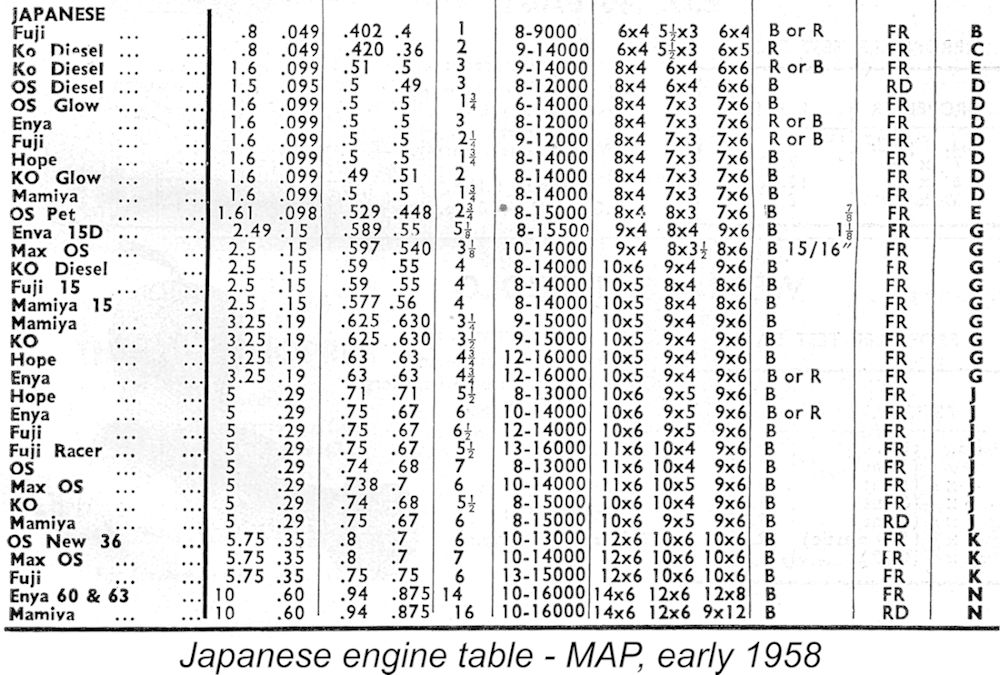
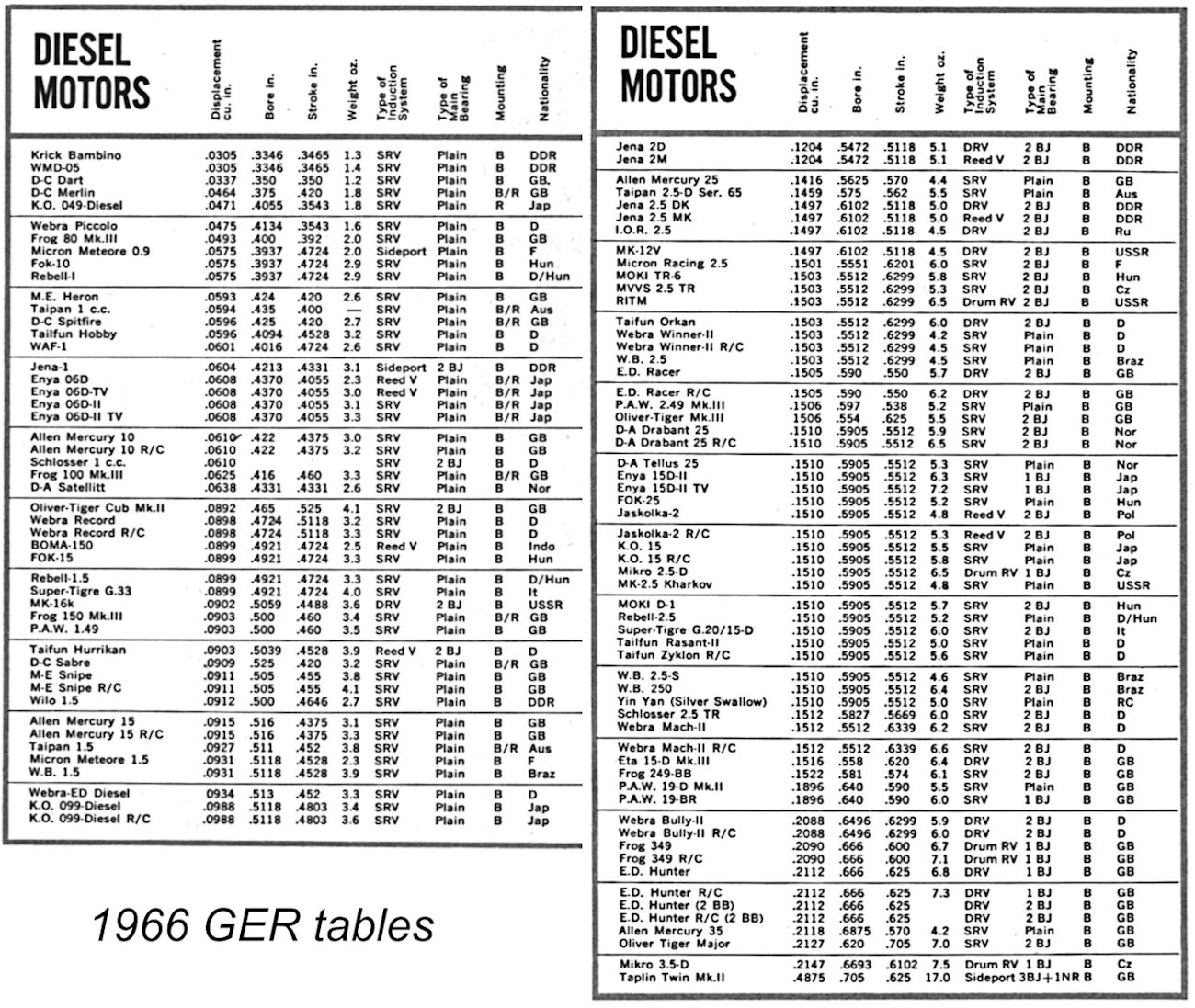
A number of K.O. diesels were featured in the accompanying table of Japanese motors that appeared in the early 1958 English compilation “Model Aero Engine Encyclopaedia” published by the Model Aeronautical Press (MAP). These include engines having displacements of 0.8, 1.6 and 2.5 cc. Incidentally, I have no idea where the included O.S. 1.5 cc diesel came from - in decades of in-depth research, I've never run across any evidence at all suggesting the existence of such an engine! The only O.S. diesels of which I'm aware are the 1 cc O.S. "Bee" from the early 1950's and the 2.5 cc O.S. MAX-D 15 diesel of 1959. The K.O. diesels were mentioned briefly in the text of Peter Chinn’s unattributed “Global Engine Review” (GER) The K.O. diesels re-appeared in Chinn's updated GER published in the 1966 American Modeler Annual. This survey was actually compiled during 1965. On this occasion, Chinn was able to include the engines in his table of model diesel specifications (right). In addition, the range was mentioned briefly in the text. The range was included once more in the specification tables associated with the 1968 GER (the last of that series of reviews), but there was no accompanying text. In actual fact, it seems certain that the engines had been out of production for several years by that time. The K.O. 2.5 cc models are covered in some detail in the late Jim Dunkin’s monumental “Reference Book of .15 ci. / 2.5 cc Model Airplane Engines”, although Jim somehow managed to miss the .15 cuin. glo-plug model which is known to have existed in the early 1960's, as recorded by Peter Chinn. Moreover, the cited dating of the illustrated models appears to be very much open to question. There's also that very brief reference by David Owen in the November 1997 issue of "Model Engine World". However, that reference provides very little information on the history of these engines. The K.O. Diesels - Production History
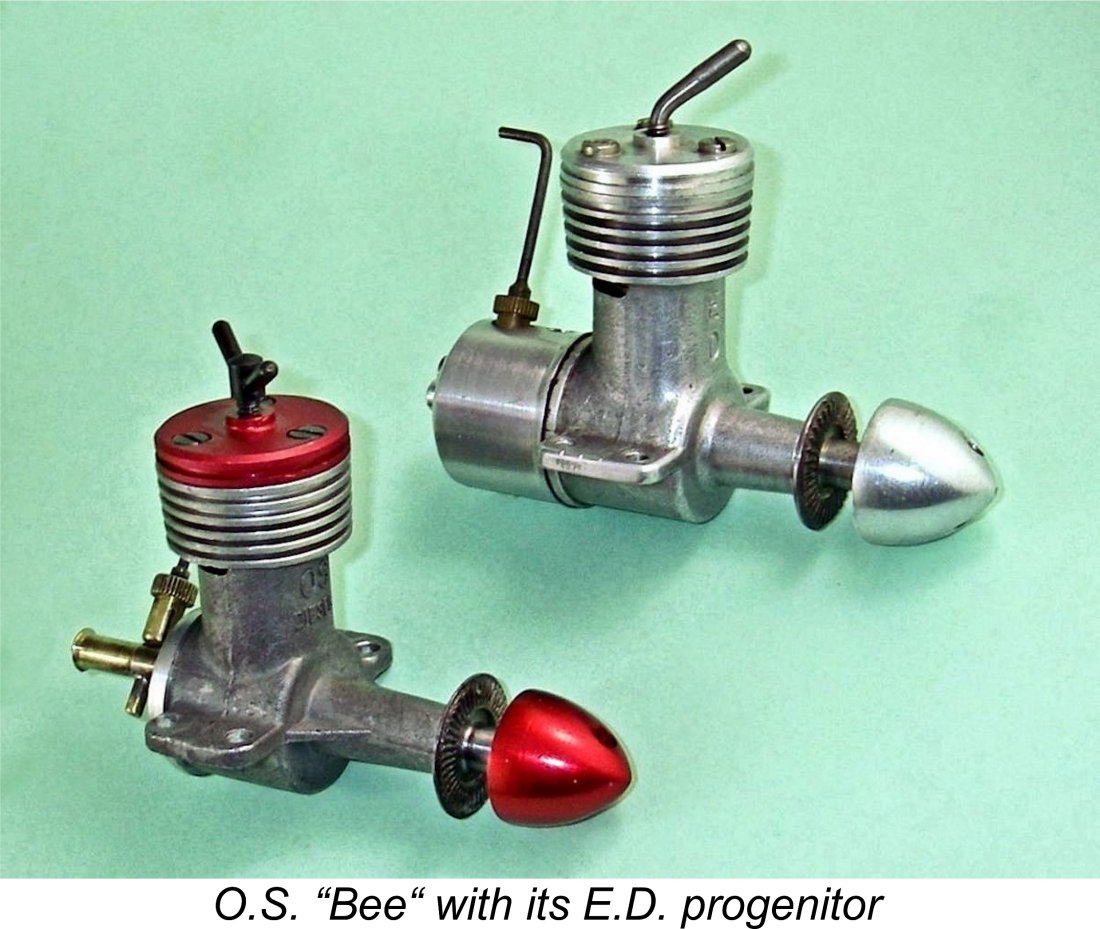
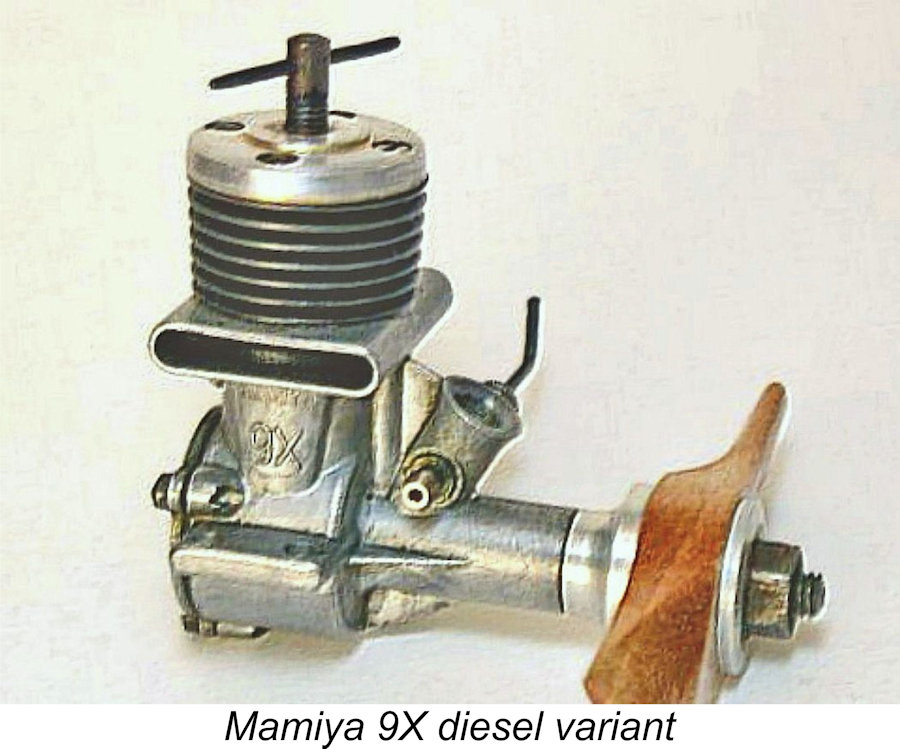
The only documented Japanese model diesel to reach commercial series production previously had been the O.S. 1 cc “Bee” of the early 1950’s (a close copy of the E.D. Mk. I Series 1 Bee), but that model seems to have drawn little commercial attention, hence enjoying a very brief production life with only perhaps 500 examples being made in total. The Enya company didn't release its Enya 15D-1 2.5 cc diesel until late 1956, while the producers of the Mamiya range, Tokyo Hobbycrafts, released diesel versions of their .099 and .15 cuin. glow-plug models at around the same time. However, the Mamiya models never really amounted to anything - indeed, the Mamiya range seems to have gone out of production during 1957.
The manufacture and further development of the R/C equipment for which the company had become increasingly well-known also continued throughout As the mid-1960’s approached, the model engine manufacturing activities of Kondo Kagaku Co. Ltd. had evidently come to constitute a relatively small proportion of the company’s overall business. It was likely for this reason that in 1965 or thereabouts the engine manufacturing operations were separated from the ongoing R/C production through the establishment of a separate company under the name of the Kondo Model Co. Ltd. In all probability, this was an accountant-driven decision since it established the model engine and R/C manufacturing lines as separate profit centres, to stand or fall on their own. Accountants love that sort of thing!
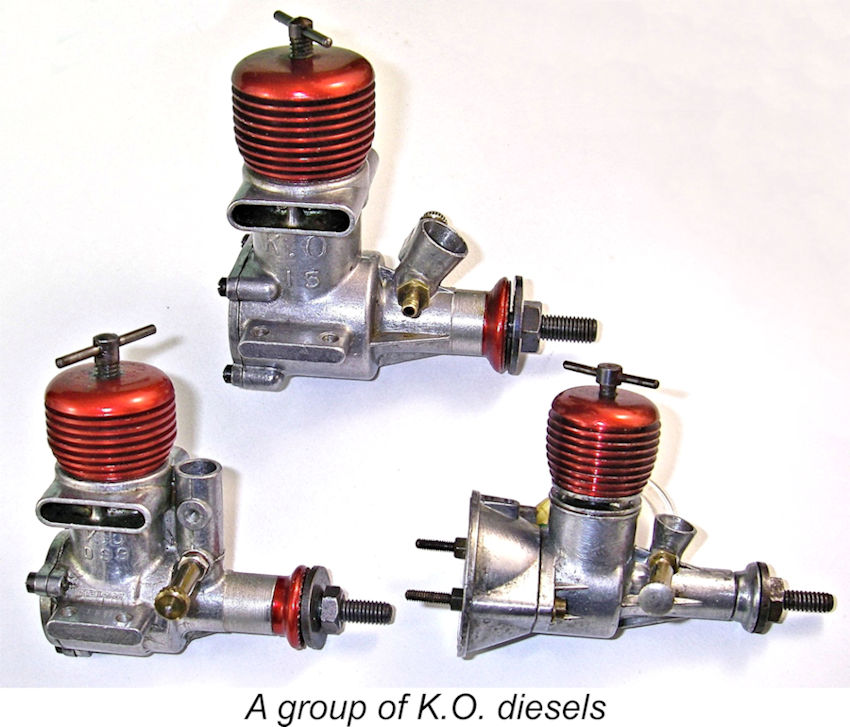
However, that was by no means the end of the company that made the engines! For additional details of the company’s overall activities both before and after, please refer to my earlier article. For now, we’ll return our full attention to the K.O. diesels which seem to have made their appearance beginning in 1955 (or possibly 1954) and continued in production for around ten years thereafter. During that time, a significant number of engines must have been produced. However, attempts made to promote their distribution to the English-speaking modelling world appear to have been minimal. The late David Owen advised that the range was marketed to some extent in Australia, but I've found no evidence of overseas marketing elsewhere. Consequently, the majority of these engines evidently remained i This is a great pity, because the examples that I’ve been fortunate enough to experience have all been very handsome units which were extremely well made and performed to more-than-acceptable sport-flying standards, although they were certainly no contest-grade power-houses. Their red-anodized cooling jackets and shiny tumbled pressure diecast cases gave them a very attractive appearance. They were also very attractively packaged in sturdy strikingly-decorated boxes. They would undoubtedly have found ready acceptance in the context of the world-wide model diesel engine marketplace of the day. It's important to note one important factor that distinguished the K.O. diesels. This was the fact that they were not diesel conversions of existing glow-plug models – rather, they were purpose-built diesels designed as such from the ground up. They appear never to have been offered in glow-plug guise. As far as I’m aware, the range included diesels having displacements of .049, .099, .15 and .29 cuin. I think that it may be best to review the engines in each displacement series together, starting with the .049 models. In doing so, I must confess at the outset that my knowledge of these engines is very far from complete. I have absolutely no doubt that the following account will include many omissions and inaccuracies. But at least it’s a start! My hope is that readers who know more than I do will get in touch to assist me in correcting any errors and omissions. I can’t do this alone – help from others is always gratefully received! The K.O. .049 Diesels
The twin-stacks disguised the fact that the engine was actually a conventional radially-ported unit. Bore and stroke were 10.3 mm (0.405 in.) and 9.8 mm (0.386 in.) respectively for an actual calculated displacement of 0.817 cc (0.0498 cuin.). Weight was around 1.8 ounces (51 gm). Cited operating speed range was 9,000 – 14,000 RPM, with 5½x3, 6x4 and 6x5 props being suggested for contest, C/L and sports applications respectively.
Apart from Allan’s engine, all other images of the K.O. .049 diesel of which I’m aware show a radially-mounted unit. Some of the engines were equipped with a small conical tank-mount highly reminiscent of the earlier Atwood .049 designs from America. This appears to have been a customer's option with the Series I models.
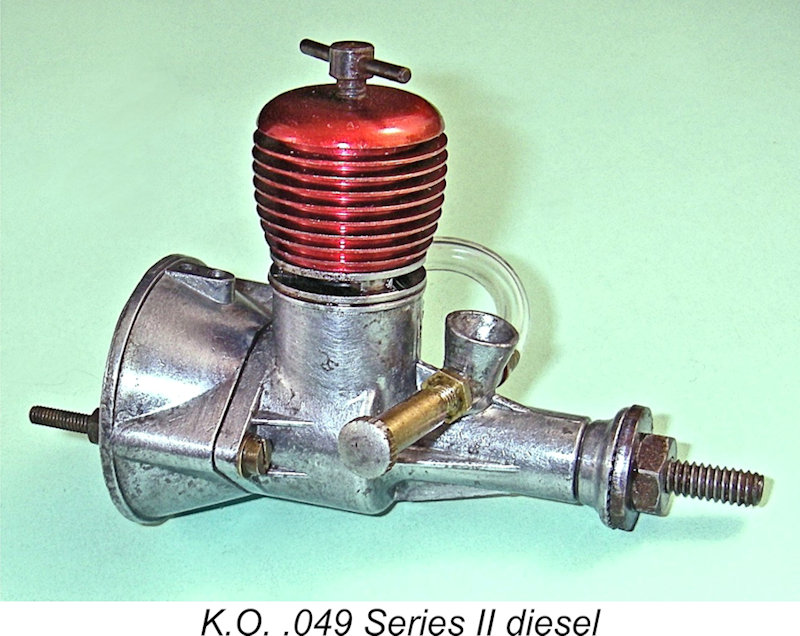
At the same time, a second variant of the .049 diesel appears to have been put on offer. This unit dispensed with the twin stacks, also being equipped with the previously-mentioned Atwood-style tank mount. It appears that both variants of of what I suppose we should call the Series II .049 model were offered concurrently.
I have an old radial mounting fitting made from a length of extruded aluminium alloy angle material which has more holes in it than the average colander after many years of accommodating various small radially-mounted engines. It's rare to find an engine which doesn't match two of the holes, and the K.O. was no exception! Using this venerable mount, it was soon set up in the test stand.
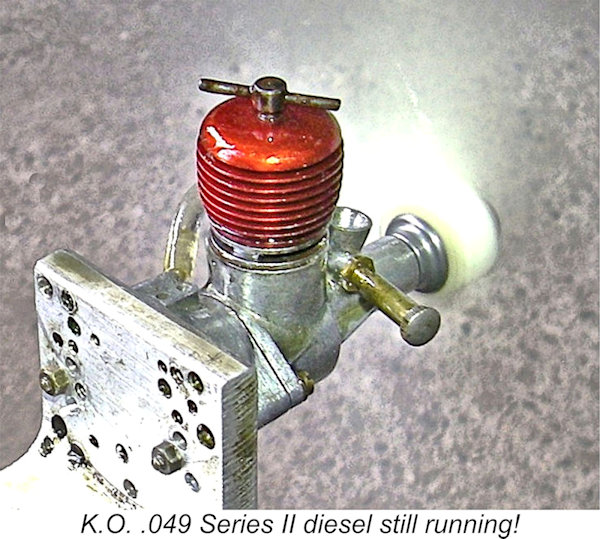
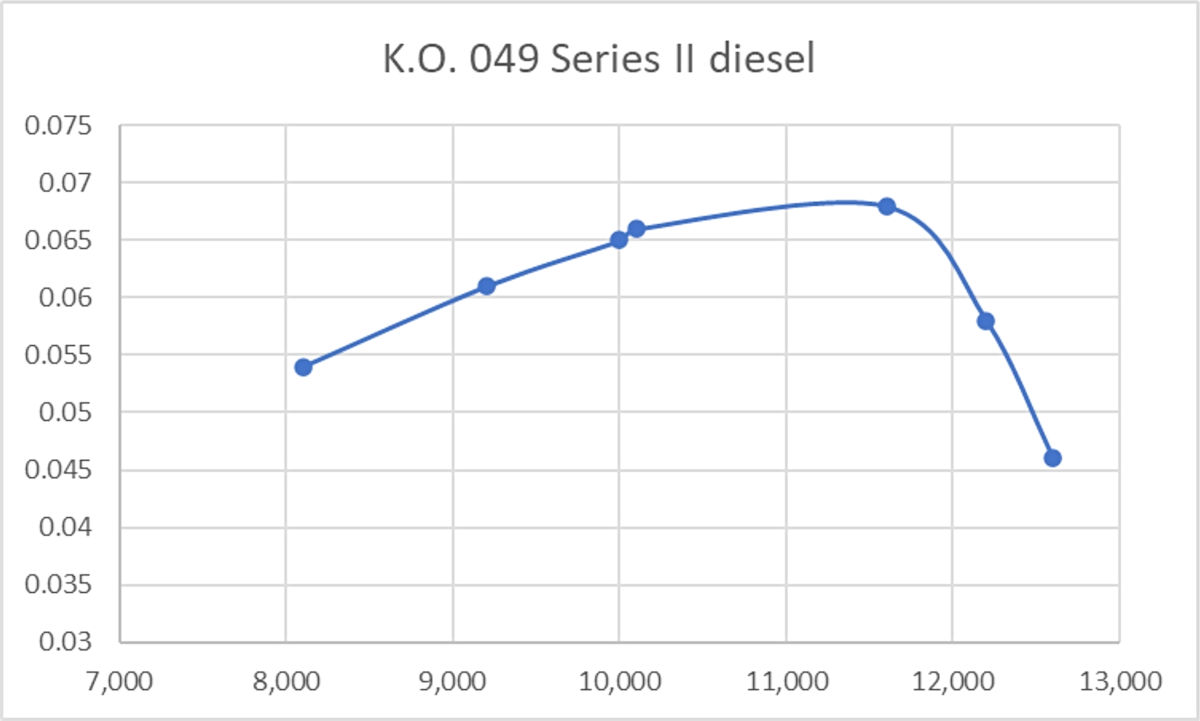
The little K.O. proved to be a very easy starter, although it did have its preferences. Like all small diesels, it was prone to becoming flooded if too much fuel was introduced at the outset. The most dependable approach was to choke to fill the fuel line (and no more), put one drop of fuel down the intake and then administer a modest exhaust prime. Using this procedure, flooding was never an issue and starting was very prompt. The engine was gratifyingly resonsive to the controls, both of which were perfectly fitted and kept their settings very securely. I kept the engine a little undercompressed initially, with the needle set on the rich side. In this mode, the engine would run After running 5 tankfuls through the engine in this manner, I changed tactics a little, running the engine rich for the first 2 minutes of each tankful and then leaning out to get the components well heated up immediately prior to the tank running dry. This began the sequence of full-range heat cycles which are an essential feature of a good break-in for any iron-and-steel model diesel. After a further half-dozen tankfuls, I judged that the engine was ready to begin providing some representative prop-RPM data. It might improve further with more running time, but since I wasn't planning to fly the engine I saw no reason to put more time onto it before commencing the actual test. My approach wa to start the engine at a rich setting for each prop, allow it to warm up for 1 minute and then set it for maximum RPM on the particular prop being tested. In this way, the break-in continued, with another full-range heat cycle being added for each test prop. The engine proved to be an excellent performer, running completely smoothly with never a misfire and a pleasingly low level of vibration. A very enjoyable test, in fact! The following data were recorded.
As the above data will confirm, the K.O. 049 diesel turned out to be more of a torque producer than a high-speed powerhouse, seemingly developing around 0.070 BHP @ 11,200 RPM or thereabouts. This output is acually quite impressive for a 0.81 cc diesel whose design essentially dated from the mid-1950's. It had the ability to swing a somewhat larger airscrew than that typically used with engines of this displacement - a 7x4 would appear to suit it down to the ground. A typical ½A prop such as a 6x4 would undoubtedly under-prop it, wasting its full performance potential. Coupled with its excellent quality and fine handling, I'd have to give this engine high marks as a very useable litle powerplant which had the potential to give its owners long and dependable service. Well done, Jiro Kondo! The K.O .099 Diesels
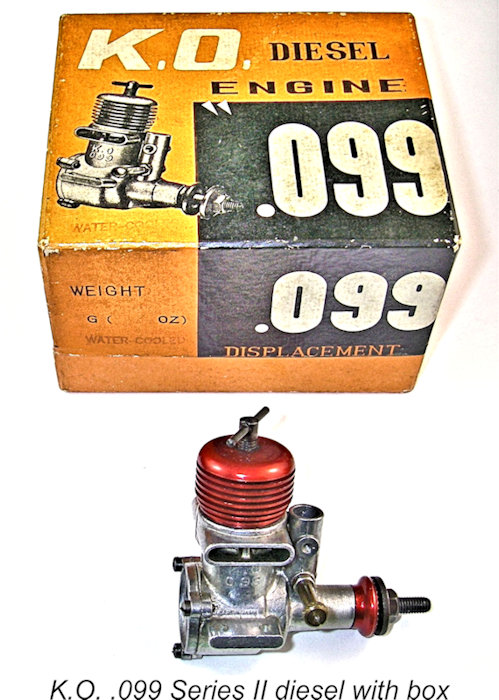
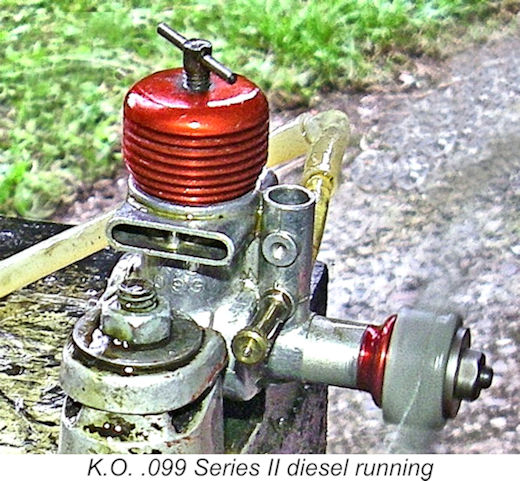
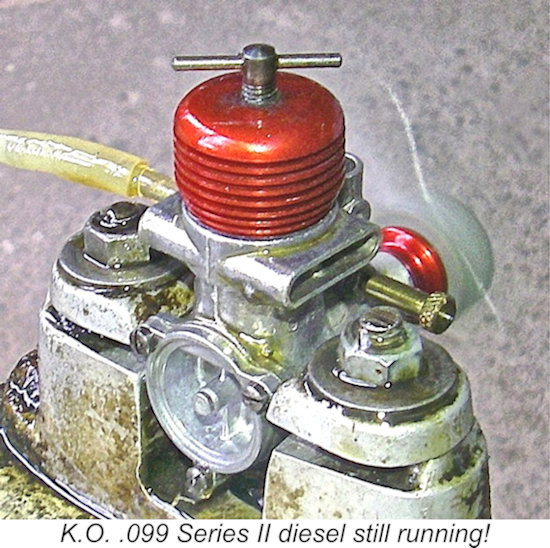
Bore and stroke of this model were 13.0 mm (0.5118 in.) and 12.2 mm (0.4803 in.) respectively for a calculated displacement of 1.62 cc (0.0988 cuin.). Weight was around 3.4 ounces (96 gm). Cited operating speed range was 9,000 – 14,000 RPM, with 6x4, 6x6 and 8x4 props being suggested for contest, C/L and sport applications respectively. The .099 diesel model was also caught up in the range-wide redesign which appears to have taken place in around 1960. In this instance, the changes were far more radical, although the twin stacks were retained. For one thing, the main casting was re-designed to allow it to accommodate a single I’m fortunate enough to have a fine boxed example of the resulting Series II version of this engine. Once again, a bench test appeared to be very much in order! The engine appeared to be more or less un-run, hence requiring a break-in period before any meaningful data could be extracted. However, despite its new condition it actually felt more or less perfect when turned over while mounted in the test stand. The single rear ball-race gave it a delightfully “free” feel.
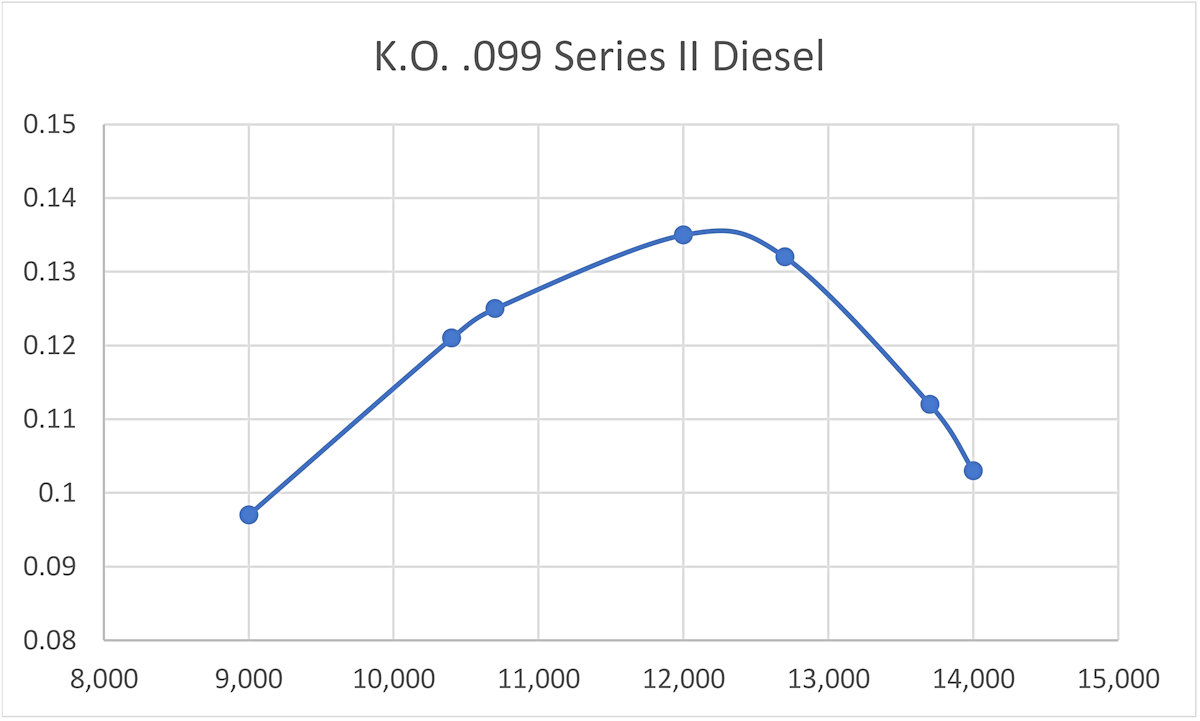
I put a total of around 30 minutes on the engine using an 8x4 APC airscrew, keeping the needle rich for the majority of the run but leaning out at the end to put the components through the full-range heat cycles which are so essential to a good break-in of an iron-and-steel piston/cylinder assembly. At the end of this, Accordingly, I began a series of test runs using what I considered to be a suitable range of test props. The fuel was my usual blend of 35/35/30 parts of ether/kerosene/castor oil, to which I added 1½% cetane booster. The continuing tightness of the contra piston made the establishment of the perfect setting very challenging, with a few “false starts” being recorded during which the engine had to be stopped in order to make a compression reduction when it went “hard” on me. Consequently, the figures that I measured almost certainly represent the least that the engine can do – with a more readily-adjustable compression control, I would expect that some of these figures might be bettered through the establishment of a more optimal setting. Moreover, the engine is still relatively new – I would expect a modest performance improvement to result from some additional running time. Setting the contra-piston issue aside, the engine proved to be an extremely smooth runner, never missing a beat at any of the speeds tested. Vibration levels remained quite modest throughout, while starting continued to be very easy. With a better-fitting contra-piston, the engine would have been a real pleasure to test! The following data were recorded.
As tested, this engine appeared to develop around 0.136 BHP @ 12,300 RPM. I’d rate this as a perfectly acceptable 1.5 cc sports diesel performance by late 1950 standards. With an eased-up contra-piston fit and a few hours of running time, I reckon that the engine would certainly develop over 0.140 BHP, probably at around 12,800 RPM. Together with the high quality of its construction (I see the too-tight contra-piston as an anomaly peculiar to this example, and one which would ease with use), it would have been a completely satisfactory sports diesel from the standpoint of a contemporary power modeller. It’s hardly surprising that a good few Asian modellers appear to have become customers, contributing to the engine's 10-year production life! The K.O. .15 Diesels
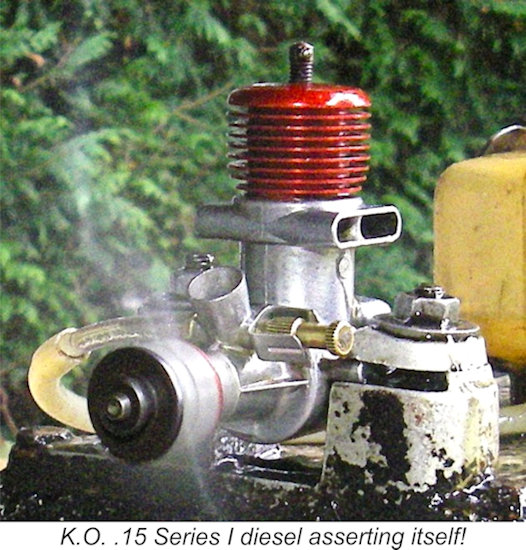
The various tables give this engine's bore and stroke as 15 mm (0.599 in.) and 14 mm (0.551 in.) respectively for a calculated displacement of 2.47 cc (0.151 cuin.). Weight of the original plain-bearing version was around 4.0 ounces (115 gm). The engine was said to be suitable for beam mounting only. Cited operating speed range was 9,000 – 14,000 RPM, with 9x4, 9x6 and 10x6 props being suggested for contest, C/L and sport applications respectively. These prop recommendations seem to me to be very much at odds with the suggested speed range, also being quite inappropriate for a short-stroke 2.5 cc FRV diesel. This view was amply supported by the results of a bench test, as we shall see below. Once again, the K.O. 15 diesel started out life as a twin-stack radially-ported plain bearing FRV diesel of basically conventional design. However, this version of the engine was subjected to a number of changes during its production run. The main crankshaft journal of the original models had been 8 mm in diameter, but it appears that either that shaft Initially, the plain bearing was retained, but at some later date a single ball bearing was added at the rear of the crankshaft. In addition, the forward-sloped intake venturi was truncated and augmented with a separate profile-matched insert, presumable to facilitate the fitting of an R/C throttle. The weight of this version of the engine crept up to a still-reasonable 5.04 ounces (143 gm). The final change came in around 1960, when the forward-sloping venturi This version of the engine was also released in water-cooled marine form, complete with flywheel. It seems likely that a similar option was available for the other models in the range, but I have no information which confirms that possibility. Once again, my possession of a fine example of the Series I model of this engine with rear ball race places me in a perfect position to subject it to a bench test. This particular example has seen some use in the hands of a careful owner, but shows little sign of this apart from a few small marks on the anodized cooling jacket.
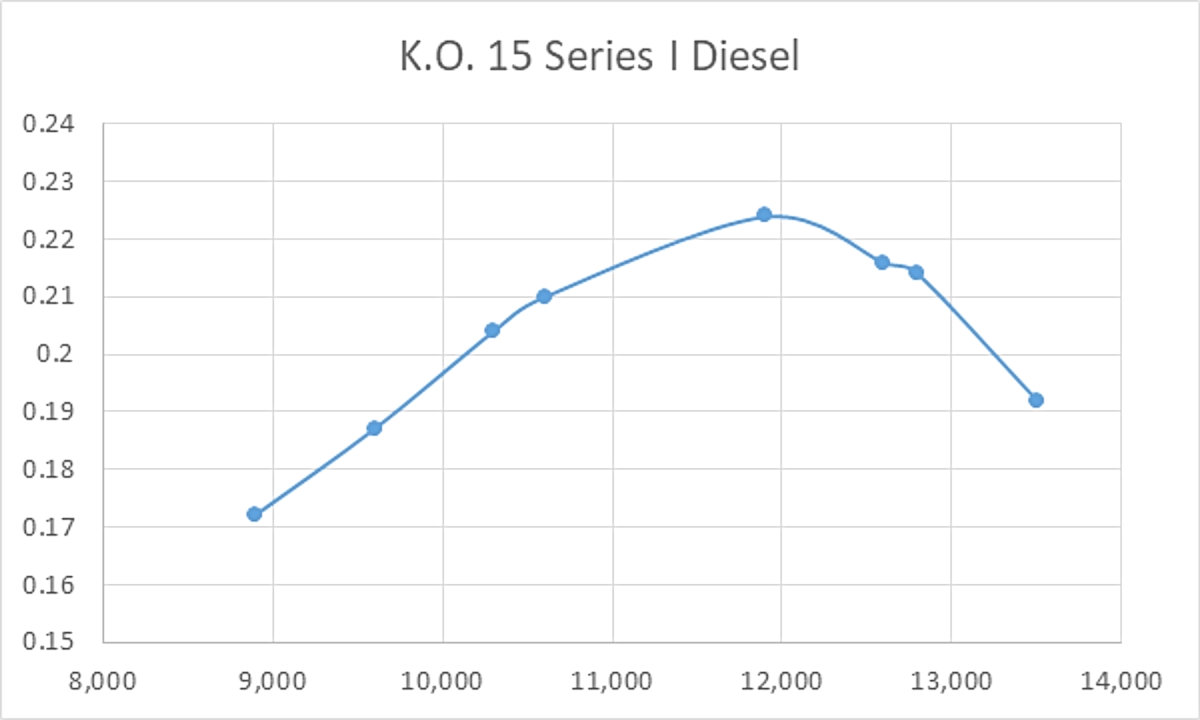
In the event, I wasn't at all disappointed. The engine proved to be just as easy a starter as its .099 relative had been, following the same pattern in requiring only a small port One thing that I did learn quite quickly was that the engine was unusually amenable to being operated at reduced speed using the comp screw and needle in concert. This characteristic would have been invaluable in making trim flights in a free flight model. The engine could be set to burble away quite happily at greatly reduced speeds. On the upside, the K.O. 15 diesel proved to be an extremely smooth runner, never missing a beat at any time and generating quite modest levels of vibration. However, it became apparent as I worked my way through the suite of test props that it was going to be a relatively modest performer in terms of power output. The following data were recorded.
As can be seen, the engine proved to develop some 0.225 BHP @ 12,000 RPM. Before we write the engine off as an also-ran in performance terms, we should recall that the Series I model tested is basically a 1954 design. At the time of its introduction, it would actually have been one of the better performers in the 2.5 cc sports diesel category, matching or beating some of the more highly regarded sports diesels of the day such as the FROG 250, the A-M 25, the Elfin 249 and the Webra 2.46. As such, it doubtless served as a very persuasive ambassador for diesel technology in South-East Asia. The K.O. .29 Diesel
Moving into the realm of speculation, as we are forced to do in this case, it would seem that this model must have enjoyed a very short production life. It is not mentioned at all in any of the previously-cited references apart from David Owen's few paragraphs, also not being covered in the generic instruction leaflet prepared by the manufacturers for the Series II K.O. diesel series. It seems possible to me that only a relatively small batch of these engines was produced purely to test the waters and that the feedback was insufficiently positive to encourage full series production on an ongoing basis. Regardless of the reason, this model appears to be the rarest K.O. diesel of them all - I've never so much as seen one! Conclusion
The K.O. diesel series can be summed up quite fairly as a well-made and notably lightweight range of sports diesels which exhibited excellent handling and performance characteristics by the standards of their day. My tests have shown that they had the potential to provide their owners with excellent service provided that performance expectations were held in check. The fact that they survived in production for ten years or so in a highly competitive market seems to me to demonstrate that they did just that! If the range had a failing, it was the seeming lack of attention paid by the manufacturer to updating the designs as time went by. As a result, the engines fell progressively further behind the times as the years went by - the 1960 upgrade was more cosmetic than functional. I suspect that the relative lack of attention to the improvement of the engines in performance terms was due to the manufacturers' ever-increasing focus upon the development and production of R/C equipment - the model engines were very much playing second fiddle. It appears that these engines were not marketed with any great fervor outside of the Japanese and possibly Asian markets. Had they reached other diesel-friendly market areas in quantity, they would doubtless have been well received, since they undoubtedly bore comparison with most of the well-regarded sports diesel produced in those areas. I would have been very happy to use one myself! As it is, examples of these engines seem to appear relatively infrequently on the world-wide model engine collectors’ market. Anyone managing to acquire one will find himself the owner of a relatively rare example of Japanese diesel manufacturing at its best. Kudos to the Kondo brothers for flying the diesel flag so effectively in the Asian marketplace! __________________________ Adrian C. Duncan, Coquitlam, British Columbia, Canada First published November 2026
|
||
 In an
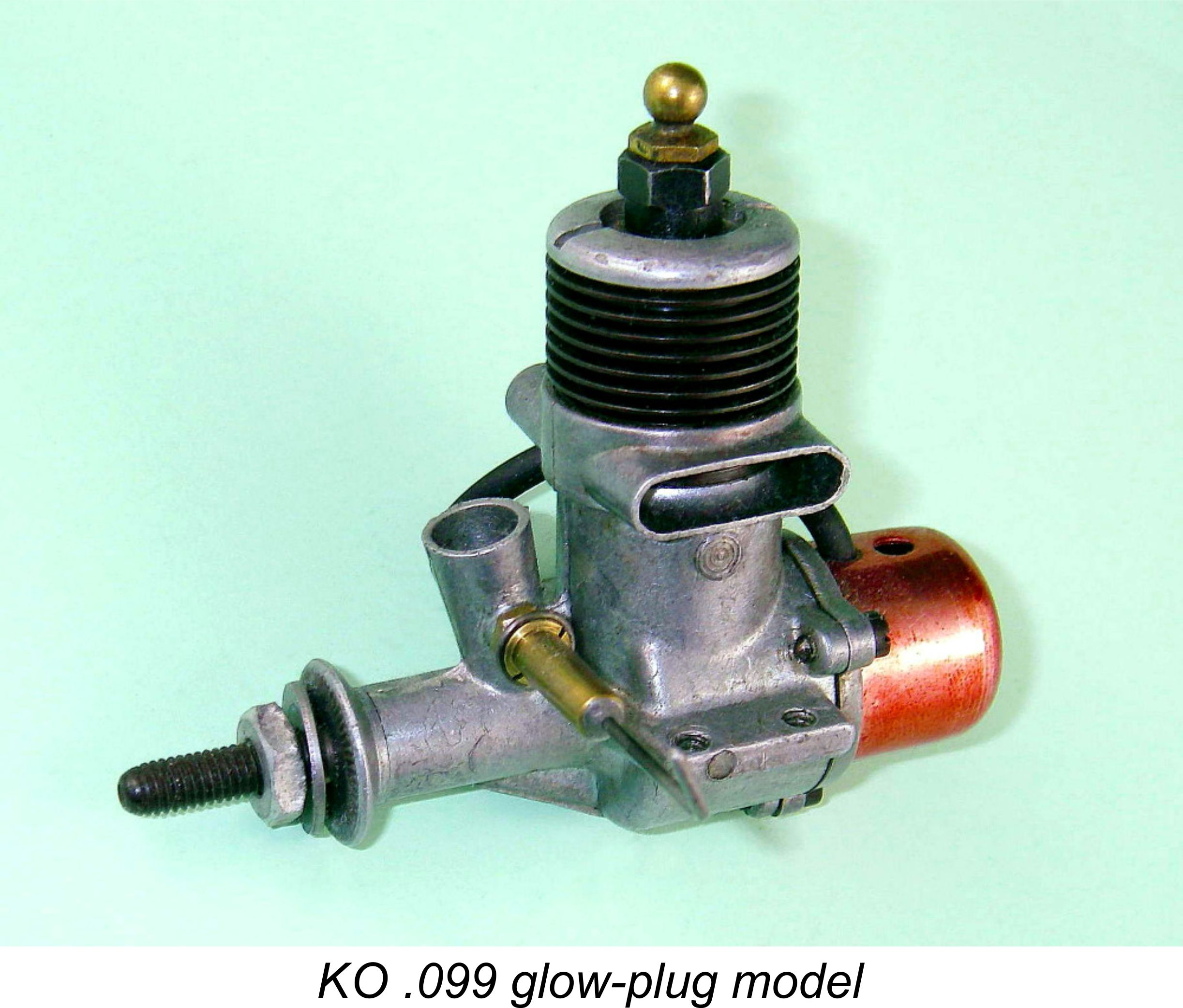 In my earlier article, I recounted the Kodo brothers’ early post-WW2 involvement in pioneering the commercial manufacture of R/C equipment and their role in establishing the annual Tokyo Hobby Shows which continue to this day. I also traced the company’s entry into the field of model engine manufacture through their production of glow-plug engines having displacements of .19, .29 and .60 cuin. during the late 1940’s and on up to the introduction of their neat little twin-stack .099 cuin. glow-plug model in 1952. This excellent little engine seems to have been very well received in the Asian marketplace.
 The motivation for the production of these diesels by a participant in a national model engine manufacturing industry which focused overwhelmingly on glow-plug models is open to speculation. A significant influence may have been the fact that competition in the diesel sphere was then thin on the ground in Japan.
 As a result, the sports diesel competition among Japanese makers was thin on the ground in 1955 – in fact, there was no commercial competition at all! This may have been perceived by the Kondo brothers as offering a market niche, which they attempted to exploit by releasing a series of capably-designed and well-made lightweight diesel engines in a wide range of displacements. They must have achieved a reasonable measure of success, because production of these engines continued well into the 1960’s with a steadily-developing series of well-made models in different displacements as well as several additional glow-plug designs. If the engines hadn’t been well received in the areas in which they were marketed, there’s no way that they would have remained in production for so long.

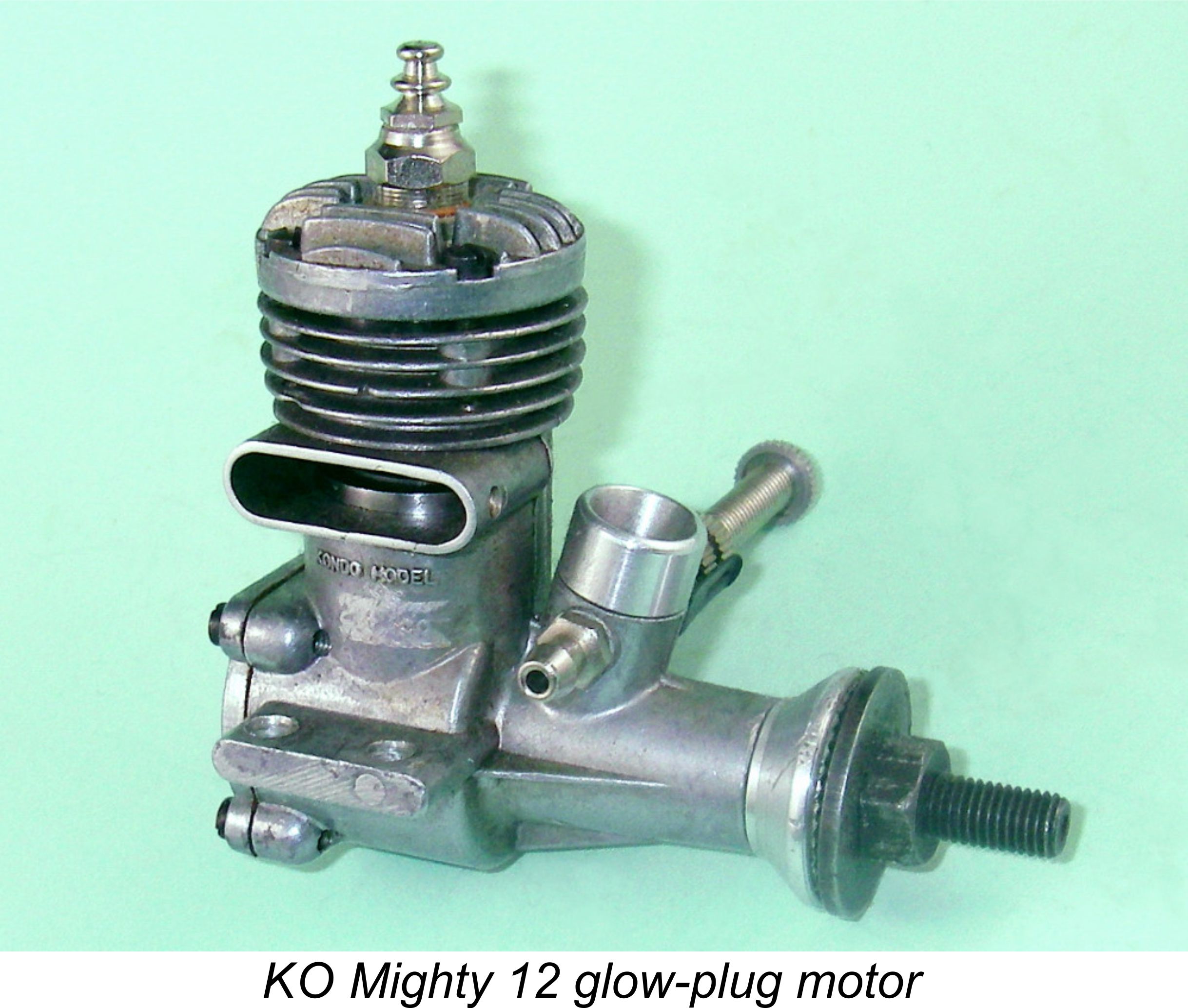 It was apparently at this point that production of the K.O. diesels ceased – there’s no record of the Kondo Model Company producing any diesel models. Instead, they manufactured the quaintly-named .12 cuin. and .15 cuin. K.O. “Mighty .12” and “Mighty .15” glow-plug motors in both control-line and R/C forms. These bore no design relationship whatever to the earlier diesels. Accordingly, the period covered in our review of the K.O. diesels ends in 1965.
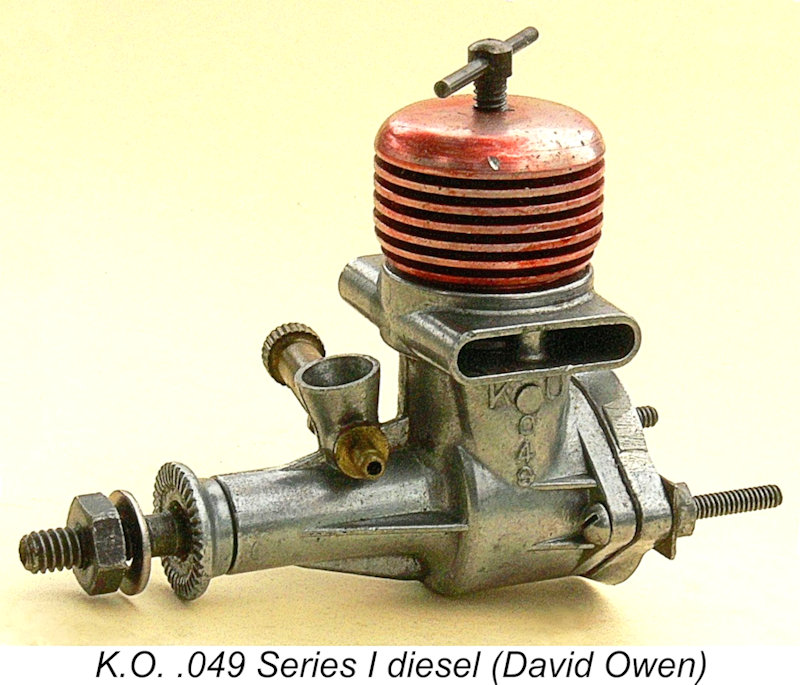 An .049 cuin. (0.81 cc) model appears to have been among the earliest diesels to appear under the K.O. banner, doing so in 1955 (or possibly 1954) in its Series I form. This original K.O. .049 diesel adhered to the plain bearing twin-stack crankshaft front rotary valve (FRV) design arrangement pioneered by the 1952 K.O. .099 glow-plug unit. Despite the twin stacks, the engine bore unmistakable signs of a strong degree of design influence from the
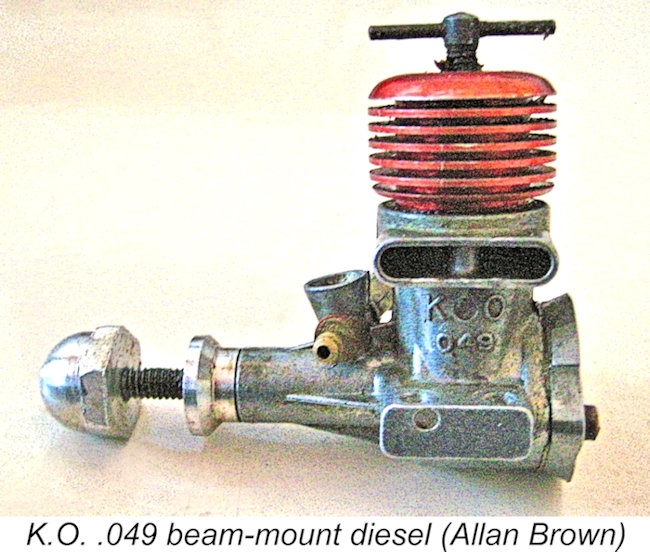 One rather strange feature of all the tables in which this model is included is the indication that the engine was strictly arranged for radial mounting. I say this because reader Allan Brown has supplied irrefutable photographic proof of the existence of a beam-mounted version of this engine. It would seem that two distinct dies were used during the casting of the crankcases – it’s presently unclear whether these were used sequentially or concurrently.
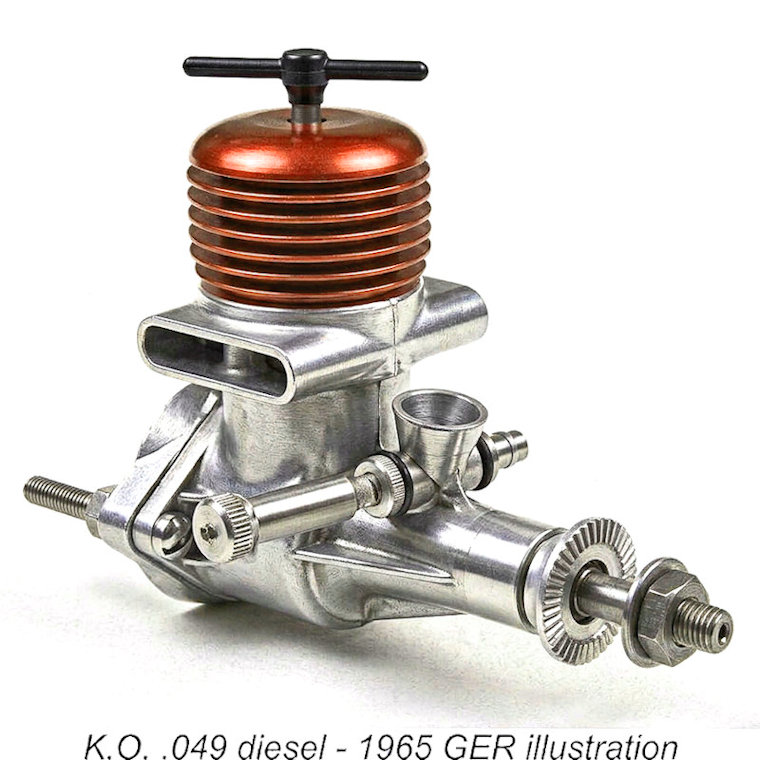 I have no definite knowledge of how long the original Series I twin-stack variant remined in production. All that I can say is that in around 1960 the K.O. diesel range underwent a collective design makeover. We’ll look at the higher-displacement models in their turn, but as far as the .049 diesel went, the major observable change was a change in the profile of the red-anodized cooling jacket, together with thinner cooling fins. The illustration of the K.O. .049 diesel which appeared in Peter Chinn's 1965 GER (compiled in 1964) showed this slightly revised version of the engine.
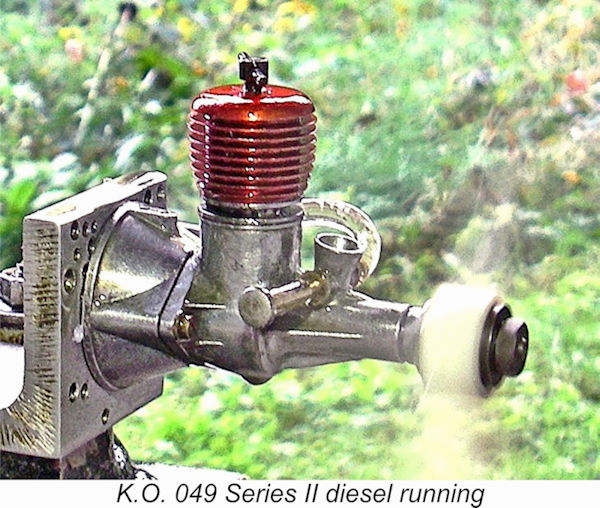 Since the engine had just been rebored by Dean Clarke, I decided to treat it as a new engine by giving it some running-in time. I chose a Tornado nylon 7x4 prop for this purpose, which turned out to be a good choice. The fuel was my usual 35/35/30 mix of kerosene, ether and castor oil, with 1½% cetane booster added. For convenience, I used the engine's tank mount as the fuel supply throughout.
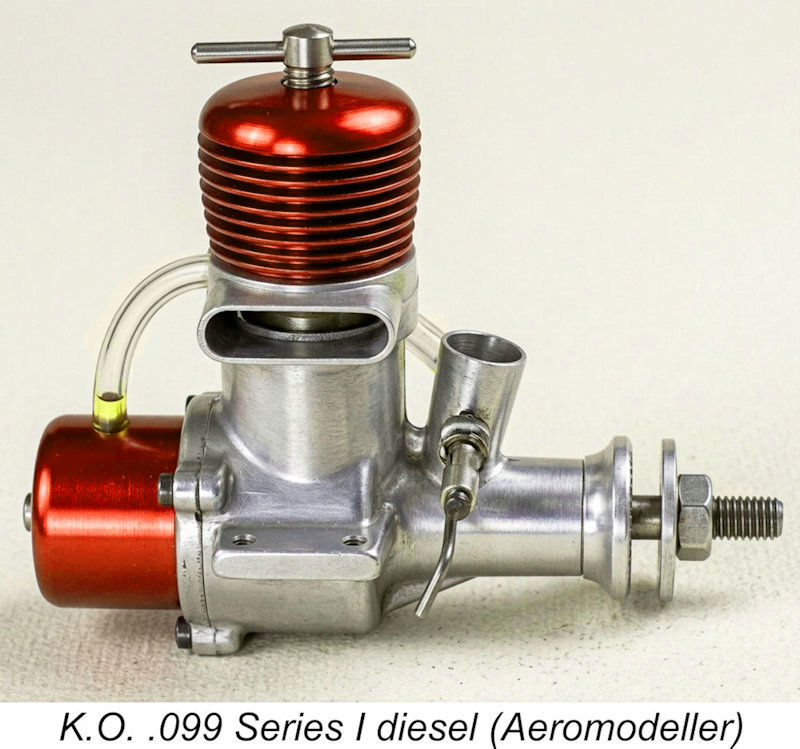 Like its .049 companion in the K.O. diesel range, the original Series I version of the .099 model seems to have appeared in 1955 or possibly late 1954. The accompanying enhanced image by Marcus Tidmarsh based on the April 1957 "Motor Mart" article in "Aeromodeller" shows that it was a plain-bearing twin-stack unit which generally followed the design of the .049 model apart from being arranged for beam mounting. In addition, it featured a four-bolt backplate with a small back-tank.
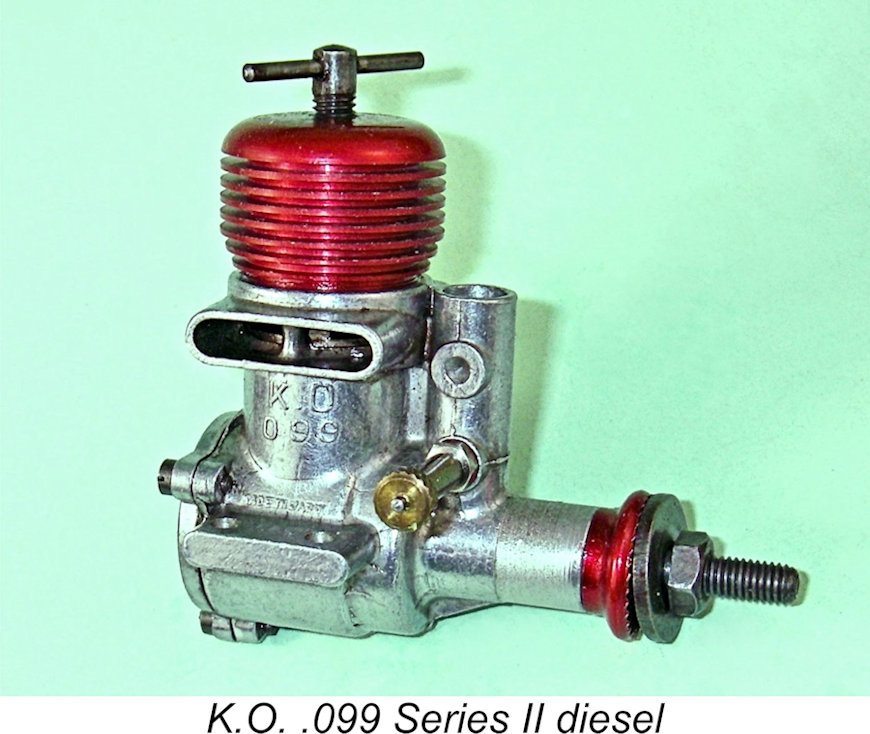 ball bearing at the rear end of the crankshaft, with a three-bolt backplate now being featured and the back tank omitted. In addition, the rising profile of R/C made its presence felt in the form of an extended vertical intake with provision for mounting two needle valves to provide for either fast (leaned-out) or reduced-speed (rich) operation – a very basic form of rudimentary throttle control.
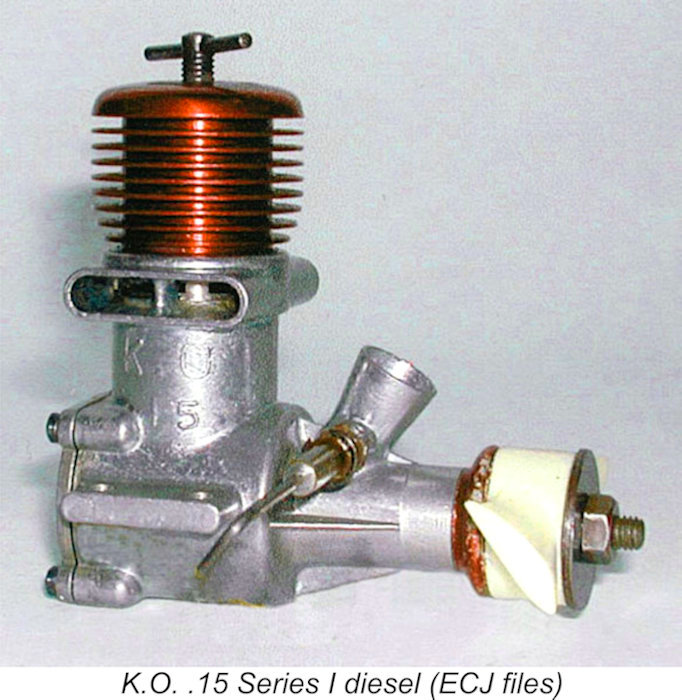 We now come at last to a displacement category for which some documentary evidence does exist! This is because the K.O. .15 cuin. (2.5 cc) diesels were included in the late Jim Dunkin’s monumental “
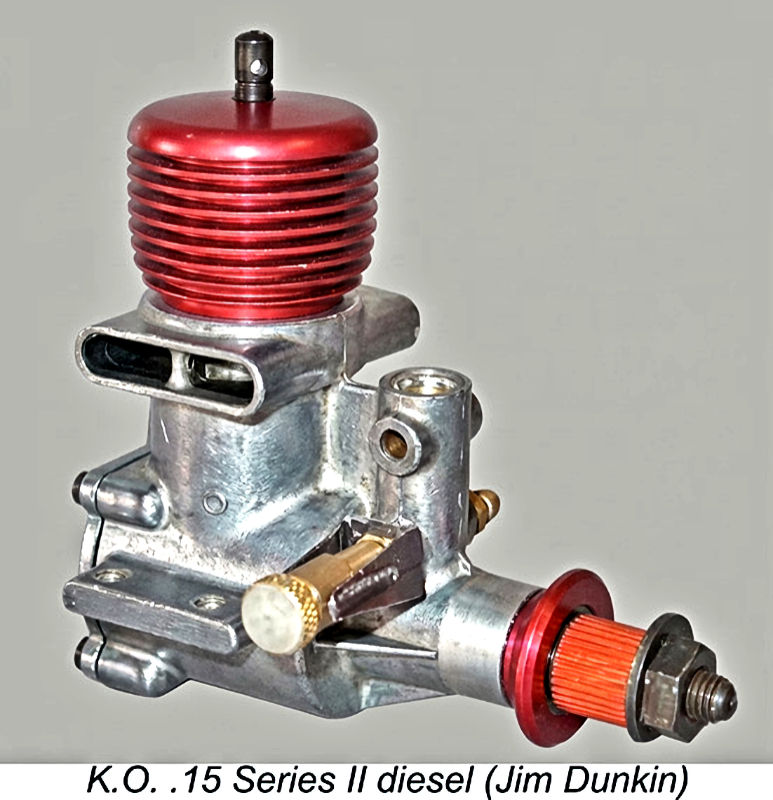 was found to be deficient in strength or that a larger internal gas passage was considered to be necessary from a performance standpoint. Regardless of the reason, the main journal diameter was increased at some point to 10 mm.
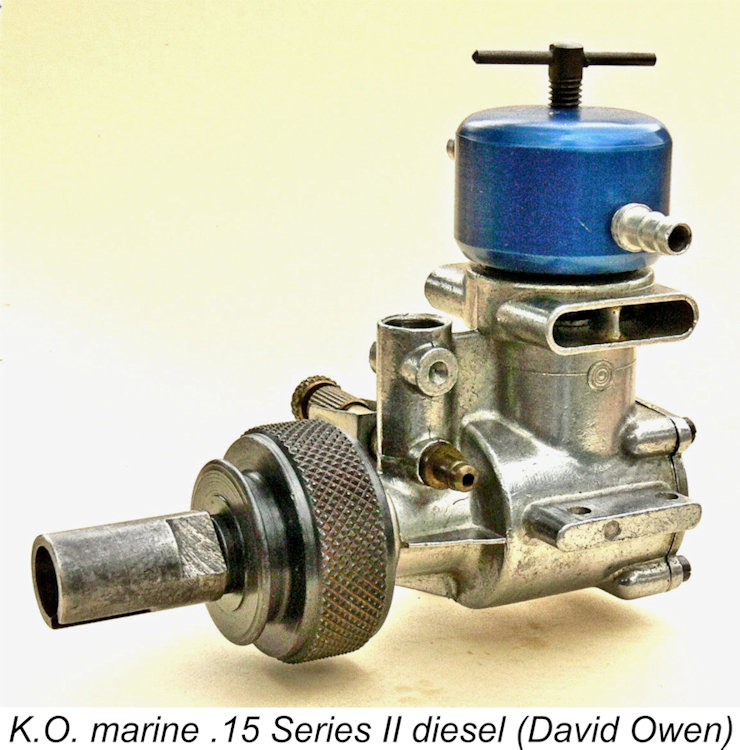
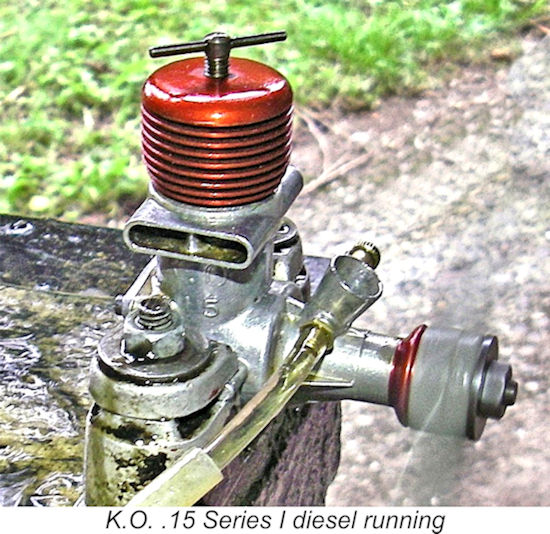 I set the engine up in the test stand with an APC 9x6 prop fitted to begin proceedings. The fuel was my standard 35/35/30 blend of ether, kerosene and castor oil, to which was added 1½% cetane booster. The engine had a delightfully "free" feel when turned over - I anticipated no problems with this one!
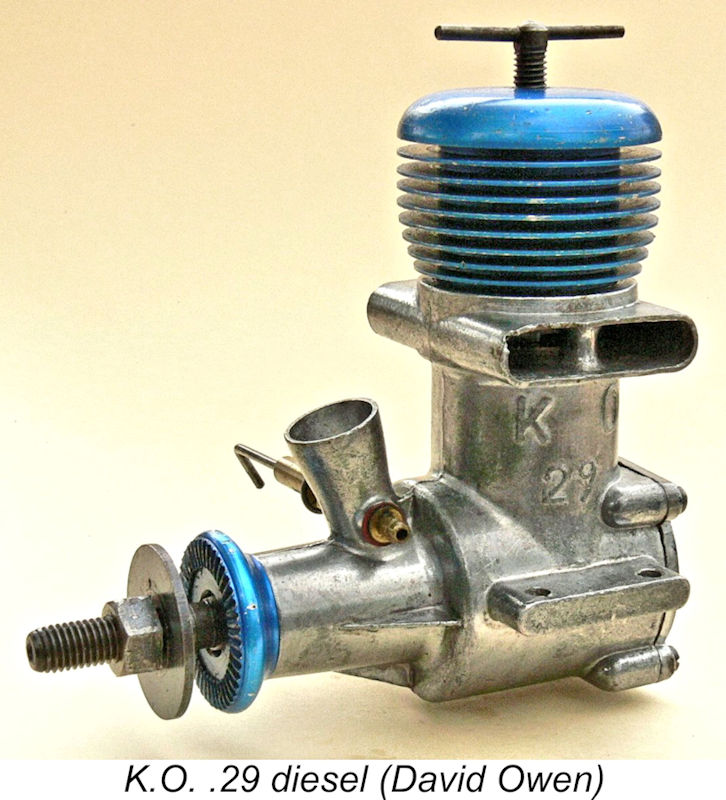 We now come to a model about which I have no personal knowledge whatsoever. I only became aware of its existence thanks to the fact that my late and much-missed Aussie mate David Owen had a very nice example and was kind enough to send me some photographs. Mike Clanford also included a photograph in his useful but often misleading
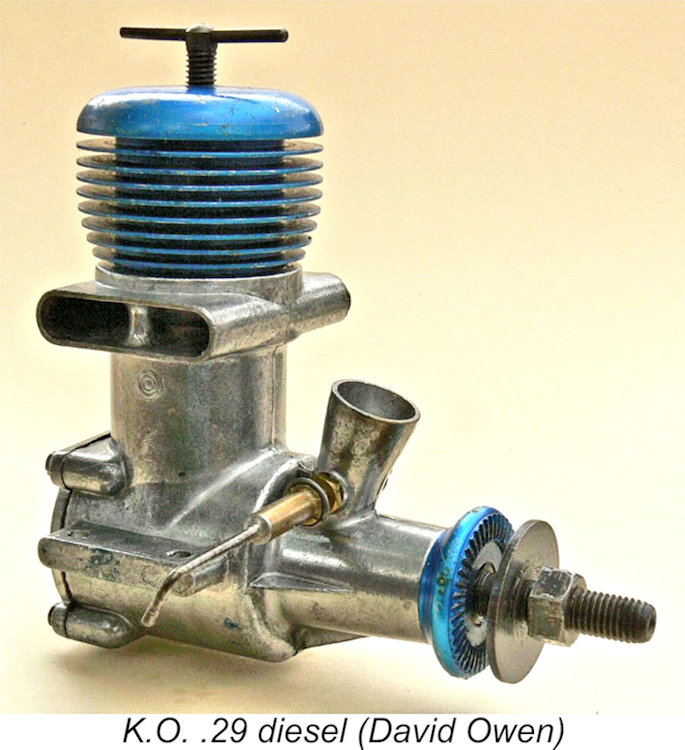 I’m unable to provide any structural data at all with regard to this model. All that can be said is that David’s photographs imply that it followed more or less identical design lines to the other Series I models in the range. Being a 5 cc diesel, it appears very likely to me that it featured the single ball bearing at the rear of the shaft that had been featured in the later .15 cuin. Series I offerings - the case appears to be designed to accommodate such a bearing. This would certainly have enhanced the engine’s starting and performance characteristics - large diesels tend to benefit more from such a feature than their smaller-displacement relatives, since it reduces their tendency towards “self-braking”.
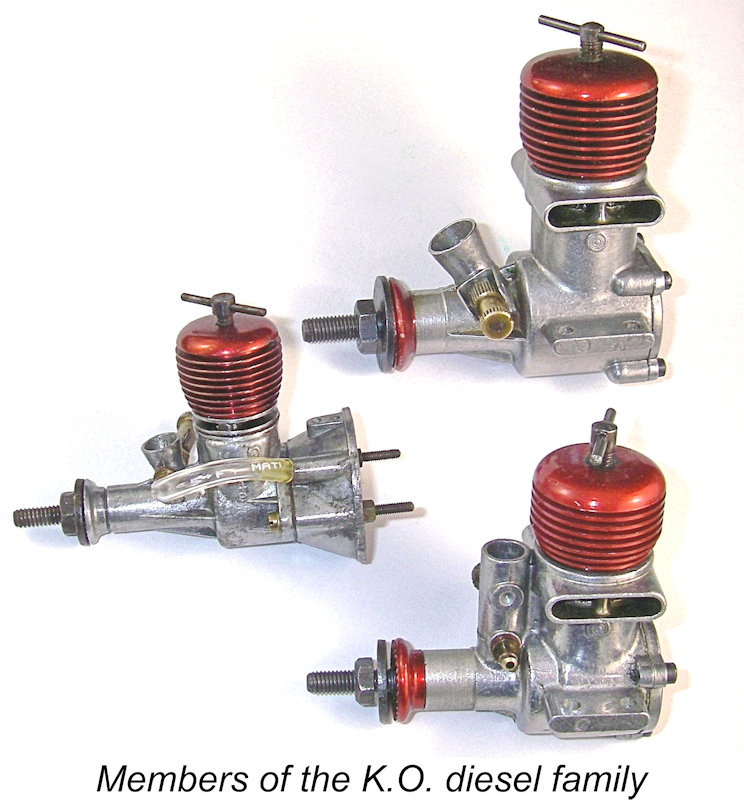 The above descriptions of the various engines in the K.O. diesel series are by no means fully comprehensive. All models were subjected to detail modification from time to time - for instance, at least three distinct needle valve styles have been seen. However, I hope that I've given you some idea of the range's qualities!
| |