|
|
Forgotten French Classics – the Cométe Engines By Adrian Duncan and Maris Dislers
In this endeavour, I’ve been greatly assisted by my good mate Maris Dislers, who contributed the section of this article which deals with the 1945 Cométe 5A diesel, including a test of that model. I'm also immensely grateful to my valued mate from the Netherlands, the massively talented model engine magician Peter Valicek, who painstakingly restored a fine example of the Cométe Monobloc 10 cc sparkie to permit its appearance here as a photographic and test subject. Without the help of these two friends, I couldn't have even attempted to write this article. Even with such outstanding assistance in undertaking this study, I must confess to feeling somewhat under-qualified for the task! I possess very little first-hand information regarding French model engines despite owning a number of examples from different manufacturers, now including the fine restored example of the 1943 Cométe Monobloc 10 cc model which will be discussed below. French engines were not imported into Britain in commercial quantities during the period when I was cutting my modelling teeth there, nor were French model powerplants the subject of much commentary in the contemporary English-language modelling media. Very few tests of French model engines ever appeared in British modelling magazines, while the various engine-related articles in those magazines rarely mentioned motors from La Belle France.
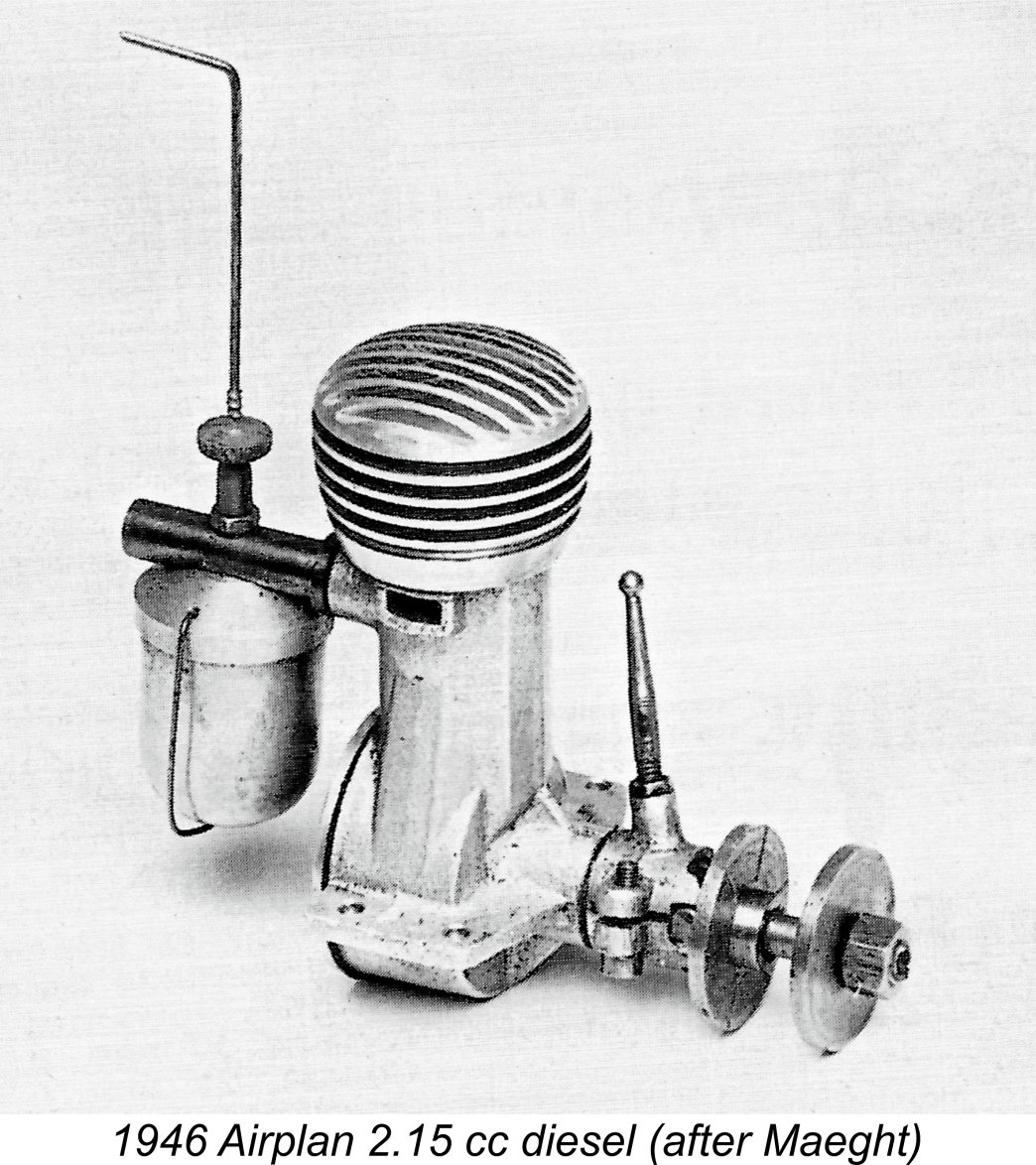
French manufacturers were particularly prominent in the early development of diesels from 1943 onwards. Many examples of these units found their way to other countries in the hands of servicemen returning home from service in France from mid-1944 onwards. The general excellence of these early French model diesels in particular was such that some of them exerted a strong influence upon British and American designers during the early post-war period. Notable examples included the Allouchéry 1.25 cc diesel (Mills 1.3), the Airplan 2.15 cc diesel (Airstar), the Micron 5AA (Drone and Owat) and the Jidé 1.7 cc model (Mite .099 diesel).
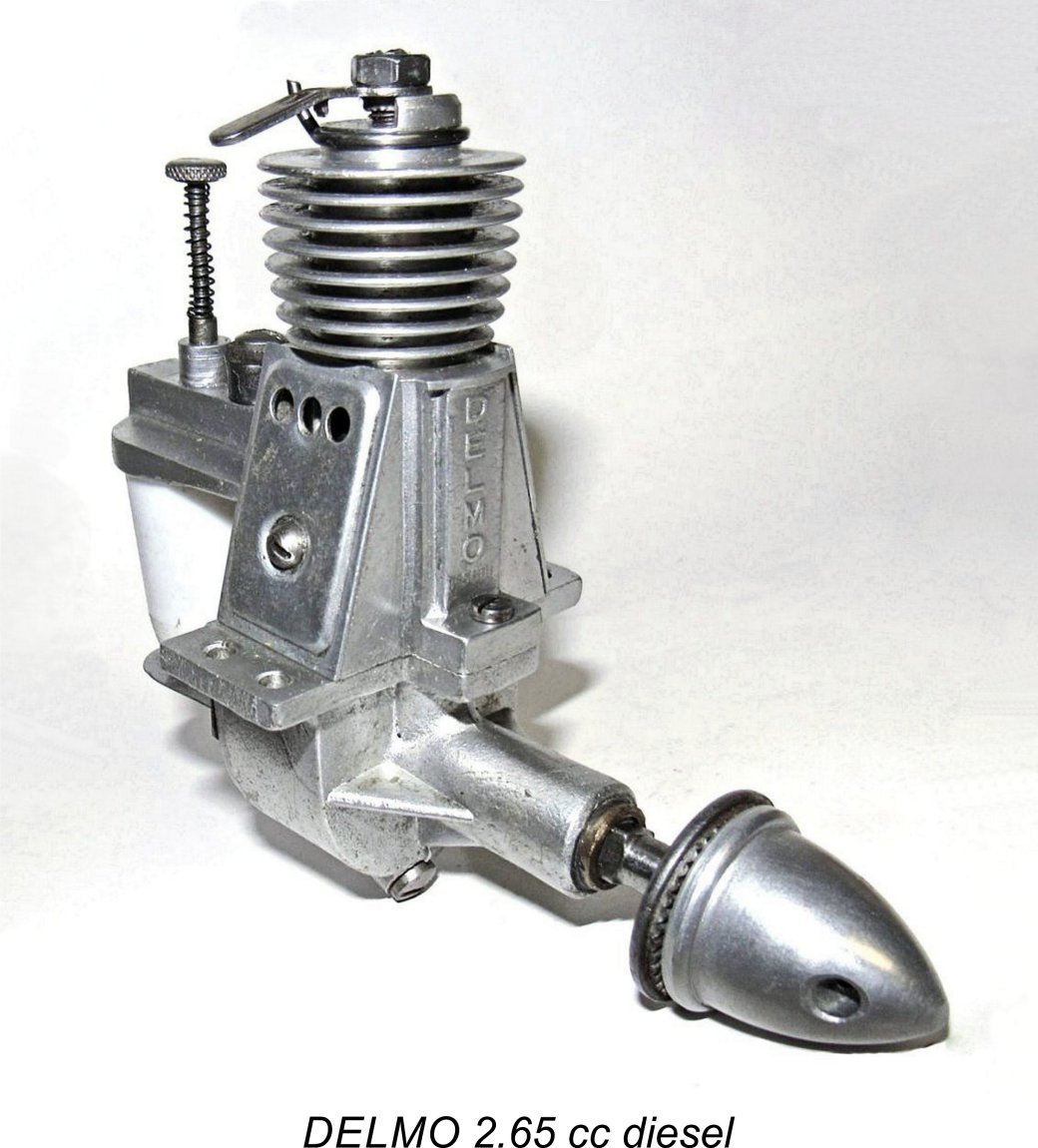
In large part, this mindset appears to have resulted from the fact that French model engine manufacturers tended to be small-scale artisan operations which lacked sufficient production capacity to supply both the domestic and international markets. Understandably, this led them to focus on the domestic market. In turn, lower production volumes coupled with a commitment to high quality resulted in elevated individual production costs and associated selling prices, further discouraging export efforts. Micron did make some such efforts during the early 1970's, but it was a case of too little, too late. That said, a few French engines did somehow manage to find their way into the hands of modellers in other countries. This was even true of some countries which then lay behind the formidable Iron Curtain of the Cold War era. My late and much-missed Hungarian friend and colleague Ferenc "Somi" Somogyi informed me that a number of French engines from makers such as Micron, DELMO and R.E.A. showed up in Hungary during the period 1949 - 1952, being in fact the first quality engines from the West to see service in that country. A number of examples of the Micron 5 cc fixed-compression diesel also ended up in the USA through various channels, serving as the major design influence for the famous Drone diesel of 1947.
Like every other model engine reference work of my personal acquaintance, Maeght's book is by no means free from error. This includes the entries relating to the Cométe series – the 10 cc models are incorrectly dated. Even so, no-one having even a peripheral interest in the fascinating history of model engine development and manufacture in general, and in France in particular, can afford to be without a copy. Although now long out of print, the book remained readily available for years both through Amazon France and eBay France, which is how I obtained my copy. A check confirmed that the book was still available from both sources as of mid-2016. However, it wasn't cheap – typically you’d pay somewhere around 80 euros (US$90.00) for a clean copy. Well worth it, though – what price knowledge?? There’s no other comparable publication. In a very real sense, this is the French equivalent of the late Tim Dannels’ invaluable “American Model Engine Encyclopedia” - I can pay it no higher compliment. I'm unable to comment on the book's continued availability as of 2026. I freely acknowledge having drawn extensively on this outstanding work when carrying out the research for this and other articles on French engines. I have also used a number of illustrations from the book, all of which are acknowledged in the captions. My very sincere thanks to Adrien Maeght and his colleagues!
I have frequently consulted Michel’s outstanding work during the preparation of various articles on French model engines, including this one. I have also periodically used images extracted from the forum, with Michel’s kind permission. A visit is highly recommended! Michel’s comments on the Cométe range are most informative. Now, before we dive into the details of the Cométe engines, it’s well worth spending a little time reviewing the hitherto poorly-documented history of model engine development in France leading up to the WW2 years. Accordingly, let’s begin at the beginning …………… Background
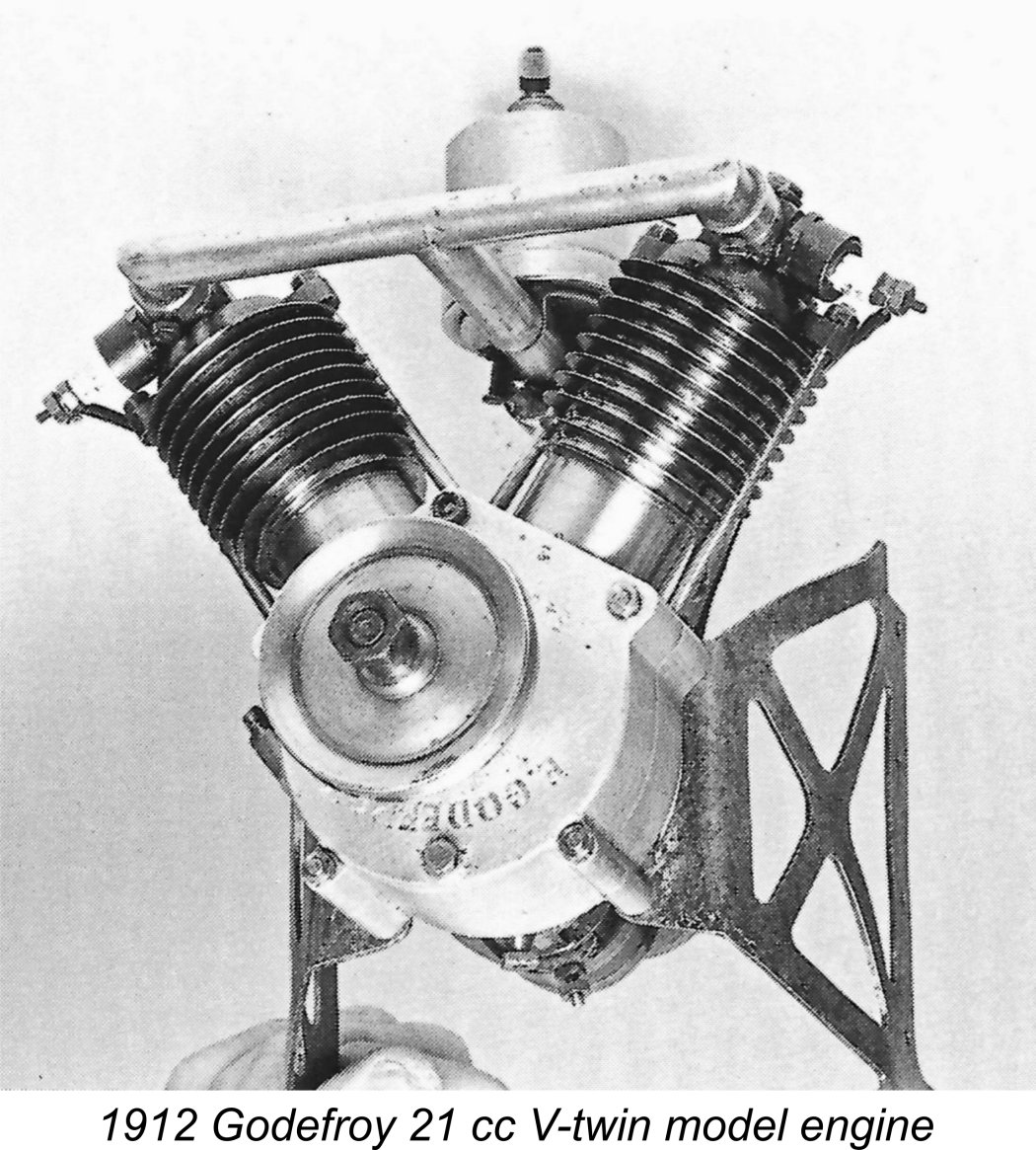
Perhaps the earliest French manufacturer of a truly legitimate model aero engine was the old-established firm of Radiguet & Massiot, who had established their reputation by making highly-regarded model steam engines. In 1911 they introduced an opposed twin-cylinder two-stroke engine of 16 cc displacement. This unit was specifically intended for model aircraft use.
At this stage, French model engine designers were clearly well ahead of their competitors in most other countries. However, there was an ominously dark storm cloud looming on the horizon in the form of World War 1, a tragic and (in hindsight) completely unnecessary conflict which engulfed Europe in general and France in particular beginning on July 28th, 1914 and dragging on until A very few model engines were made in France by talented amateur enthusiasts during the 1920’s, but for the most part these were model boat powerplants. Power aeromodelling stagnated throughout much of this period. It was not until 1930 that the commercial manufacture of model aero engines resumed in France, with both Rebous and Fameaux commencing the commercial production of model aero engines on a relatively small scale. The French power aeromodelling movement began to make a slow recovery from that point onwards.
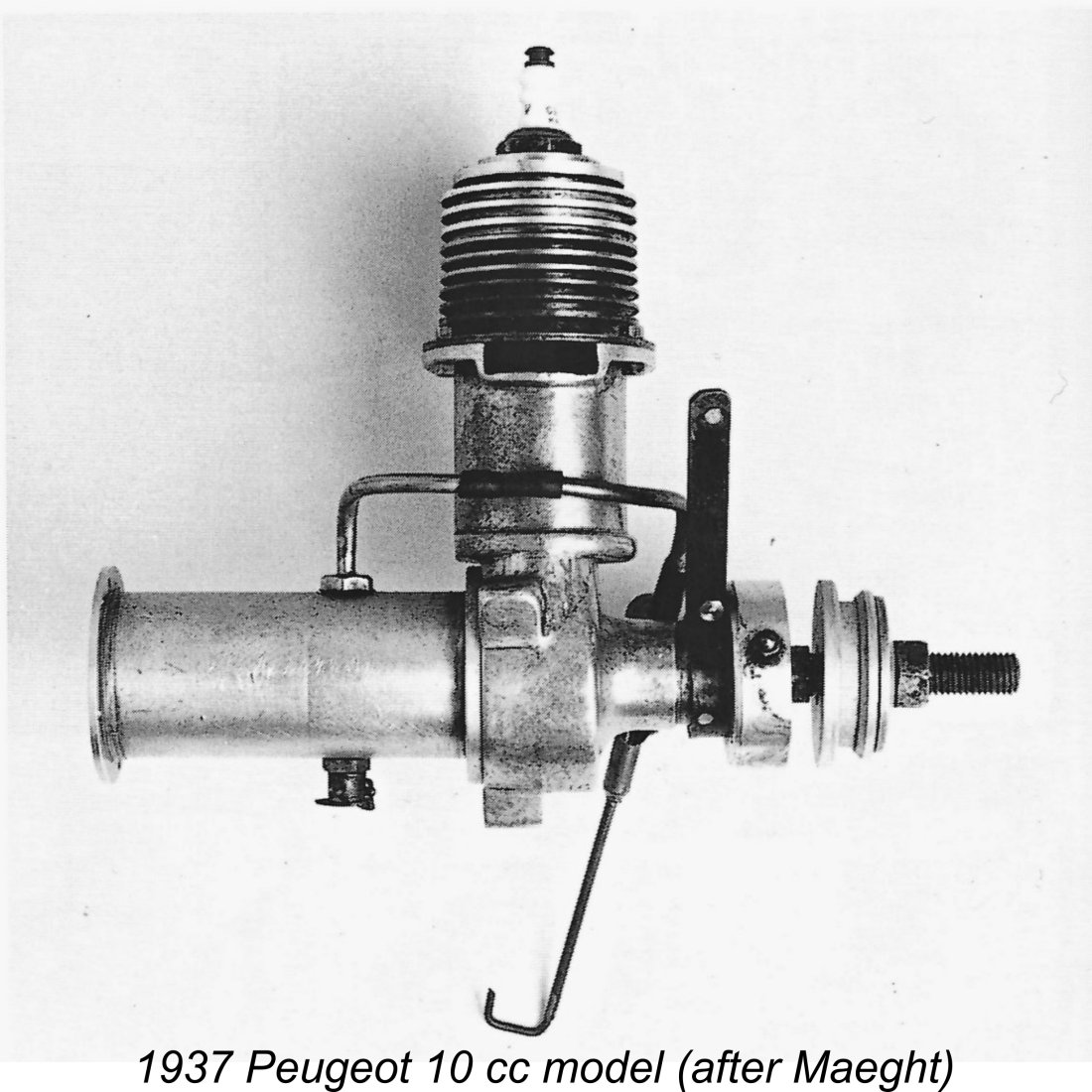
The Popular Front was an alliance of left-wing movements which included the French Communist Party, the French section of the Workers’ International (SFIO) and the French Radical-Socialist Party. A similar coalition called the Frente Popular had won office in Spain in February 1936, and now the French followed suit. The Popular Front won the May 1936 French Legislative Election, resulting in the formation of a government initially headed by SFIO leader Léon Blum and composed exclusively of Radical-Socialist and SFIO ministers. Blum's government implemented a range of social reforms. Among these was the adoption of a policy of “democratization” of all forms of motorized sport, including power aeromodelling. Hitherto these activities had been viewed by government as the exclusive purview of the wealthy and aristocratic members of society, To take just one example, a model flying club was started by employees of the Peugeot automobile factory, which went so far as to manufacture about 100 examples of a fine 10 cc model petrol (gasoline) engine for the use of those employees. This engine was designed by Peugeot engineers at their Issy-les-Moulineaux factory and constructed during 1937-38 by the company’s apprentice mechanics at the Peugeot training facility in Sochaux as part of their training. These engines were very well-made and extremely successful. Indeed, on November 20th, 1938, one of these units established an early free flight World Duration Record for model aircraft weighing over 5 kg, achieving a flight of over 1 hour’s duration. Another French industrial organization which followed a similar pathway was the Train company, whose main business was the supply of full-scale motorcycle engines under contract to others. In 1937-38, encouraged by the rising popularity of power aeromodelling in France, they manufactured a small number of 3 cc engines for aeromodelling use. As with Peugeot, these engines were constructed by the firm’s trainee machinists to give them valuable precision machining experience. Naturally, the rising interest in power aeromodelling provided an incentive for others to get in on the act. The Rebous company had somehow managed to survive through the 1930’s, and now they felt able to expand their activities, introducing a new 7 cc model in 1937. They were joined by the Terrot company with their 5 cc model in the same year.
Thus by the end of 1938 there were no fewer than ten firms engaged in the commercial manufacture of model engines in France. Even at this early stage, this was a highly competitive business in which both performance and quality would count when it came to generating sales. However, as 1939 drew on, Europe edged steadily closer to war. This came to a head in early September of that year with the declaration of war with Germany by Great Britain and France. This unhappy event naturally applied the brakes to model engine development and manufacture in France, although some examples continued to be made for a while. History tells us that following the “phony war” which lasted for some eight months from September 1939 until May 1940, France was quickly overwhelmed by the German blitzkrieg. Following the armistice signed in June 1940 between France and Germany, there was an understandable hiatus in model engine manufacture in France, with only Maurice Rebous continuing to produce very limited numbers of engines. This situation was due in part to the very tight control exercised initially by the occupying Power over the French population in the occupied zone in which Paris was located. Access to former model flying areas and airfields was limited or restricted, while the economy floundered under the pressures arising from the situation.
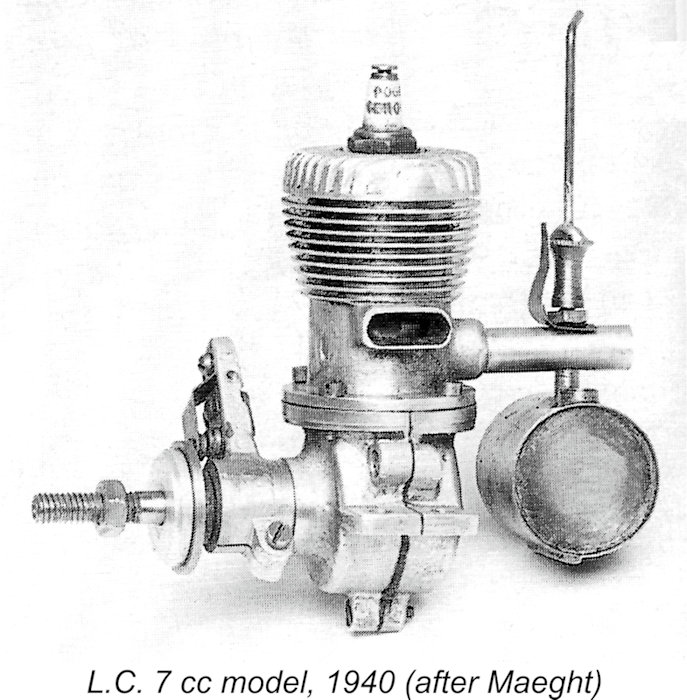
New manufacturers slowly emerged to meet this renewed demand, while a few previously-established makers resumed some level of production. However, the prevailing shortages of such commodities as fuel and construction materials dictated that the come-back trend focused for the most part upon smaller engines. Apart from L.C., which introduced a 7 cc model at the end of 1940 (its development had essentially been completed pre-war in 1939), the first half of 1941 saw the appearances of the STAB 2.27 cc, Polymécanique I.D.I. 2 cc, L.C. 2.4 cc, and Rebous 2 cc offerings.
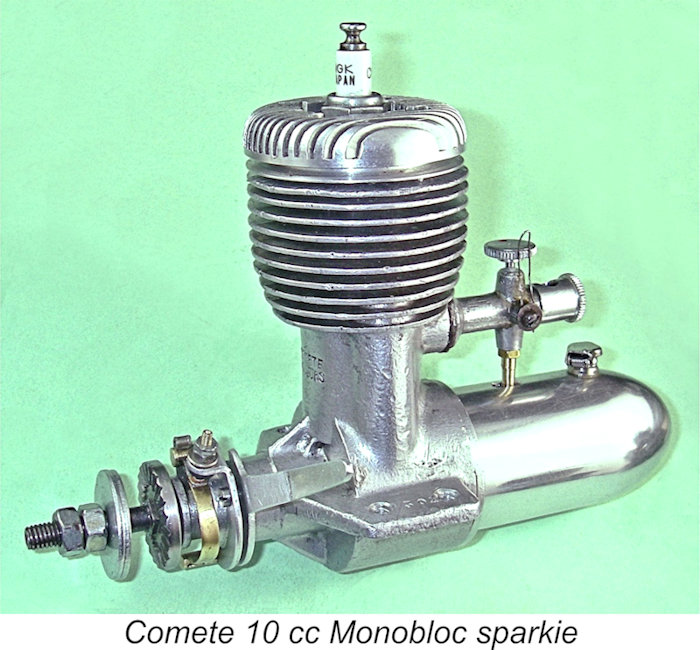
These larger engines were sufficiently well received to encourage the mid-1943 introduction of the first member of the Cométe series. This was a 10 cc sideport sparkie called the Cométe Monobloc which bore a probably more than coincidental resemblance to the L.B. 10 cc engine which had been introduced in 1942. It seems very likely that the production of this engine was entrusted to L. Bourgeonnier, the designer of the L.B. engines. The Cométe’s stamped aluminum fuel tank was identical to that of the L.B. "Competition" model that Bourgeonnier produced, appearing in fact to be the same component.
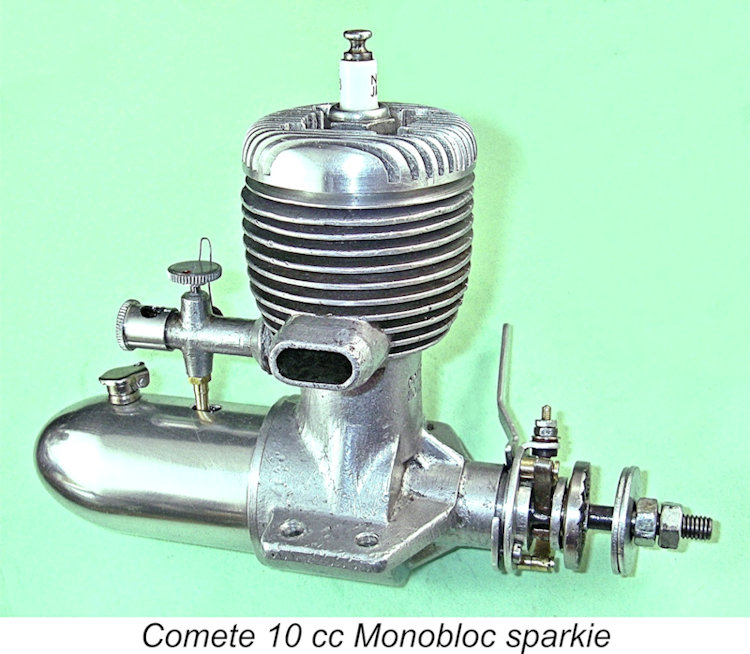
The Cométe Monobloc 10 featured bore and stroke measurements of 22.5 mm and 25 mm respectively for a nominal displacement of 9.94 cc. It weighed 410 gm (14.46 ounces) complete with plug and tank but minus the essential spark ignition support system (typically around 4 ounces at the time). The high domed piston was machined from an aluminum alloy casting and was fitted with two rings. The steel cylinder liner was equipped with bridged transfer and exhaust ports to prevent ring snag. The hardened steel crankshaft ran in a phosphor bronze bushing which was embedded in the crankcase during casting. One point which is well worth noting in case any other owner feels the urge to try a test run or two is the fact that the crankpin is of the screw-in type to facilitate assembly. The crankpin on my example of this model has a right-hand thread, which means that the engine should be operated strictly in the clockwise direction viewed from the front – the opposite of the normal direction. Otherwise, running torque on the crankpin could cause it to unscrew, with disastrous results. It's possible that other examples featured left-hand threaded crankpins to allow running in the opposite direction - there's no data to support further commentary. I'd recommend that anyone contemplating a run with one of these engines first confirm the orientation of the crankpin thread.
Induction was handled by a screw-in cast alloy intake tube which was fitted with a rotary air restrictor at its intake end – useful for adjusting engine speeds during initial flight testing. The needle valve and fuel pickup tube were mounted in integrally-cast bosses at top and bottom of the intake tube respectively. The manufacturers claimed that a maximum power output of 0.20 BHP was achieved at 6,000 RPM during testing. This may not sound like much for an engine of this displacement and weight, but this was 1943 after all! In whatever configuration, the engine apparently sold well enough to encourage some level of production throughout the balance of 1943 and down to mid-1944. The factory engines all appear to have borne serial numbers - my illustrated example of the engine bears the serial number 302 stamped onto the top of the left-hand mounting lug, implying that at least that many examples may have been made depending on where the sequence started. However, the resumption of fighting on French soil in June 1944 following the D-Day landings caused production to cease as Paris became affected by German military defensive preparations.
JESCO had previously offered flying model plans and construction kits under the STAR MODELES trade-name. The addition of the Cométe model engine line represented a significant expansion of their involvement in the model trade. They officially registered the "La Cométe" trademark in the "engines and scale models" registration category. JESCO appears to have begun by resuming production of the 1943 Cométe Monobloc 10 cc model. They subsequently released a new 5.09 cc spark ignition model, the Cométe 5A, soon after taking over the Cométe line.
This unit displayed several unique features. For one thing, it was air-cooled, with the cooling airstream being Very few of these units were constructed and sold. Consequently, they are extremely rare today, and collectors of model marine engines know it! A seemingly mint example sold on eBay in early 2026 for no less than US$1200! Another example was offered recently at a starting bid price of US$900. However, the aero version of the old Cométe Monobloc was clearly a somewhat lacklustre performer by emerging standards. In the spring of 1945, faced with the arrival of the R.E.A. 10 cc model, it was decided that the engine needed some improving if it was to compete in the marketplace. The result of such deliberations was the mid-1945 appearance of the second variant of the Cométe 10. The major change was in the induction system, which was switched from sideport to a crankshaft front rotary valve (FRV) arrangement. Interestingly The induction arrangements were a bit unusual, reminiscent of the setup featured on the earlier Cannon engines from America. The intake tube entered the main bearing housing horizontally from the left, resulting in the needle valve being positioned in a vertical orientation on that side, just in front of the cylinder. This arrangement had of course been featured in the design of the Cométe 5A sparkie.
The first examples of the revised model were ready at the end of spring, and introductory advertisements appeared simultaneously in MRA magazine, issue no. 79, in June, and in “L'Air pour les Jeunes” magazine, issue no. 106, in the same month. However, JESCO’s attention was now becoming increasingly drawn towards a rapidly-emerging model engine technology – compression ignition (a.k.a. “diesel"). This technology had actually been under development by French designers for some time. According to Michel Rosanoff, the model diesel concept was first unveiled in France on July 26, 1942 by two Parisian residents, Pierre Meunier and M. Rietti. They demonstrated an example of the 2 cc Swiss Dyno 1 diesel in front of an audience of model enthusiasts and journalists from the modelling community and the hobby media. A number of French model engine designers were witnesses to this event, which immediately got them thinking about developing diesel models of their own. Although it undoubtedly inhibited production volumes, the ongoing German occupation did not prevent model diesel manufacture in France from beginning to take off in 1943. Apart from André Gladieux with his Micron 5 cc and 10 cc designs, a host of other French model diesel designs appeared more or less simultaneously during that year. These included offerings from Allouchéry, Fulgur, Jide, Marquet, Morin and STAB. For context, it's important to remember that this was three years prior to the appearance of the first British commercially-manufactured diesels.
Naturally, JESCO were well aware of the growing interest in diesels. They continued to advertise the FRV Cométe 10 model until November of 1945, but at that point the 10 cc sparkie disappeared from the advertising, to be replaced by a completely new offering – the Cométe 5A diesel of 5.09 cc displacement. But that’s another story, to be recounted below in its place by Maris Dislers. However, before turning the pen over to Maris, I should conclude my evaluation of the Cométe 10 cc sparkies by reporting on the results of my own limited testing of a fine example of the original sideport Monobloc model. This engine was superbly restored for me by my valued and amazingly talented mate Peter Valicek of the Netherlands. Can’t let that amount of skilled work go to waste! The Cométe Monobloc 10 cc Sparkie on Test The example of the Cométe Monobloc sparkie which is available for testing came to me from my valued mate Peter Valicek following a complete restoration. It bears the serial number 302. As received by Peter from a source in Poland (these old engines do get around!), it was in very sad shape indeed, being both incomplete and totally clapped out! However, the main casting remained in excellent condition. That's always a good start from a restoration standpoint! Peter had to practically re-manufacture the engine from the ground up, making replacements for the head, piston, rings, rod, main bearing bushing, crankshaft and tank. In addition, he had to make a complete replica timer. All this took an inordinate amount of Peter's time, but the result was well worth it - I received a fine example of this very rare engine which is probably in better-than-new condition! My mate Peter is an amazingly talented craftsman!
With this issue sorted, Peter reported that the Cométe started quite easily with the needle set at around ¾ of a turn and the air intake restrictor fully open. He provided a hefty APC 11x6 pusher prop which he felt suited the engine well (it runs clockwise viewed from the front, remember!), although it seemed to me to be a somewhat smaller prop than might be ideal for such a large slow-revving engine. Peter's one cautionary comment was the observation that the engine felt a bit "draggy" when hot, possibly indicating that the alloy piston was still a little tighter than ideal. He recommended some more running-in time on an oily fuel before operating the engine flat out. Advice like that from the builder is not to be ignored! I set the engine up in the test stand with an APC 14x6 pusher airscrew fitted to provide more flywheel effect. The engine felt really good when flicked over (even in reverse!), with an outstanding compression seal being provided by the two rings despite the probability that they were still far from being fully bedded in. A function check on the timer found everything working perfectly, so I set the timer to open the points (triggering the spark) at around 10° BTDC and hooked up my ever-dependable Larry Davidson SSIGNCO ignition support system. I then filled the tank with a 70/30 mix of white gas and SAE 60 mineral oil, opened the needle ¾ turn as recommended by Peter, administered two choked flicks, donned my industrial-grade earmuffs, switched on the ignition and got stuck in.
I quickly found that the engine was unusually sensitive to the amount of fuel in the cylinder - too much or too little, and it wouldn't even fire. It took some determined flicking to get it to the point at which firing commenced. Once that happened, starting was quite prompt provided that the needle setting was somewhere near correct. Once running, the engine maintained a steady speed in a rich and retarded four-stroke running mode as required for running-in. Like Peter before me, I found that the engine became quite "draggy" when hot - this drag was very noticeable when the engine was turned over by hand immediately after a run while still hot. There was no indication of an incipient seizure - this felt to me like ring drag, as if the rings were closing their gaps when hot and expanding to become tight in the bore. However, after the engine had been allowed to cool completely, happiness was restored - the engine turned over very smoothly once more, with the rings providing an excellent compression seal. I put three or four tankfuls of fuel through the engine, finding that this additional running had little if any detectable effect upon the high-temperature drag. It would clearly take quite a lengthy running-in period to ease this problem, something which I was reluctant to put into effect given the noise levels to which the Cométe was subjecting my quiet residential neighbourhood. Neighbourly forbearance can only be pushed so far ............the engine's delightfully throaty exhaust note was music to my (muffled) ears, but most of my neighbours would doubtless disagree!
Just for fun, I then switched to the APC 11x6 pusher prop which Peter had used for his testing. The engine started just as readily on this far lighter load, but a very brief leaned-out run only yielded a speed of 6,500 RPM, implying an output of around 0.156 BHP. This pretty much confirmed that the peak lay somewhere between 5,100 and 6,500 RPM. I'd hazard a guess that in its present state the engine is probably good for a peak output of around 0.170 BHP @ 5,900 RPM. It would doubtless do better than this if given further running-in to relieve the hot tightness issue. Overall, the manufacturer's performance claim appears to be quite credible for a well run-in example of the engine. As matters stand, that's about all that I can say about this engine's operational characteristics. If I ever manage to find an opportunity to give the engine the lengthy running-in time which it clearly needs, I'll re-assess its performance and add any relevant data to this article. Now, having dealt with the Cométe 10 cc sparkies to the extent possible, I'm done! It’s time to turn the pen over to Maris Dislers for an up-close and personal look at the model which supplanted the 10 cc models – the Cométe 5A diesel. Take it away, mate! The Cométe 5A Diesel - by Maris Dislers
First-generation French diesels soon appeared following this demonstration, most notably the Micron 5AA (auto-allumage) model. After various experiments by André Gladieux, a small series was produced in 1943. These engines essentially used Gladieux’s earlier 10 cc spark ignition bottom end fitted with a new, reduced-bore fixed-compression diesel cylinder assembly. They soon set new free flight altitude, distance and speed records. The higher-quantity production model seen at the left came a little later.
The Cométe-Moteurs company had released their 10 cc Cométe Monobloc sideport spark ignition engine in the summer of 1943. These engines were well made, but somewhat heavy and lacking in power. In late 1944 the Cométe line was acquired by JESCO, whose first new engine design, the crankshaft rotary valve Cométe Junior 5A spark ignition engine, was probably marketed in late 1944 or early 1945. An improved version of the Cométe 10 sparkie with rotary crankshaft induction appeared in mid-1945, as described earlier. Very few of these models were made owing to the rising interest in diesels by this time. That interest soon led to the introduction of a diesel variant of the Cométe 5A sparkie. This was far better received than its spark ignition forebears. The Cométe 5A Diesel - Description
From these sources we learn that the engine featured nominal bore and stroke dimensions of 18 mm (.709 in.) and 20 mm (.787 in.) respectively for a swept volume of 5.09 cc (.31 in3) The engine’s checked bare weight is 220 g (7.76 oz). Cited operating speeds were 5,000 RPM (diesel) and 6,000 RPM (spark ignition). The rated power output was .17 BHP, not that far short of the 0.200 BHP claimed for the 1943 Cométe Monobloc 10 cc sparkie. The recommended propeller was 13.25x8.5 inch. The specified fuel was 50% ether with 50% motor oil (pretty much a fixed compression blend), or 50% ether, 30% motor oil and 20% medicated paraffin oil.
The cylinder is secured to the crankcase with a single screw on each side. A narrow front bypass passage feeds the single transfer port cut into the shrunk-in thin steel tube cylinder wall. Two generously-dimensioned rear-facing exhaust ports are separated by a central bridge section. The diesel variant has a taller cylinder to accommodate the contra piston, so its taller head has one more cooling fin than the spark ignition version. The piston crown has a shallow truncated conical profile, providing some upward deflection of incoming mixture. Even so, the top of the transfer port is fully exposed to the exhaust towards bottom dead centre, suggesting the probability of partial loss of incoming mixture directly through the exhaust. This exposure is possibly a necessary compromise to adequately clear the sparkie’s exposed spark plug electrode and ensure a reasonable compression ratio in the diesel version at the top of the stroke.
Any French model engine is a rarity in Australia, but back in the day Jack Black brought a few Cométe Junior diesels home after WW2, using one to win the Free Flight duration event at the 1949 Australian Championships in a modified “Toreador” (“Flying Models”, June 1948 by Claude McCullough). Could my example, bought locally in 1978, be that very engine? The non-standard prop driver from one of Jack’s own-built JB 60’s strongly suggests this possibility. A cracked cylinder casting (near one of the mounting screw pads) let go completely when I tried running it in all my youthful enthusiasm. I eventually machined a replacement cylinder from bar stock, putting me in a position to present a report on this engine's performance, using the original fuel formula for authenticity. The Cométe 5A Diesel on Test Starts are easy after priming with a few drops of fuel onto the piston crown. Not difficult for a seasoned spark ignition user once the more energetic “diesel” flipping action is mastered. The compression setting for starts is not critical. Variable compression is very welcome if the crankcase becomes flooded. The engine is responsive to small tweaks, made easier by the short warm-up time. Mixture adjustment is not sensitive and revs remain constant as the fuel level becomes lower, suggesting a sensible effective choke area. The piston seal when restarting hot is not so good. If left at peak settings, the hot engine will cough once – PAAH – from pre-ignition. Better than a nasty backfire, and solved by backing compression off a quarter turn. Running with the ether/oil fuel was messy, but lack of the usual kerosene smell was a plus. Running is smooth and with little vibration at low to medium speeds. The engine was willing to turn heavy loads right up to our largest 14x6 test propeller, creating a substantial breeze. When seeking higher speeds on lighter loads, running becomes rough and erratic. A significant compression advance fails to correct the misfire. Despite attempts to compensate with a richer mixture, pre-ignition is evident.
Our performance curves show good 30 oz-in maximum torque developed at around 5,500 RPM, dropping slightly to 28 oz-in at peak power speeds. The power curve almost overlaps, with a peak output of .17 BHP a little before 6,000 RPM. This matches the claimed power output, also making the claimed 5,000 RPM with the recommended propeller seem entirely plausible. (Editor's note - it also matches the measured performance of the 10 cc Cométe Monobloc of 1943 almost exactly)! Unloading in the air would allow this prop to approach maximum power. Less power than the Micron 5AA or Bonnier 5AA (both achieving .22 BHP), but able to hold its own against other peers. Conclusion
Upon its September 1945 introduction, the Cométe Junior 5A diesel was the cheapest French 5 cc diesel at 1750 francs compared to the Bonnier 5 cc at 2300 francs, the Micron 5 cc at 2500 francs and the Marquet M 5 at 2650 francs. This led to the engine receiving its share of market attention. However, as 1946 drew on, the attention of JESCO became increasingly focused on other areas of activity, to the point where they eventually decided to end their involvement with model engine manufacture. The final JESCO model engine advertisement in L'air Pour Les Jeunes no. 123/124 of November/December 1946 probably coincides with the end of sales of the Cométe engines, as JESCO pursued other ventures. ___________________________ Article © Adrian C. Duncan and Maris Dislers First published September 2026
|
|
 This article is a further addition to my series of studies of French engines from the vintage and classic eras during the 1940’s through to the 1960’s. I’ve dealt elsewhere with the
  This is a great pity, because the history of model engine development in that country is every bit as interesting and influential as that of parallel efforts in other countries. Indeed, the commercial manufacture of model engines in France actually preceded that in the United States, making France a true pioneering nation in this field. I view this article as another opportunity to pay long-overdue tribute to the many noteworthy French achievements in the realm of model engine design and manufacture.
  Another very good reason for any serious model engine enthusiast to take an interest in French motors is the unquestionable fact that in general their quality was of the very highest order. The products of pioneering French manufacturers such as Rebous, Peugeot, R.E.A., Micron, L.C., Bonnier, Fulgur, Airplan, Allouchéry, STAB, Ouragan, DELMO, Artus-Borde, Maraget-Météore and Bosmorin (to name just a few) were all built to the very highest standards - no early British-style “garden shed” or American "
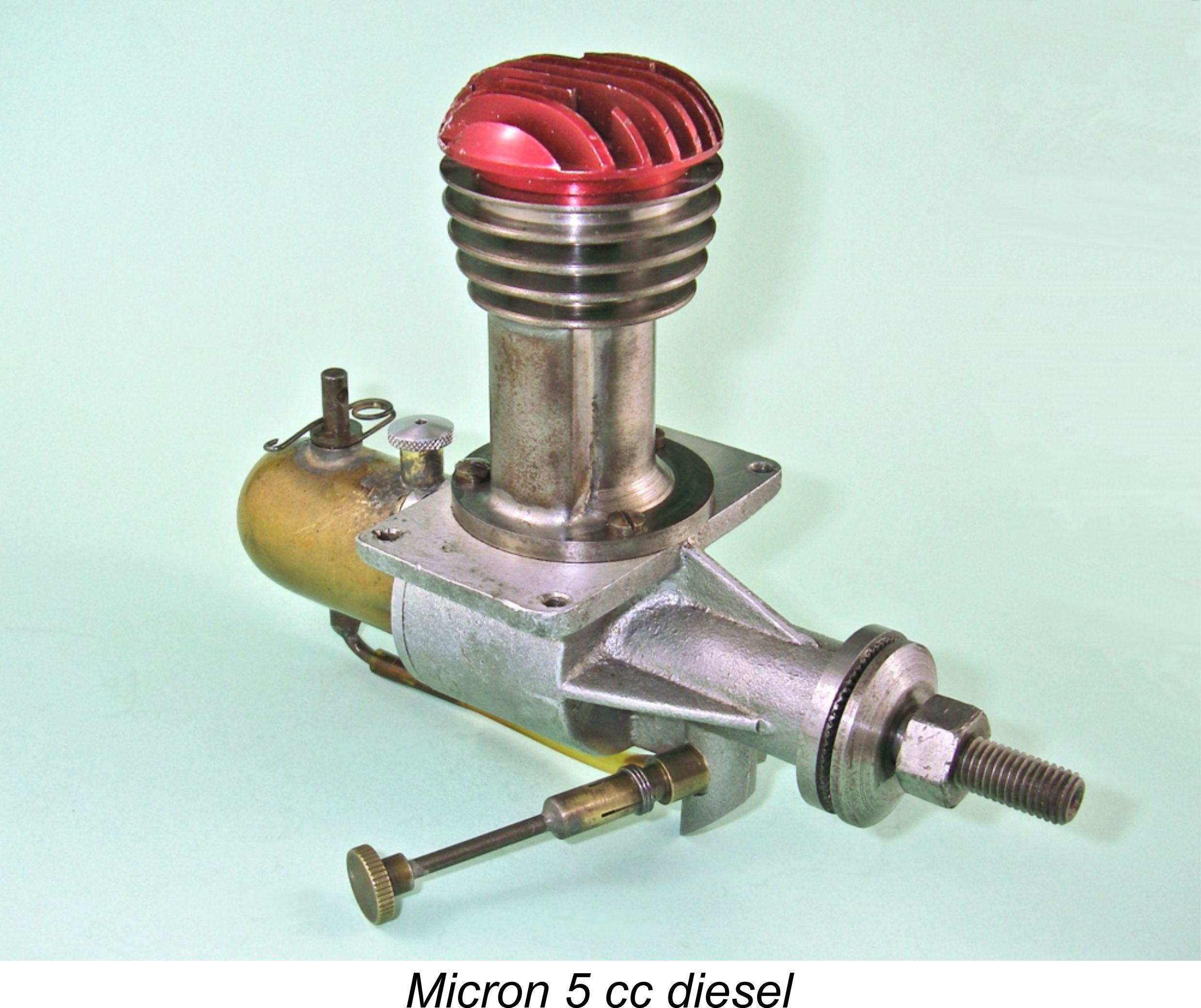 My French friend and colleague Christian Farcy has commented that the main reason why French engines never attracted much attention outside France is that French manufacturers tended to confine their thinking to "French market" rather than "global market". Put another way, they "thought small". Their products certainly had sufficient merit to support overseas marketing efforts, but they either didn't know how to pursue such initiatives or didn't take the trouble to find out.
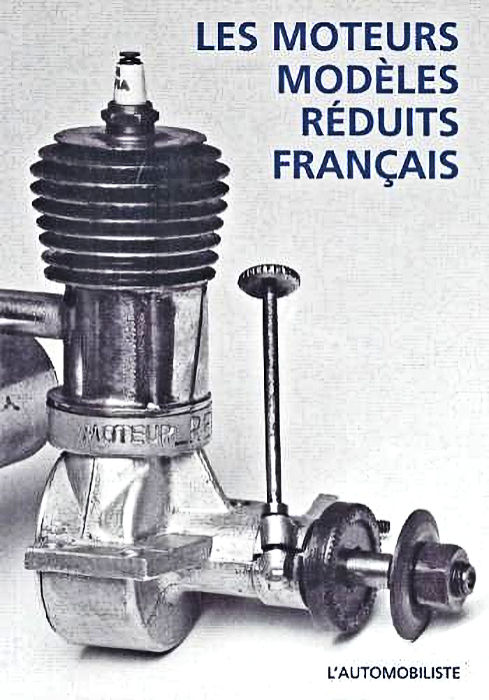 Fortunately, a very useful reference source is available to anyone having an interest in the subject of French model engines. This is the invaluable book
  Another indispensable source of information on French engines is Michel Rosanoff's ever-informative on-line model engine discussion thread on the "
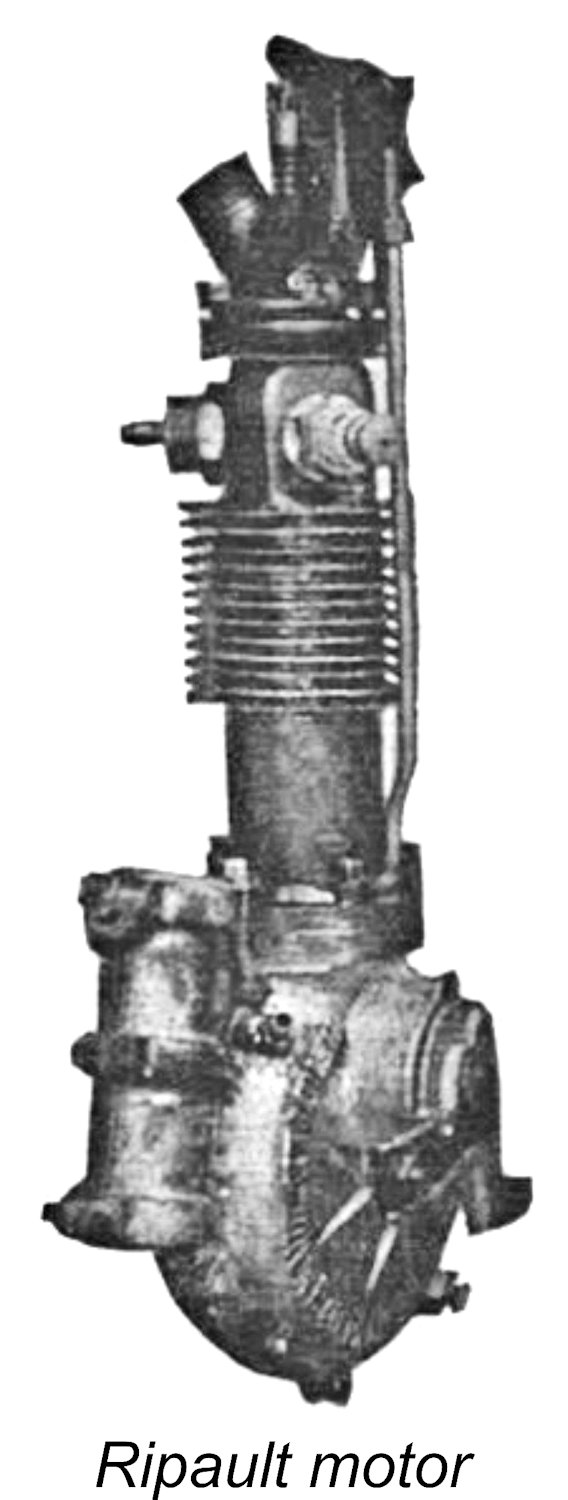 France was very early in the field of commercial model engine manufacture. The first French engine to be specifically offered as a potential powerplant for model aircraft was the massive 1908 four-stroke single cylinder 215 cc engine (65 mm bore and stroke) unit made by the motorcycle manufacturers
 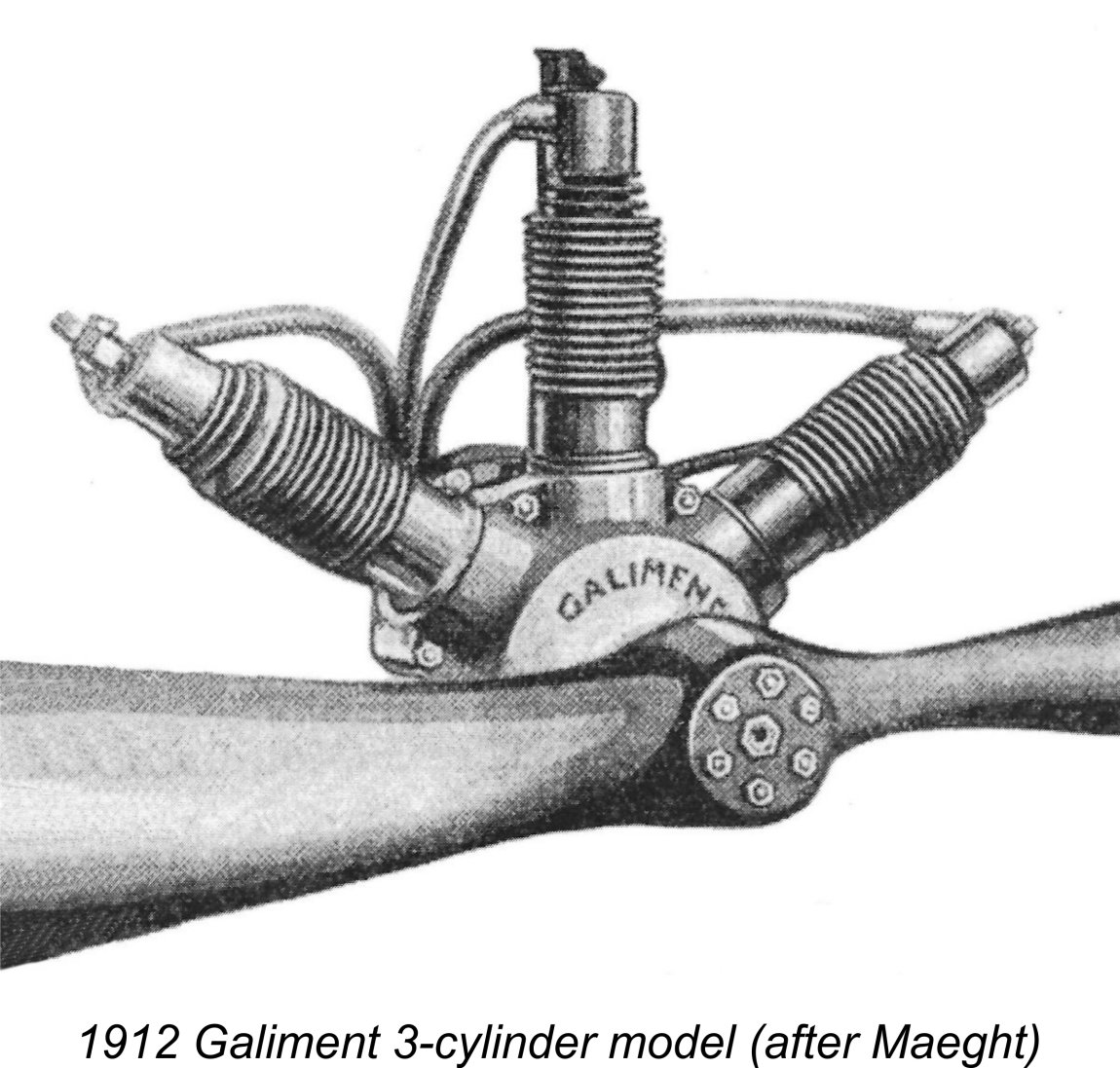 Radiguet & Massiot were soon joined by the Galiment company, who introduced a series of one, two and three-cylinder four-stroke model aero engines in 1912. The design of their illustrated three-cylinder model was clearly influenced by that of
  November 11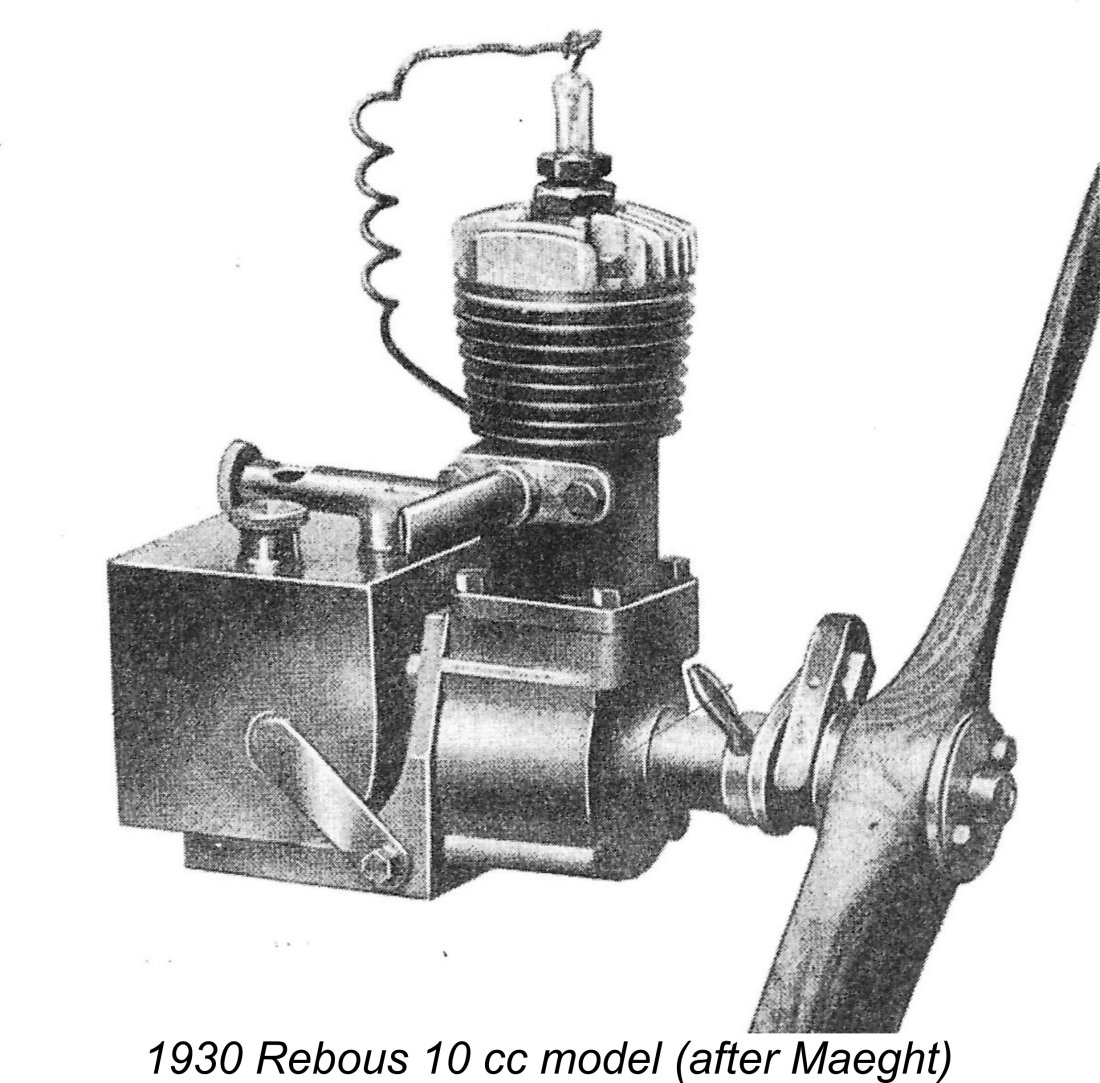
 but the new policy changed this completely. Particular emphasis was placed upon air sports, with financial incentives being offered to young people from all walks of life to take flying lessons and become licensed pilots. This led to an immediate proliferation of both full-sized and model flying clubs throughout the country.
 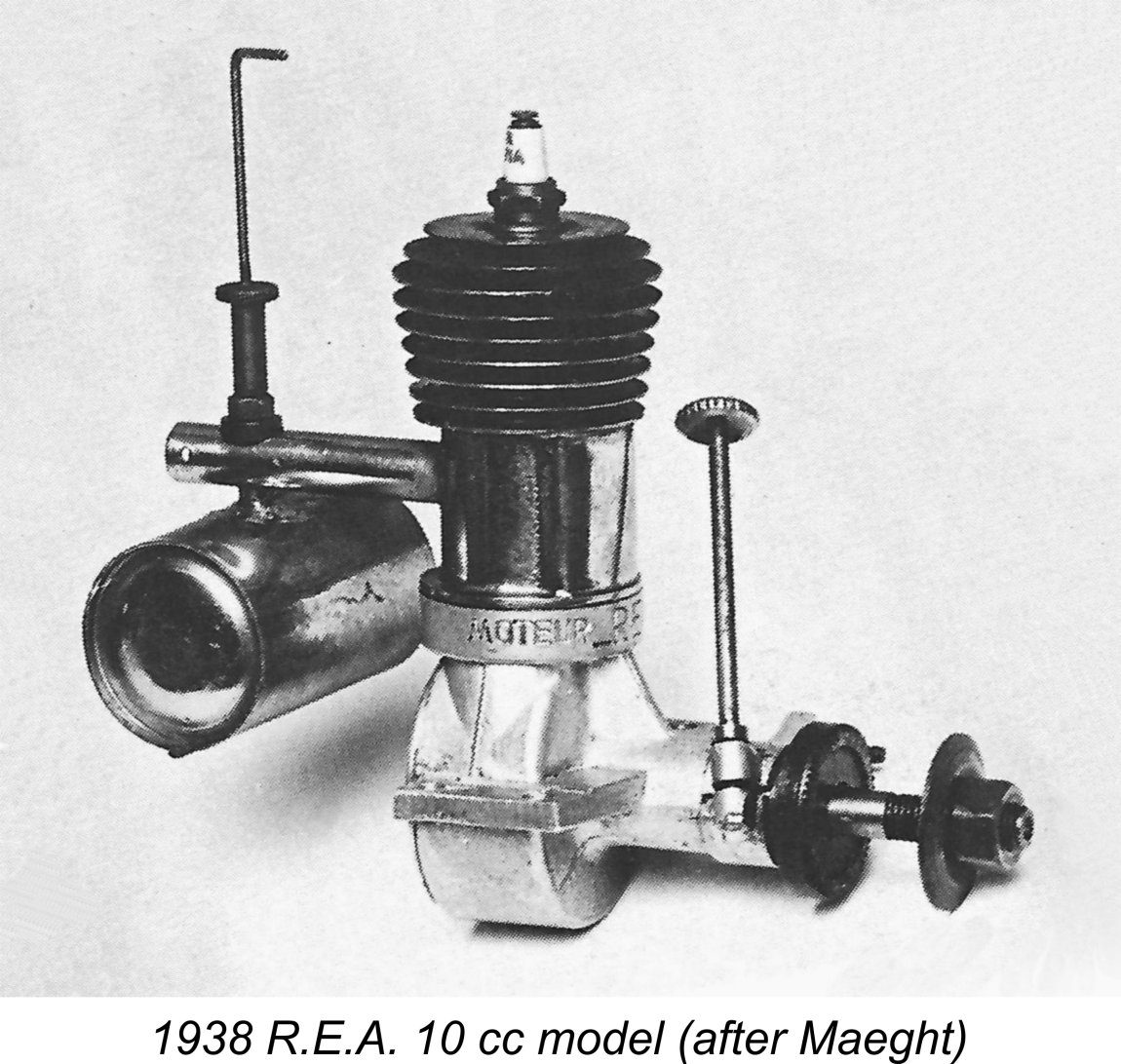 The growing political instability in Europe brought about by the aggressive moves of Adolph Hitler's Nazi Germany and General Francisco Franco's right wing totalitarian faction in Spain led to ever-increasing fragmentation among the Popular Front membership arising from disagreements regarding appropriate responses. By 1938 the coalition had begun to crumble. Nevertheless, the shot in the arm which it had given to the aeromodelling movement undoubtedly had a lasting effect. In particular, the arrival on the scene of new model engine manufacturers continued unabated. 1938 saw the entry into the French model engine market of an amazing number of newcomers, including Artus-Borde, Astus, Ceko, Radium, STAB and R.E.A. among others
 However, the level of control over people’s leisure activities seems to have been somewhat relaxed in fairly short order as the Germans tried to bring the French population at least to a state of quiescent acceptance of the occupation. Moreover, participation in such activities was somewhat less restricted in the unoccupied zone. As a result, it seems clear from the course of events that some level of renewed demand for model engines developed fairly quickly in France.
  It was only during the first half of 1942 as conditions apparently became further relaxed that larger-displacement engines became available once more. These included the STAB 7.6 cc, the L.C. "Special" 10 cc and a pair of 10 cc models offered by L.B.
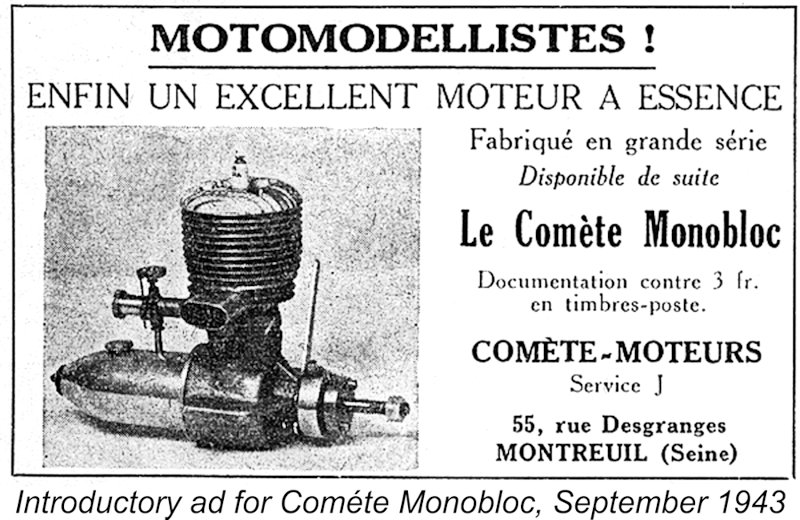 Sales of the new model began during the summer of 1943. The manufacturers identified themselves as Cométe-Moteurs of 55 rue Degranges, Montreuil (Seine), an eastern suburb of Paris. The first advertisement appeared simultaneously in issue no. 63 of "Le Modèle Réduit d'Avion" (MRA) magazine for September 1943 and in issue no. 90 of “L'Air pour les Jeunes” magazine of the same month. Likely due to a lack of resources, these would be the only manufacturer’s advertisements, with promotion and sales of the company’s clearly limited output being handled thereafter by a few Parisian shops. The engine’s plan was also made available, along with the option of purchasing castings for home construction.
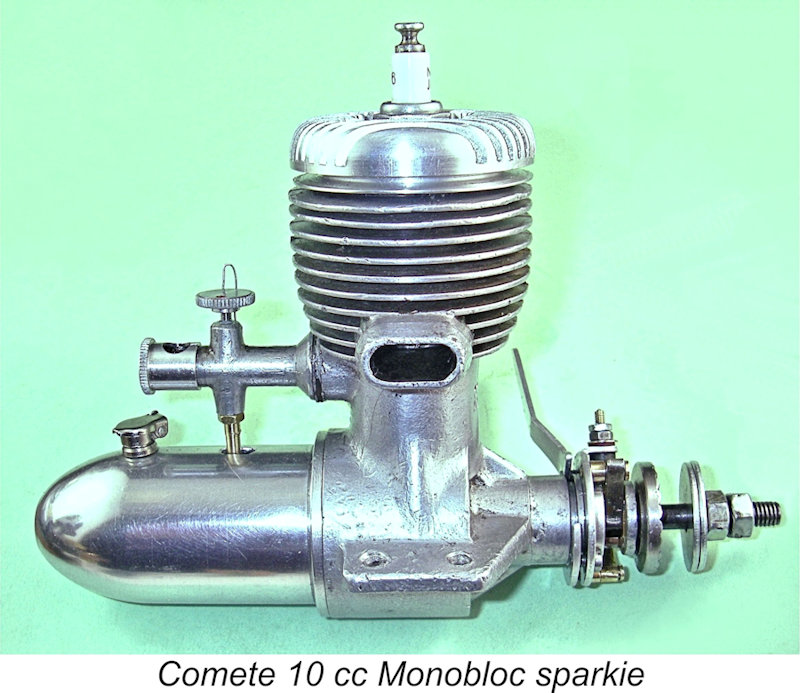 The original 1943 Cométe Monobloc 10 followed the classic sideport design configuration for the time. It was built up around a massive main casting which incorporated the crankcase, heavily braced main bearing housing, beam mounting lugs, exhaust stack and finned cylinder barrel in unit. The heavily-finned cylinder head was a separate component which featured a centrally-located M10x1.0 spark plug installation thread. It was secured to the cylinder barrel by four substantial machine screws.
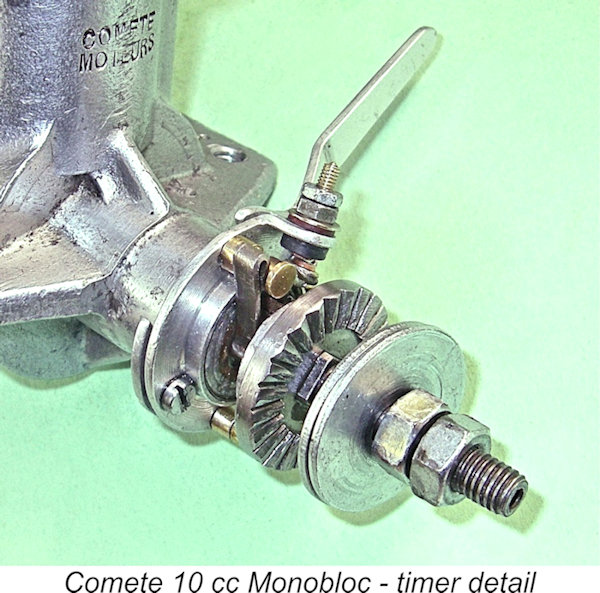 My example features a rather “cobbly-looking” but functionally quite effective open frame timer. This timer is fully adjustable for rotational resistance and points gap. It should be pointed out that several different timer configurations have been encountered with these engines - the one seen here was copied from an original component which was fitted to another example of the engine in Peter Valicek's care at the time.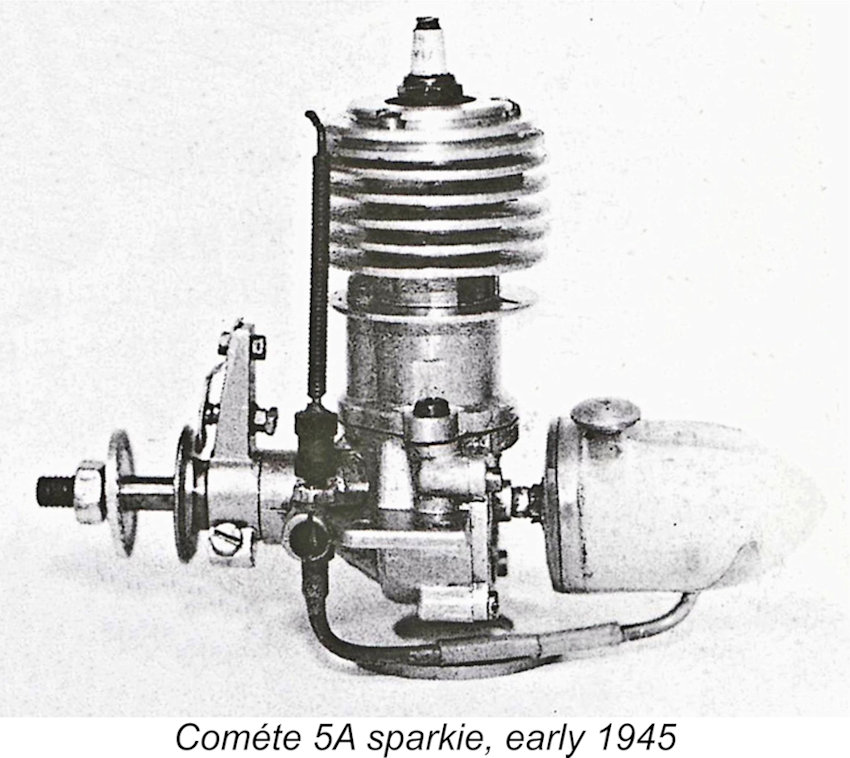
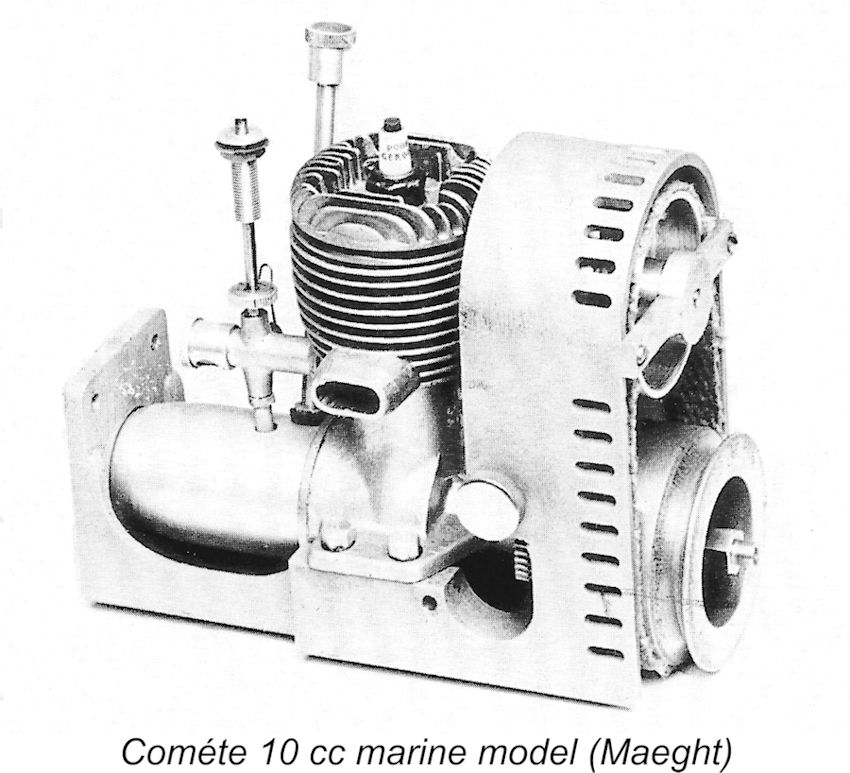 One of the most interesting engines ever released under the Cométe label was a marine version of the Cométe Monobloc, which seems to have been offered at around this time. This was a basically standard air-cooled 10 cc Cométe Monobloc aero powerplant installed in a special mounting cradle which was itself to be installed in the boat, engine and all.
 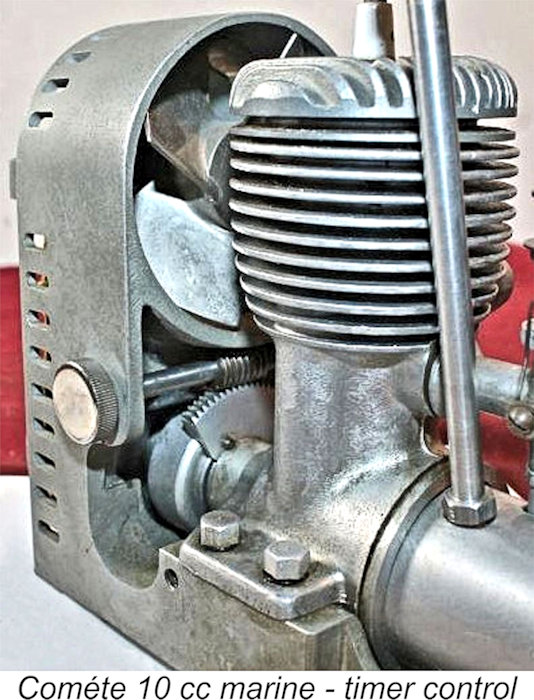 supplied by an appropriately-oriented shrouded fan which was belt-driven at engine speed from the flywheel. For another, the ignition timing was adjusted using a worm gear-equipped rotary shaft which engaged with a segmented spur gear attached to the timer body. Finally, the tank was equipped with an extended fuel filler tube which facilitated refuelling in the confines of a boat hull.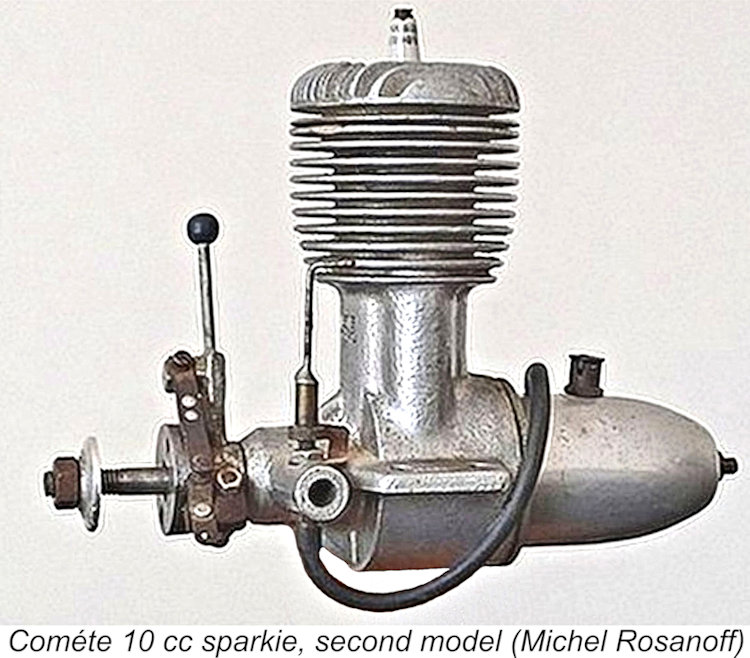
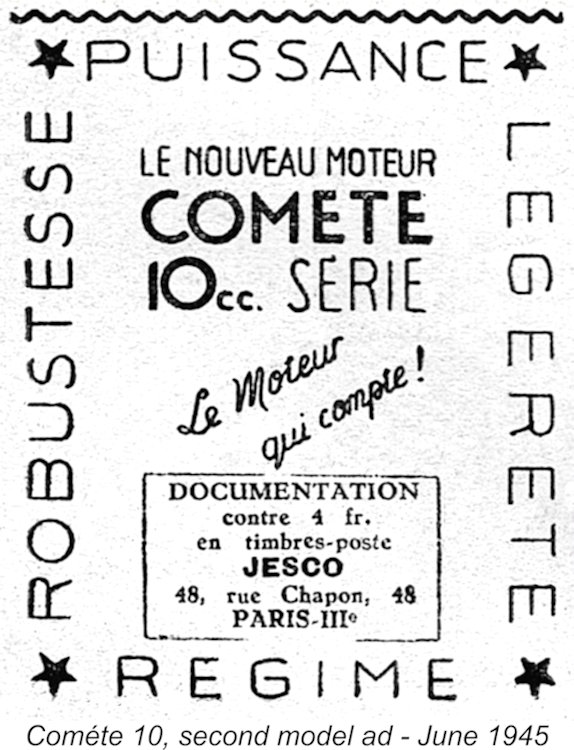 I haven’t been able to find any reports on the revised model’s performance, but it seems reasonable to suppose that it would have been a somewhat stronger performer than the original sideport model. It certainly needed to be in order to attract purchasers.
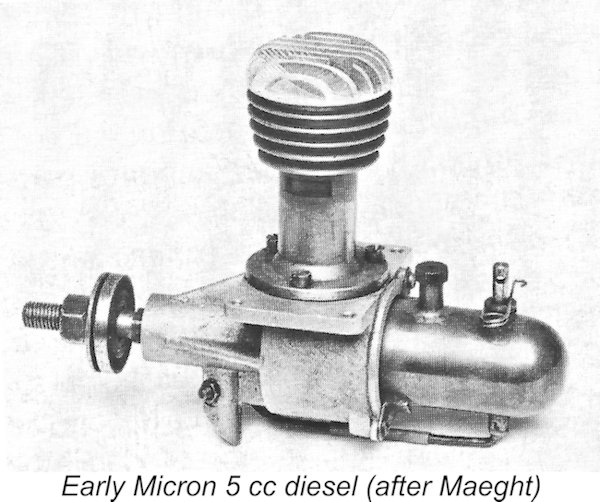 Although the production of larger spark ignition engines continued, the smaller and mid-displacement diesel models rapidly gained ground in terms of modeller attention, to the point that by 1945 they were heading towards domination of the market. Their ability to perform dependably without the need for the heavy and potentially unreliable spark ignition support system doubtless had much to do with this, as did their excellent torque development characteristics.
 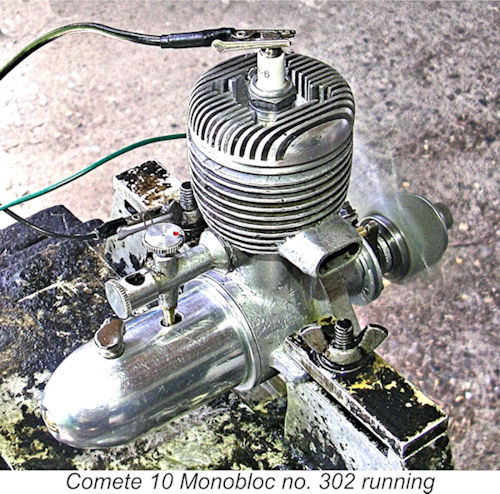 As received by me following Peter's ministrations, the Cométe had outstanding compression and seemed all ready to go. Peter advised that he had given the engine some running-in on the lathe before actually firing it up for a few test runs. He found that a 10 mm NGK CM-6 spark plug had a slightly too-long reach, resulting in the ground electrode contacting the piston crown at TDC. The engine was presumably designed to use a French Pognon Gergovia 10 mm plug, which has a shorter reach. Peter fixed this problem by making a spacer to fit over the NGK plug's installation thread.
 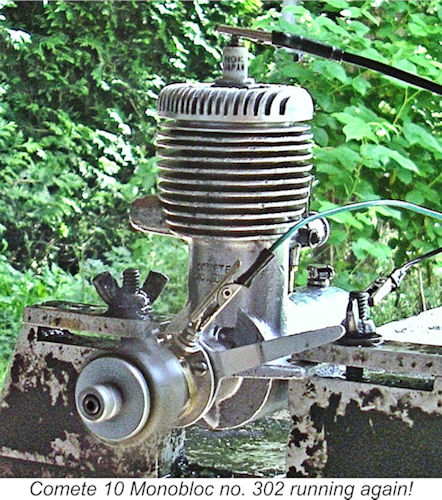 I really dislike flicking in reverse - it feels unnatural to me, and I can never put quite as much into it as I can in the conventional anti-clockwise direction. My approach is to set the prop at "ten past eight" when just coming up against compression in the clockwise operating direction and then flick sharply downwards with my right hand. This feels weird, but generally seems to work OK, especially with a sparkie, which doesn't require as energetic a flick as a diesel.
 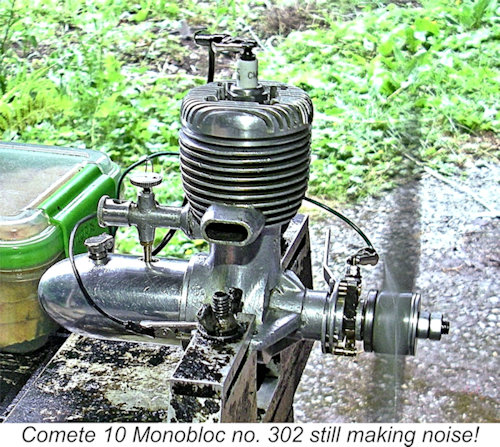 After the engine had made a number of trouble-free runs, I tried advancing the ignition and leaning out the mixture momentarily to allow the engine to run very briefly at full chat, quickly returning it to rich retarded four-stroke mode thereafter. In doing so, I found that the engine was extremely sensitive to the needle setting. I observed a best speed of 5,100 RPM on the APC 14x6 airscrew, which equates to around 0.154 BHP at that speed. The engine would undoubtedly do considerably better if completely run in. Even so, this figure actually lends some credibility to the maker's claim of 0.200 BHP @ 6,000 RPM, also making it appear that a 14x6 prop suits the engine perfectly - that prop turning at over 5,000 RPM shifts a lot of air, while it would almost certainly approach 6,000 RPM in the air if the engine was fully run in.
 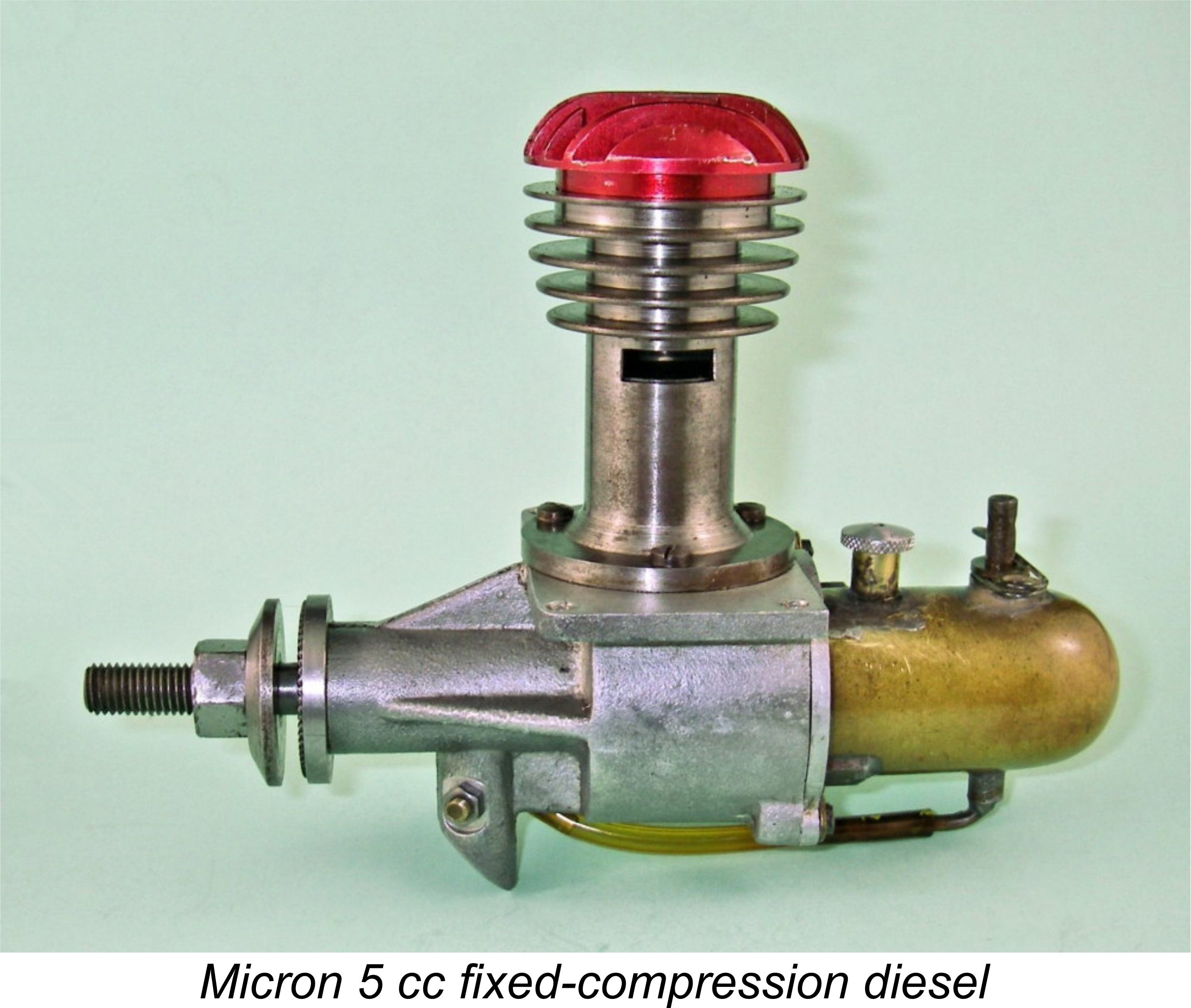 Despite the difficult situation in occupied France, Pierre Meunier’s demonstration of a Dyno 1 engine in the summer of 1942 immediately convinced many observers of the advantages of auto-allumage (auto ignition, a.k.a. ”diesel”) over traditional battery and coil spark ignition.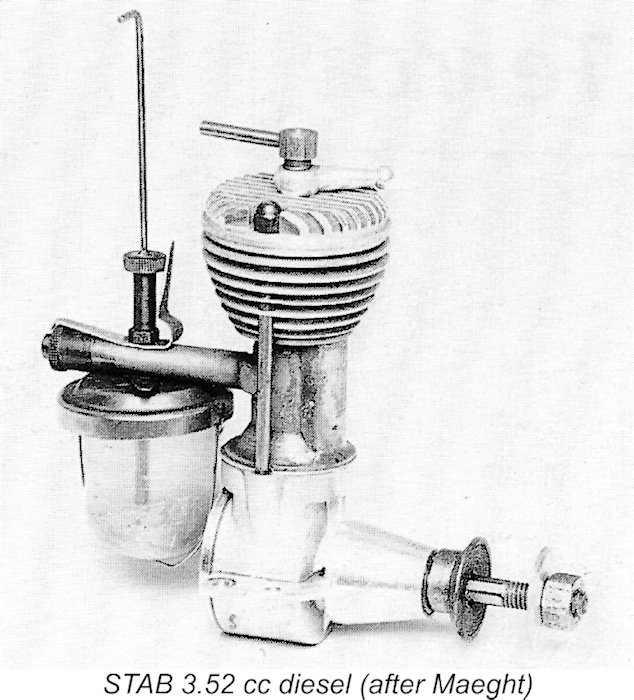
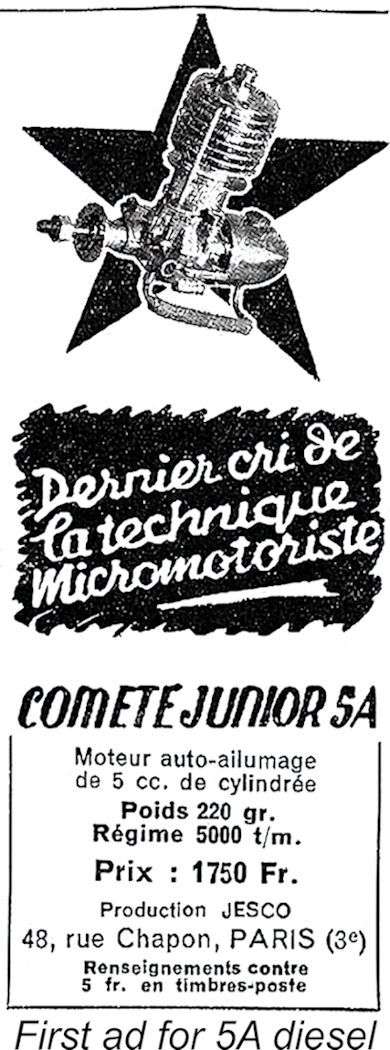 The Cométe Junior 5A diesel model was first advertised in the September 1945 issue of L'air Pour Les Jeunes (no. 111) as reproduced at the left. D. J. Laidlaw-Dixon’s book “
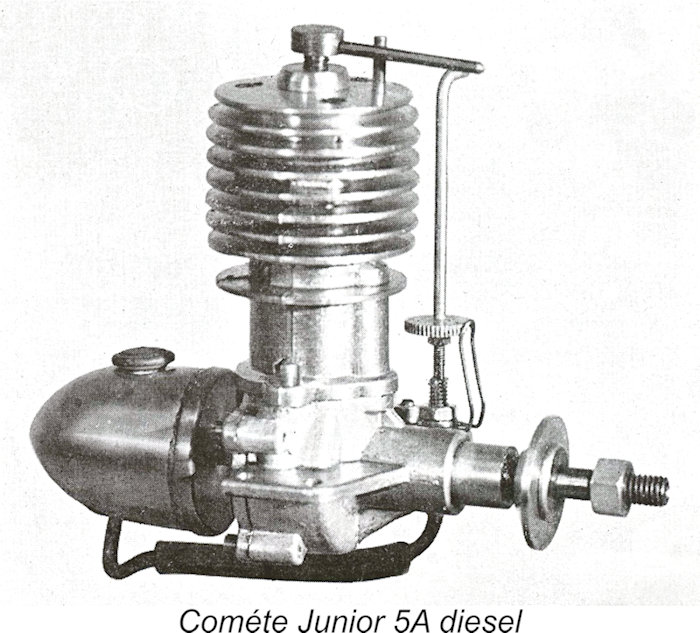 This engine is built up around four permold castings – main case, back cover, cylinder and head. It features front rotary induction via a horizontal intake tube located in front of the port beam mounting lug (a feature carried over from the ealier 5A sparkie and the second model of the 10 cc engine). The intake is equipped with a convenient vertical needle valve assembly. The bronze bushing protruding from the front for mounting the contact breaker assembly on the spark ignition version is evident also on the diesels.
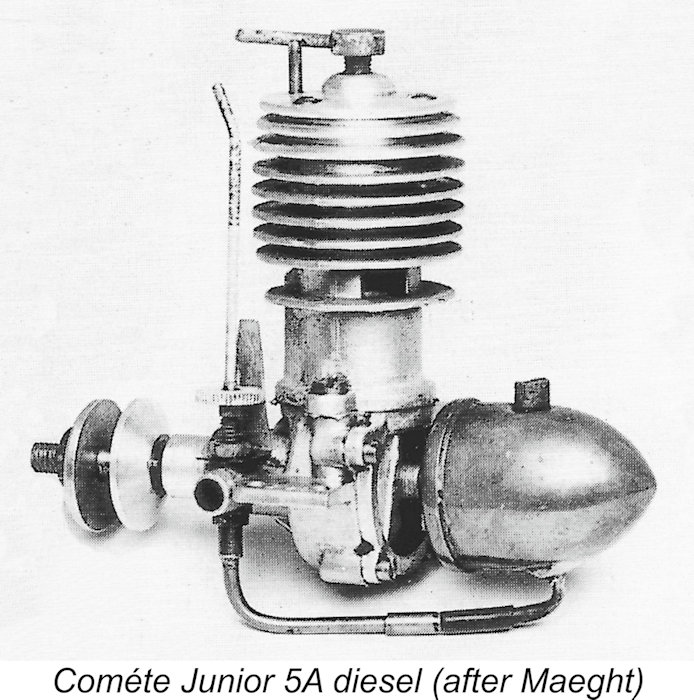 Looking somewhat like an insect’s abdomen, the fuel tank attaches with a single screw and jam nut to the crankcase back cover. The tank is made of metal for the diesels and molded transparent plastic for spark ignition (having a nice cork filler hole plug with turned wooden top).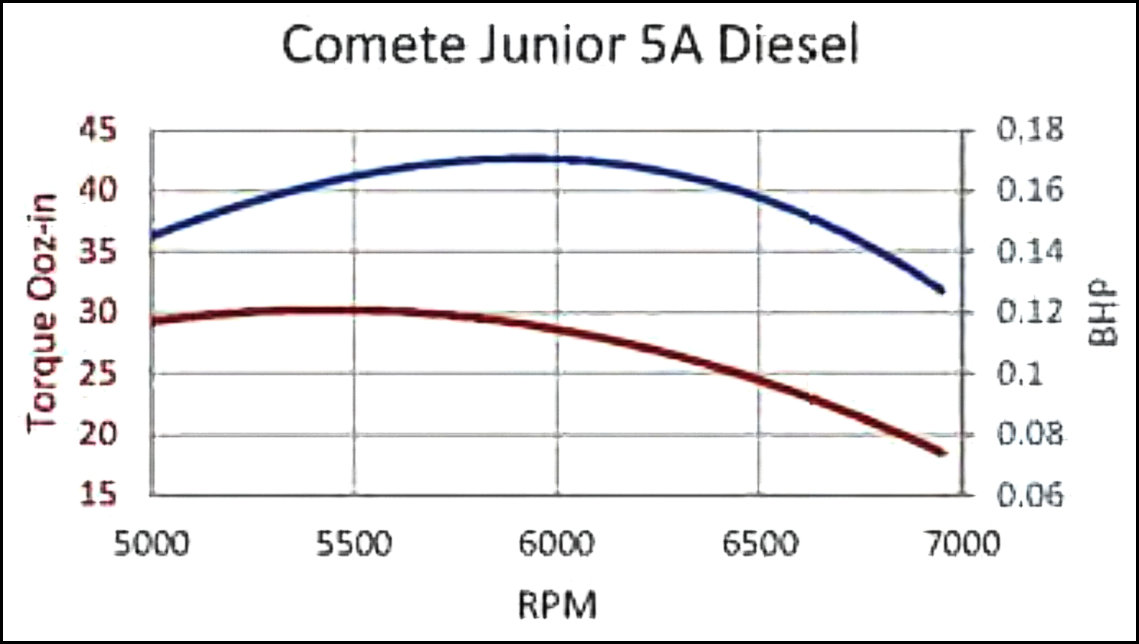
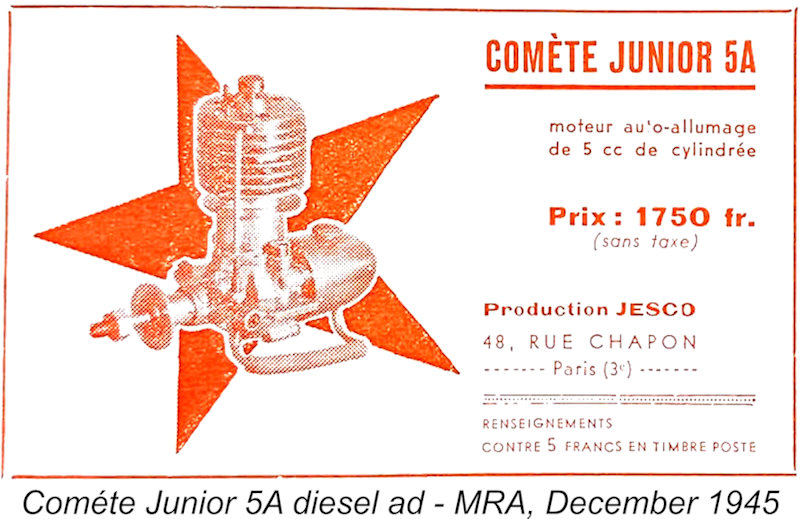 Following the September 1945 introduction of the Cométe Junior 5A diesel model, the Cométe 5A and 10 cc spark ignition models quickly dropped out of the JESCO advertising. Their limited production probably continued for some time, but it seems almost certain that their manufacture ceased entirely at some point well prior to the end of 1946.
| |