
|
|
Gems from Gravesend – the Kemp and “K” Hawk Miniatures
The original version of this article appeared in March 2010 on the late Ron Chernich’s now-frozen but still wonderful “Model Engine News” (MEN) website, where it may still be found. I’m reprinting it here because our greatly-missed mate Ron left us in early 2014 without passing on the access codes to his heavily encrypted site. Consequently, no maintenance of that site has since been possible, making it inevitable that a slow but inexorable process of deterioration is taking place over time. It’s this issue that has led me to transfer a number of what I consider to be the more important or interesting articles over to my own site, this being one of them. I've also taken the opportunity to incorporate some corrections and additions into the text. Acknowledgements Before proceeding with the recounting of the Kemp and “K” Hawk story, it’s both an obligation and a pleasure to acknowledge the very considerable assistance that I received when researching the original article way back in 2009. An amazing number of people helped in various ways to bring this study to a successful conclusion, and I freely admit that I could not have completed it without their contributions. Although I accept full responsibility for the following text, I wish to go on record as stating that this study is as much their effort as it is mine, as is the credit for any merit which it may possess. First and foremost, much of the following discussion about company founder Harold Kemp personally and the manufacturing operations which he initiated was developed from information supplied by Harold Kemp's daughter Mrs. Jean Hards-Nicholls (née Kemp). Mrs. Hards-Nicholls gathered a great deal of information about her late father's activities both from other family members and through an open request for information from outside the family. The response to this request was extremely gratifying, not least because it put her in touch with Harold Kemp's early associate Les Duffy, the long-time Secretary of SAM 35 in England, who was an invaluable source of eyewitness information. All of us are deeply indebted to Jean Hards-Nicholls for her initiative and effort in gathering as much information as possible about her late father's activities while it was still there to be gathered and then so generously sharing it with the rest of us. I freely acknowledge that much of the following material could not have been presented without her invaluable contribution. Secondly, I must thank Eric Offen for his unstinting help in providing photos, measurements and serial numbers to support the findings presented below. Eric's contribution has done much to add authority and completeness to what follows. My valued Swedish friend Lars Gustafsson also deserves great credit for shedding light upon pioneering model diesel developments in Sweden, including the activities of Swedish model engineering master Harry Fjellström. It's solely due to Lars's efforts that the information on Harry Fjellström's tiny diesels became available. I can’t omit an acknowledgement of my very considerable debt of thanks to my late friend and colleague Paul Rossiter, who not only shared his wealth of knowledge about Kemp engines but was also kind enough to make a trip to Gravesend to photograph the various locations associated with the Kemp story as they appeared sixty years later in 2009. This really helps to relate the past to the present, always a valuable perspective from my point of view. I'm also most grateful to my late and much-missed Aussie mate David Owen for digging deep among his images to find some more serial numbers. The late and equally-missed Ron Chernich was kind enough to undertake a focused trawl through the early issues of various modelling magazines to find advertisements for the Kemp and ”K” engines. And finally, Gordon Beeby of Australia undertook a further invaluable search of the pages of contemporary modelling magazines to fill in a few remaining gaps in the advertising and media records. Thanks, mates! OK, on with our tale.......... Background
Following the conclusion of the war, information regarding this new form of model power unit quickly spread to England. Initial development was carried out predominantly by the model engineering fraternity, but it was not long before a number of commercial interests began to take notice of their efforts. An article by pioneer British diesel experimenter and later engine tester Lawrence H. Sparey entitled "The Gen on Diesel Engines" appeared in the December 1945 issue of “Aeromodeller” magazine. This article was highly influential, prompting an ever-increasing number of Progress was rapid, and within a year or two the best British diesels were well up to par with the majority of their Continental rivals. This chain of events initiated the love affair between the modellers of Britain and her Commonwealth partners and the model diesel engine which was to last for the following three decades or more. For some of us, the affair has never ended! One of the great advantages of the model diesel over its spark-ignition counterpart was the potential for its construction down to extremely small displacements. The absence of the complex and heavy ignition components as well as any form of plug were the keys to making this possible. The consequent potential for sub-miniaturization was quickly recognized, and experiments were soon underway to probe the lower limits of practicable construction.
Harry Fjellström attended both the 1947 and 1948 Model Engineer Exhibitions in London, where he demonstrated a slightly larger version of this engine (which also still exists at the Museum) having a bore of 4 mm and a stroke of 6.5 mm for a displacement of 0.082 cc. This certainly caught the attention of the redoubtable Mr. Sparey! In his October 1949 “Aeromodeller” test report on the Mk. 1 E.D. Bee, Sparey included the statement that "a diesel of only 0.08 cc has been successfully run", a comment which must surely relate to this engine. It's possible that Kemp Hawk designer Harold Kemp may also have seen this engine in operation, drawing some inspiration from the experience.
All well and good in terms of showing what could be done in a purely technical sense, but the series manufacture of model diesels of this near-microscopic displacement could never have been seen as a viable commercial proposition - quite apart from the extremely limited practical application of such a "novelty", the amount of detailed individual work and consequent production costs required to achieve the necessary extreme standards of precision would doom such a project commercially. Commercial manufacturers therefore quite understandably set their sights a little higher in terms of displacement. The first British commercial move towards the true sub-miniature diesel came in mid-1947 with the introduction of the London-made Ace 0.5 cc model - the first British commercial diesel of that displacement to appear. This triggered something of a "race to the lower limit" among British manufacturers, and The makers of the Kemp (later "K") engines were among the most successful and prolific manufacturers of sub-miniature diesels in the early post-war period. Their various Hawk models were reportedly in steady demand for several years, consequently being produced in relatively substantial numbers. This has had the happy result of ensuring that a fair number of them still exist today, remaining probably the best-known of the early British sub-miniatures. In this article I'll attempt to sort out the various forms in which this fine little motor appeared. However, it's important to remember that no particular series of engines from a given manufacturer evolves in isolation - there's always the question of context, and the story of a particular model can only be fully appreciated if the context in which it was designed and manufactured is understood. Those who do not feel the need for any discussion of this aspect of the matter are invited at this point to proceed directly to the description of Hawk variants which constitutes a later section of this article. For those desiring the complete picture, I'll start by having a look at the background to the inception and manufacture of the Hawk series. In The Beginning
During the WW2 years, Kemp had worked in the full-size aircraft industry for Short Brothers in Rochester, Kent, where Sunderland flying boats and Stirling bombers were made. As of 1939, Kemp was almost certainly of military age (initially 18-41, expanded to 17-51 by 1941), but his employment at Shorts doubtless placed him in the reserved occupation category. Even so, his war would not have been without risk - Short Brothers' Rochester factory and the surrounding residential areas were heavily bombed by the Luftwaffe on a number of occasions. Kemp's work at Shorts would have brought him into contact with other Short Brothers employees who were to go on after the war to become involved with model engine design and construction, including Sid Smith (Electra Engines), and Ken Robinson (Speedwell). It's not widely known that Short Brothers also owned and operated the co-located Pobjoy Airmotors company which developed and manufactured small petrol engines for such applications as reduced-scale prototype aircraft and compact airborne generators, working closely with Short Brothers in doing so. There’s some circumstantial evidence to suggest that Pobjoy staff may have had some involvement with the design and manufacture of the early post-war 6.4 cc Keil K6 spark ignition engine. An article about the K6 which appeared in the June 1946 issue of "Model Aircraft" magazine included the statement that during its design, development, production and testing phases, the K6 had benefited from "the supervision of ex-Government research engineers, who have been responsible for miniature petrol engine design during the war period." This undoubtedly sounds as if it could be Pobjoy - there can't have been too many groups of engineers engaged in such work. However, the connection cannot be claimed as firmly established - it's merely a very good circumstantial fit. Nonetheless, such a connection could well make sense of the long-standing oral association of Harold Kemp's name with the Keil K6 - Kemp could have become associated with that model through a wartime Pobjoy connection established during his time with Short Brothers. The K6 name is certainly suggestive given the fact that Harold Kemp's first definitely-attributed self-manufactured design was the similarly-identified K4 diesel of 1946. As we shall see, the letter "K" loomed large in Kemp's history of involvement with model engine design and manufacture.
If he did not wish to relocate or if he was in any event made redundant, a second option would have been to seek employment with another English firm. This of course would have placed him in competition with large numbers of similarly redundant and perhaps equally qualified individuals. As matters transpired, Kemp took neither of these steps - instead, he took matters into his own hands by moving to nearby Gravesend and starting his own specialty engineering business under the name Kemp Engines. His chosen field was the manufacture of model aero engines. A prior interest in power model aircraft or at least an interest in model engineering are implied here, but unfortunately we know nothing definite about any previous involvement which Harold Kemp may have had with either field other than his presumed wartime association with other small engine designers such as Sid Smith, Ken Robinson and possible Pobjoy Airmotors staff while working in the full-sized aero industry at Short Brothers. Whatever the influences in play, it's readily apparent that Kemp must have had some rational basis for believing that a viable business could be based upon the manufacture of model engines and must in addition have begun with some well-formed ideas with respect to model engine design. A measure of practical experience with model engines either as a user or a designer (or both) would certainly best explain these factors.
Regardless, once he had decided to engage in the model trade as an engine manufacturer, Kemp did so with energy and enthusiasm coupled with a considerable measure of obvious talent. At the conclusion of the war, significant quantities of machine tooling which had been used in wartime production became available for sale at competitive prices as being surplus to peacetime requirements. We may safely assume that Kemp (like many others) took full advantage of this in assembling the necessary production equipment. Much of this machinery was doubtless well-used and rather "tired", but the price was right and a combination of realistic tolerances and skilled operation could do much to overcome any deficiencies.
Harold Kemp was very much a "hands-on" businessman, being personally involved in all aspects of the company's operations. Apart from handling the sales and other business matters, he did all of the engineering design and also worked in the machine shop alongside the other employees. In addition to Kemp himself, the operation initially employed only three other men - two full-time and one part-time. A far cry from E.D., who started out with a full-time workforce of some 50 individuals! The part-timer at Kemp Engines was Les Duffy, a wartime colleague of Kemp's who was still working full-time during the day as an apprentice at the downsized but still operational Short Brothers plant in nearby Rochester - the move to Belfast was not completed until later in 1947, after which Les took a job with Rolls-Royce which ended his association with Kemp Engines due to the need to relocate.
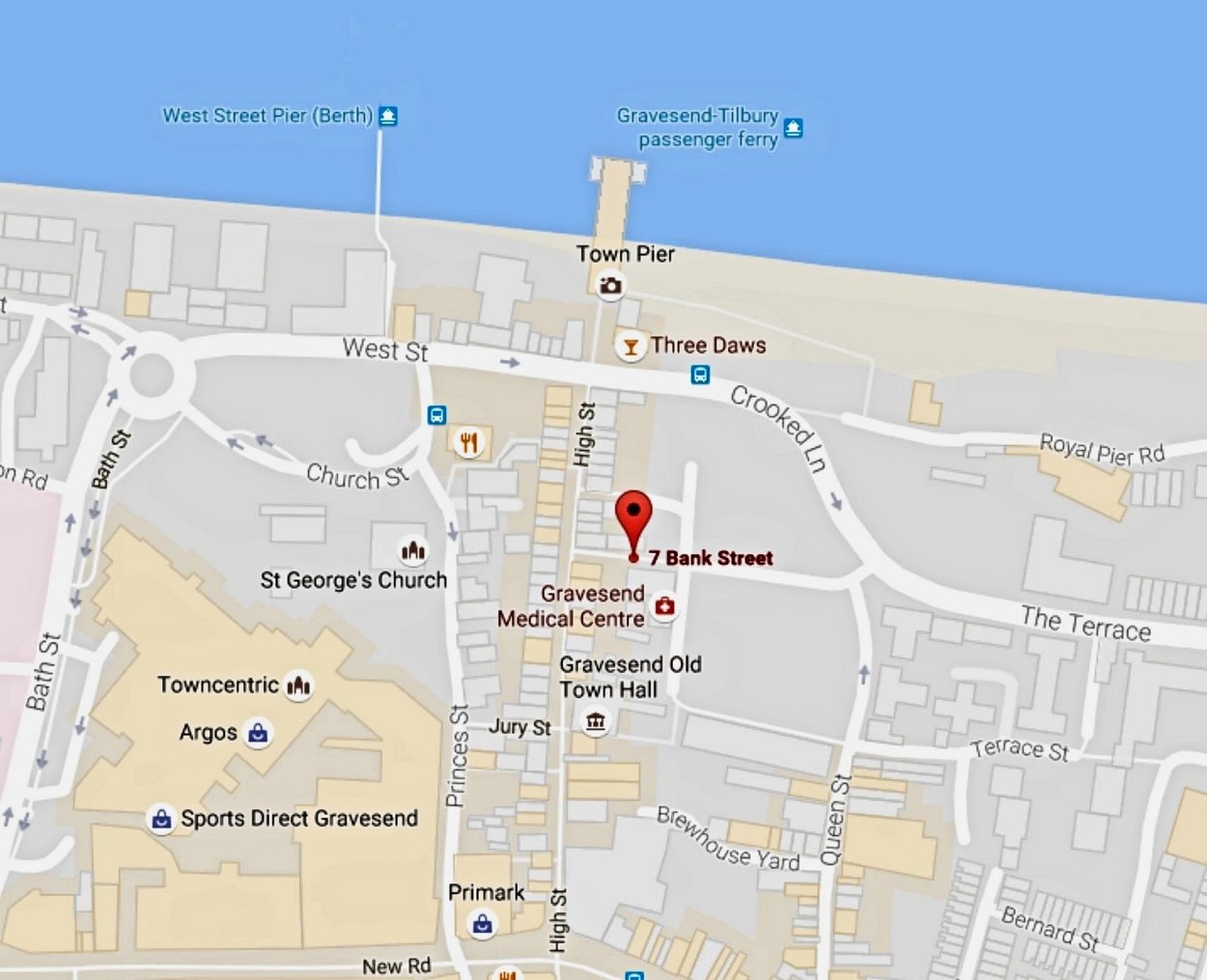
Speaking many years later to Harold Kemp's daughter Jean, Les retained a very clear recollection of the workshop at 7 Bank Street. His evocative eyewitness description constitutes an invaluable insight into the way that small-scale "cottage industry" engine manufacturing operations like this typically functioned. It appears that the premises had originally been a residence and had been converted to a workshop at some time prior to Kemp taking up occupancy. This kind of adapted accommodation was probably entirely typical of such small-scale engineering operations - large purpose-built factories like those of International Model Aircraft (IMA - FROG) and E.D. were undoubtedly the exceptions rather than the rule. Fortuitously, another small engineering firm had premises opposite the Kemp workshop, and Kemp would sometimes exchange materials and other bits and pieces with his neighbors. Les recalled that as one approached the premises one would usually find a motorcycle leaning against the outside wall. As one entered the building, there were large doors on the left which opened into the main workshop and a large window looking into another room on the right. The main workshop on the left housed a large capstan lathe and an extremely oily work bench, also used for counter sales which were usually handled personally by Harold Kemp. The downstairs front room on the right with the large window accommodated additional lathes and other machinery. These two downstairs rooms were probably the living room and the dining room of the original residence! One of the upstairs rooms (likely a former bedroom) was used for assembling the engines, after which each and every one was test-run on the premises - perhaps in the former kitchen. Try that today - Harold must have been popular with the neighbors! Those engines that passed their test were packed into plain brown cardboard boxes ready for dispatch, while the failures were set aside to have their faults rectified. Seemingly, Kemp had a first-rate hands-on quality control program - others might have done well to copy. Some of the engine castings were formed in magnesium alloy and were produced at a nearby foundry in Gravesend. They were delivered loose in hessian sacks and had to be individually checked for defects before machining and assembly. The castings were emptied out onto the workbench, examined and sorted. It was quite normal for a proportion of them to have to be returned to the foundry for reprocessing. Les recalled that the men had great fun burning the magnesium shavings from the machining operations on the plot of waste ground next door, as they burned with a very bright blue flame! No recycling in those days.............indeed, fire was one of the hazards of using magnesium castings, and a number of fires at the E.D. plant in the late 1950's may have had much to do with E.D. abandoning the use of magnesium castings at that time. Kemp Production Commences
As those of us who are Mills owners know to our cost, magnesium alloy has an incorrigible tendency to want to return to its elemental state in the form of corrosion! Kemp evidently received a number of complaints about this problem, and his response was to introduce the Series II version of the engine, which was still based upon magnesium alloy castings but was chemically blackened like the Mills engines when they switched to magnesium castings. This treatment did much to reduce the tendency of the castings to corrode.
Kemp soon carried this design one step further by producing an 8.8 cc in-line twin cylinder diesel colloquially known as the "Black Devil" which was effectively two of the 4.4 cc engines joined together. This was labour-intensive to produce, consequently having to be sold at a very high price in order to generate a profit. As a result, there were few takers for the very small number of these engines that were manufactured. The mega-rare survivors (which do exist - Paul Rossiter once owned an example) are highly prized collector's items today. The fledgling company embarked upon a more significant product expansion phase later in 1947 with the introduction of a small FRV 1 cc diesel engine, which sold for the still considerable sum of £5 0s 0d. The tank, cooling jacket, and spinner on many examples of this engine were cast in magnesium alloy, although the rest of the castings were formed in aluminium alloy. Once again, production figures were limited by the very small workforce available at the time, making this a comparatively rare model today. The Hawk Arrives on the Scene
The precise introductory date of the Hawk has been the subject of some debate. However, the evidence appears to be pretty clear. Model shop advertisements in the December 1947 and January 1948 issues of “Aeromodeller” make no mention of the Kemp 0.2 cc model, which they surely would have done if such a novel design had been made available in time for the 1947 Christmas rush.
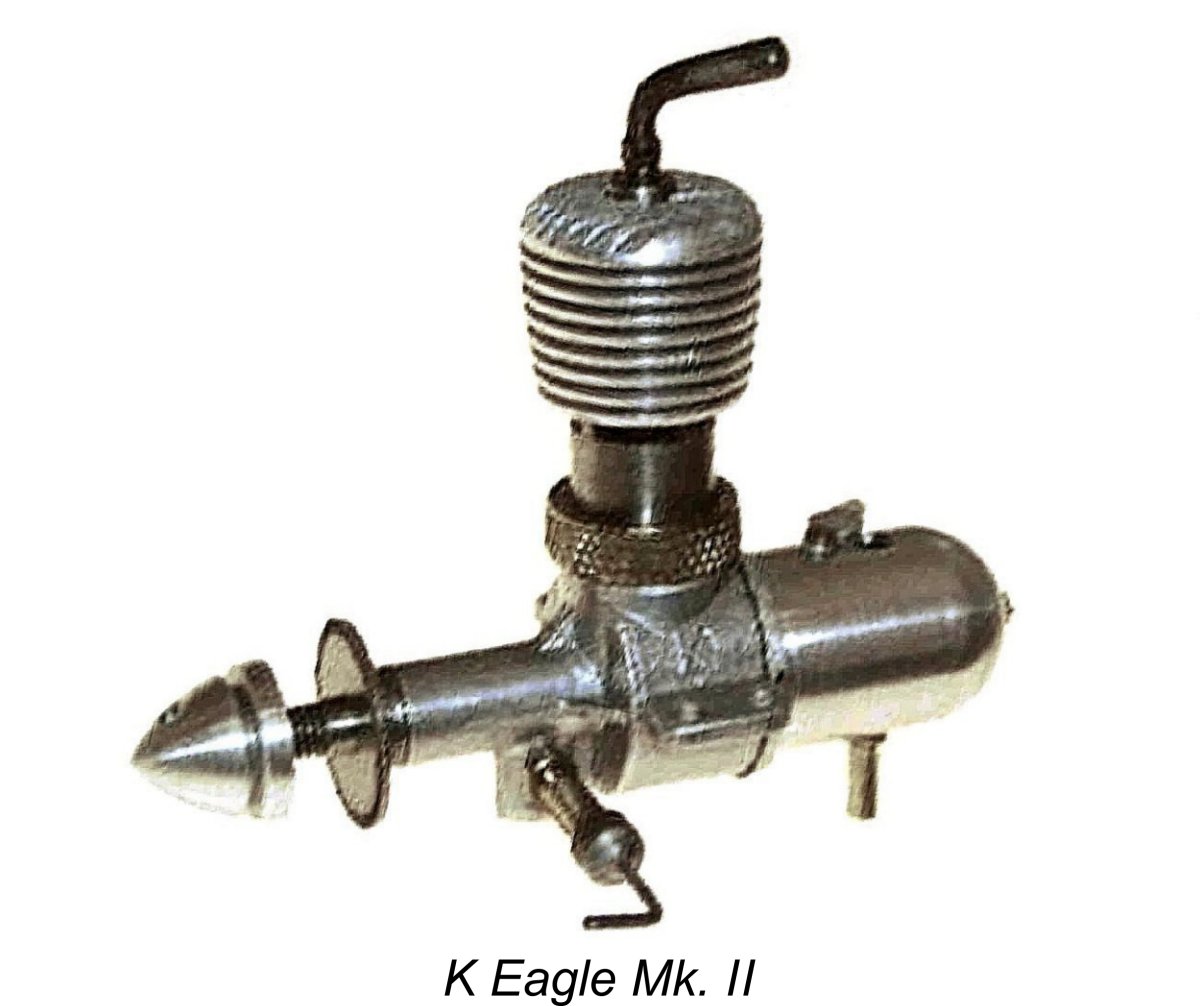
The introductory version of the sideport Kemp Hawk Mk. 1 had a displacement of just under 0.20 cc, making it the smallest-displacement British diesel produced commercially up to that time. This little gem was usually sold complete with a 4 in. diameter laminated wooden airscrew. The introductory retail price was £4 8s 0d (£4.40), reflecting the amount of individual work required to produce each example. Despite the relatively steep price by 1948 standards, the novelty appeal of such a tiny engine ensured its immediate acceptance along with the development of a steady if not overwhelming demand. Production figures (see later discussion) certainly reflect a modest dgree of sales success. The design evolved fairly rapidly through a number of variations, as we shall see in due course. At the time of the Hawk's introduction, the 4.4 cc K4 had apparently already been dropped, but the previously-mentioned FRV 1 cc model was still b The Kemp Eagle was a sideport unit which shared a number of key features with the Hawk. It sold for a somewhat more competitive price of £3 18s 6d (£3.93) and was apparently well received, appearing in two distinct variants. However, its production life was very short, as we shall see. By this time the little three-and-a-half man operation must have been taxed to the limit to keep up with the demand for both models now on offer! The constraints upon their production capacity are surely obvious, but their consequently limited output did at least have the beneficial effect of ensuring that they were easily able to sell all the engines that they could produce. There was little danger of supply exceeding demand. Many of the engines were marketed through a main selling agent - Gamages of 116-128 Holborn, London. They were dispatched to Gamages by carrier from the workshop, two dozen or so at a time. Eddie Keil was also a Kemp distributor, and the previously-mentioned firm of Henry J. Nicholls of 308 Holloway Road, London was a major retail outlet as well. In July 1948 a Scots distributor was added to the roster in the form of the Caledonia Model Co. of Glasgow. The engines could also be bought directly from the makers either by mail order or in person over the counter from the workshop at 7 Bank Street. It would have been well worth taking advantage of the latter option since one would then be served in person by Harold Kemp himself! Change of Ownership
Harold Kemp's daughter Mrs. Jean Hards-Nicholls recalled that the workshops at 7 Bank Street in Gravesend were part of the deal and remained in operation at least for a time following the change of ownership. This may certainly have been true, but there is no doubt at all that the business address of the "K" Model Engineering Co. was given from the outset as Darnley Street in Gravesend, rather than Bank Street. Somewhat frustratingly, no street address was ever given, although there are still several "period" buildings on Darnley Street like those seen above at the right which could have housed the new business. Darnley Street lies a little further from the river towards the town centre of Gravesend, but the two locations are within easy walking distance. Accordingly, maintaining the Bank Street workshop in conjunction with the development of the new Darnley Street facilities would have been readily possible. Mrs. Hards-Nicholls believed that this transaction took place in late 1948. However, the preponderance of evidence is inconsistent with this timing. A published July 1948 review of the "K" Hawk (see below) specifically referred to the manufacturer as the "K" Model Engineering Co. Ltd. of Darnley Street in Gravesend. Moreover, The first “K” Model Engineering Co. advertisement of which I’m presently aware (reproduced at the left) appeared in the August 1948 issue of “Aeromodeller”. It included both the Hawk and Eagle models. Allowing for Editorial lead time, this ad must have been submitted in early July 1948 at the latest, seemingly confirming that the change of ownership had taken place by that time. In addition, time would be required to reorganize and enhance the reorganized company's production facilities in advance of the appearance of new models, and such models actually began to appear in October of 1948. All of this seems to confirm that the sale must have been completed no later than June 1948 and quite possibly earlier.
Certainly, a subsequent advertisement placed by the new company in the 1948 edition of Ian Allan’s annual "Model Aviation" publication (reproduced at the right) focused entirely on the Hawk model while hinting loudly at several new designs which were then in preparation. The precise date of this advertisement is uncertain, but it must post-date June 1948 (when the transfer of ownership seems to have occurred) while clearly pre-dating October 1948 given the fact that the first of the touted new models, the Vulture, actually made its appearance in October 1948.
Steward's clear intention from the outset was to replace the Kemp range as it then existed with entirely new models. The old 4.4 cc Kemp K4 design had already been dropped and the sideport 1 cc Eagle model soon followed. As an active competitor himself, Steward must have realized that as of mid-1948 the Eagle was too bulky and slow-revving to compete with the significantly updated models which were by then beginning to appear from other manufacturers. Model engine designers were learning fast and learning well!
However, the old Hawk too was starting to fall behind the times in technological terms, and its manufacture appears to have been discontinued in late 1948 after about a year in production. It had disappeared from the manufacturer's advertising by December 1948, while its final appearances in dealer advertisments came in January 1949. This disappearance from the advertising record wasn't the A Series II "Special" version of the same basic Hawk Mk. 2 design made a one-time appearance in an advertisement which was published in the June 1949 issue of “Aeromodeller”. However, the seeming complete absence of reported surviving examples suggests that this variant never actually achieved series production. See below for further discussion. The question of whether or not Harold Kemp retained some level of involvement with the "K" Model Engineering Co. Ltd. remains unresolved. According to Harold's daughter Jean, certain members of the Kemp family recalled information passed down to them from Harold's brothers to the effect that Harold only sold a part-interest in the business and remained a partner in, or at least an employee of, the new company. This would be completely consistent with the notion that the primary intent of the sale was to attract additional investment to allow for the creation of expanded production capacity rather than to dispose outright of what must have appeared to have been a growing business at the time in question. The idea of an ongoing involvement is also consistent with the indisputable fact that Harold Kemp continued to live at 3 Bank Street for some years following the reorganization of the business. He married in Gravesend in 1949 and remained at 3 Bank Street until at least late 1951, well after the cessation of production by the "K" Model Engineering Co. This is apparently confirmed by the address on the birth certificate of one of his daughters. Since this urban location was then very much dominated by industrial activity, it's hard to see why Kemp would continue to live there with his new family unless he had some compelling reason for doing so. An ongoing involvement with the "K" Model Engineering Co. would certainly constitute such a reason. Kemp's daughter Jean also recalled her father invariably referring to the model aero engines that he had once made as "K" engines. This is circumstantial evidence for sure, since he may have simply been referring to the "K in a circle" trade-mark, which was certainly introduced during his sole proprietorship, as opposed to the registered name of the successor company. However, this expression on Kemp's part is undeniably consistent with the notion that he remained somehow involved with the business after the entry of Steward into the operation. He continued to live only a few doors away, and it would have been very hard indeed to "abandon the baby" by steering completely clear. In his place, I would certainly have been unable to do so! On the other hand, when interviewed in 2009 Les Duffy expressed the belief (on unspecified evidence) that Harold sold the business in its entirety. Admittedly, Les no longer worked there by that time - after Shorts relocated to Belfast in 1947, he had moved on to Rolls Royce and was living elsewhere. However, he must surely have had some basis for expressing the belief that he did. There seems to be no surviving documentation to confirm either story - the above-quoted information is all that we're ever likely to have. Feel free to make up your own mind! Harold Kemp finally left Gravesend at some point in 1952 (well after the "K" Model Engineering Co. had ceased operations) to start a new job as a development engineer for Gyproc (later renamed British Gypsum) back in nearby Rochester, Kent. He designed machinery for them to produce plasterboard products, working there until he finally retired in 1969. Len Steward continued in the model engine field for some time after the late 1950 demise of the "K" Model Engineering Co., spending some years working with Dennis Allen on the AMCO and Allen-Mercury (AM) ranges during the 1950’s. This association had its genesis on the flying field, since both men were prominent members of the West Essex club and were very active in control-line stunt contests during the early post-war period, often competing against one another and placing well in the events which they entered. In addition, Allen had been working in the engine repair department at Henry J. Nicholl's shop at 308 Holloway Road during Steward's tenure at the "K" Model Engineering Co., and the fact that HJN was one of the main retail outlets for the "K" range doubtless further cemented the relationship. Even after his subsequent association with Allen-Mercury ended, Steward retained his connection with model engines, operating an engine reboring and repair service during the 1960’s in competition with the likes of Gig Eifflaender of P.A.W. fame. I don’t know how long this continued, but Steward was certainly still advertising his services in “Aeromodeller” as of July 1969. Harold Kemp died in 1975 and Len Steward followed him in 1992. Sadly, they both took a great deal of unrecorded information with them, leaving many unanswered questions regarding the pioneering model engine manufacturing venture which they so ably and energetically directed. Having set the scene as best I can, it's now time to turn our full attention to our main subject - the series of miniature diesels marketed over a two-year period as the Kemp (later “K”) Hawk. The initial Mk. 1 sideport Hawk and the later FRV versions were the smallest engines ever made by the Kemp company or its successor, and were in fact the smallest British commercially-produced model engines of them all for a number of years until the 0.15 cc Allbon Bambi came along in 1954. Hence this series occupies an honoured place in British model engine history! Let's take a close-up look at these intriguing little engines. The Kemp (later “K”) Hawk - Description of Variants
The Mk. 1 Hawk was a typical long-stroke sideport diesel of its day, being set apart from its contemporaries chiefly in terms of its unusually small displacement. In his 1949 book "Miniature Aero Motors", Ron Warring quoted the bore and stroke very precisely as 0.2187 in (5.554 mm) and .3125 in. (7.938 mm) for an actual displacement of 0.192 cc. Warring’s figures reflect precise nominal design dimensions of 7/32 in. and 5/16 in. respectively, this being a time when British designers still worked in fractions of an inch rather than decimals for some unaccountable reason. Careful measurements taken directly from one of my own examples of the original Series I version of this engine yielded a bore of 0.223 in. (5.66 mm) and a stroke of 0.311 in. (7.90 mm), which are near enough allowing for normal manufacturing tolerances using well-worn equipment and also considering the possibility that the engine may have been rebored at some point. These figures made the Hawk the smallest-displacement British model engine to enter commercial production up to that time. The weight of 30 gm (1.06 oz.) complete with tank also set a new lightweight record for British production engines.
There were in fact three quite distinct versions of the Mk. 1 Hawk. The edges between these variants have become somewhat blurred today by the fact that many examples have clearly had original components replaced with equivalents from later models, either acquired "back then" by original owners as spare parts or taken more recently by collectors from "bones" examples. Thus it's important to attempt to sort out the defining characteristics of each variant in its original form. Although the manufacturers did not differentiate between the successive variants by identifying them differently, it seems convenient for reference purposes to follow the lead established by Mike Clanford in his useful but often unreliable "A-Z Pictorial" on model engines by referring to the different variants as the Series I, Series II and Series III versions of the Hawk Mk. 1. I’ll adopt this approach from here on in, merely reminding the reader that these Series designations do not originate with the manufacturer. They are used here purely for convenience in clarifying the particular variant which is under discussion at any point. The three variants of this engine were fundamentally very similar. The stroke remained unchanged throughout, as did the sideport induction system and most of the working components. All variants used drilled exhaust and induction ports which were arranged in pairs and were of relatively modest area. The round shape of the exhaust ports resulted in progressive opening of the exhaust, giving rise to the fact that these little engines are relatively quiet in operation. A welcome feature for flying in urban environments, as often practised in those far-off and more tolerant days! But there were differences, and some of them were quite significant. Let's see if I can sort them out................. The Hawk Mk. 1 Series I The earliest version of the Hawk is quite distinct from its successors in four key respects - the cylinder porting design, the bore, the method of carburettor attachment and the treatment of the main bearing housing. Let's examine these features in turn.
Naturally, the cylinder wall had to be relatively thick to accommodate the internal bypass passage. The Hawk Mk. 1 Series I had a cylinder outside diameter of 0.312 in. (measured directly from two examples), which combines with the 0.219 in. bore to give a wall thickness of 0.046 in. - quite generous considering the tiny size of the engine.
The transfer port itself was set well below the exhaust, but the piston crown was chamfered at the front to give a deflector effect and also to advance the opening of the transfer port. Consequently, the opening of the transfer port lagged behind that of the exhaust ports by only a few degrees of crank angle. The cylinder was externally threaded at the top to accommodate the screw-on alloy cooling jacket and was provided with an integrally-formed flange of square planform located at its base. It was attached to the crankcase using four tiny screws which passed through holes in the corners of this flange to engage with tapped holes in the crankcase. Caution - do not tighten these screws unduly! The very small threads are prone to stripping and it's not necessary in any case – finger-tight is generally sufficient. A gasket was used to ensure a good crankcase seal, always critical in any engine of this tiny size. The screw-in rear cover was also provided with a gasket. A further distinctive feature of this variant was the means of attachment of the carburettor/tank assembly. On the Series I version of the Mk. 1 Hawk, the carburettor mounting boss (which was soldered onto the cylinder) was internally threaded. The delivery end of the cast alloy venturi tube was externally threaded to match, and tank alignment was maintained through the use of a simple brass locknut which bore upon the end of the mounting boss.
An externally threaded needle (10BA) screwed into a boss on the opposite side of the intake tube from the tank to engage with the fuel jet. Needle tension was provided by a tiny coil spring. A very effective cut-out was included which operated by blocking the intake on the delivery side of the fuel jet. This system was to be applied to all three variants. Even Lawrence Sparey, who had endless problems getting cut-outs to work, should have had no trouble with this one! Turning now to the main bearing, this was un-bushed and was cast integrally with the main crankcase, the material being aluminium alloy. The bearing on this initial variant was completely unbraced and frankly looked a bit sketchy. Furthermore, the engine bore no marks of identification other than a serial number which was usually stamped on the left side of the crankcase (looking forward in the direction of flight). The final distinctive feature of this variant related to the beam mounting lugs. These were considerably thicker than those which were to appear on the subsequent model. This variant had two mounting holes, one in each lug. The illustrated example is fitted with a modified case from a Series III engine - the former serial number was 1106, but the initial 1 has been "invisibly" filled in and the "K in a circle" trade-mark has been very neatly removed from the front of the case. This explains the fact that this case has four mounting holes! In addition, the exhaust holes on each side have been joined to enlarge their area. The engine is otherwise in original Series I configuration and is fully representative of that variant in performance terms. It starts and runs extremely well. There appears to have been one change made to this original variant quite early on during its production life, which is not in my opinion sufficient to warrant classification as a separate variant since the balance of the engine was unchanged. Experience seems to have quickly shown that the unbraced main bearing was overly However, for reasons which are somewhat obscure, the gain in strength which had been achieved with the three bracing webs was significantly offset by the fact that the mounting lugs on the revised cases were considerably thinner than they had been formerly. Go figure! The revised mounting lugs still had only one hole each. It's worth noting that the illustration in the instruction leaflet supplied with the later examples of the Hawk clearly shows an example featuring the internal-bypass cylinder and straight screw-in venturi in combination with a three-web thin-lug crankcase. This confirms the above statement that at least some of the Series I Hawks featured this case - perhaps most of them did. The serial number is not visible in this right-side view, apparently indicating that it continued to be placed on the left side of the case, at least in the initial stages. Later on, it was relocated to the right-hand side of the case. The Hawk Mk. 1 Series II
The increase in the bore of the Hawk is a matter which somehow appears to have escaped earlier commentary. Reading between the lines, we may reasonably surmise that experience had shown that the power delivered by the original 0.2 cc Hawk was a bit on the marginal side for practical purposes. It seems likely that customer feedback had indicated the desirability of raising the output somehow, and increasing the displacement was the most obvious means of accomplishing this if it could be managed within the established design parameters for the engine, in particular its external dimensions. For cost control reasons, there were clear advantages in retaining as many of the existing components as possible. The simplest approach would obviously be to bore out the existing cylinder, leaving everything else unchanged. In this context, Harold Kemp evidently took note of the fairly thick cylinder (relatively speaking) which had been forced upon him by the use of the internal bypass passage featured in the first model of the Hawk. He took the decision to increase the bore by a matter of around 0.031 in. to a nominal diameter of 0.250 in. This still left an adequate cylinder wall thickness (for this tiny engine) of some 0.031 in. Eric Offen very kindly took measurements from his illustrated example of the Mk. 1 Series II Hawk no. 1018, obtaining bore and stroke dimensions of 0.252 in. and 0.312 in. respectively. This is close enough for confirmation purposes, considering the fact that the engine may well have been rebored at some stage of its life. Eric's example retained its original box and high-pitch 4 in. dia. wood airscrew with which it was supplied. So far so good, but there was no longer sufficient wall thickness to accommodate the internal bypass formerly used. To get around this, the transfer port was now cut right through the cylinder wall at the front. This port was supplied through a soldered-on external bypass passage similar to that used by E.D. in their contemporary 2 cc models. Apart from allowing the use of the increased bore, this was clearly a far simpler production job, beside seemingly being amenable to increased efficiency in operation. Since the piston port used in the Series I variant was no longer necessary, it was naturally omitted.
The carburettor mounting system was also changed to resemble that then in use on the companion sideport Eagle 1 cc model. The mounting boss was now unthreaded and was split from the rear. The unthreaded delivery end of the intake venturi simply plugged into this boss and was secured by a split collar which was tightened against the split intake boss with a tiny screw. However, the tank continued to be of metal and the cut-out was retained unaltered as well. The change in the carburettor mounting arrangements was in all likelihood a response to the fact that the externally-threaded venturi tube used on the Mk. 1 Series I model was highly susceptible to breakage arising from a crash or some other form of rough handling. My own example of the Series I venturi was broken as received. The new system was undoubtedly stronger because the venturi tube was not weakened by the presence of screw threads. The modified three-web crankcase which had been applied to the later versions of the Series I variant was retained in this new version. The engines continued to bear the "K in a circle" trade-mark cast in relief onto the front of the case on a small raised circular area. The use of a serial number was also continued, but this now appeared for the most part on the right-hand side of the crankcase. The Hawk Mk. 1 Series III
The cylinder was unchanged from that of the Series II model, indicating that the revised design had been found to be satisfactory. The same bore and stroke measurements were also retained, as confirmed by measurements taken by Eric Offen from his Series III example. The method of mounting the carburettor assembly was also unchanged. However, the tank assembly was completely revised. The intake end of the induction tube was now standardized with a bell-mouth configuration, and a plastic tank was featured in place of the former metal unit. This tank was secured by a wire spring clip. Like the carburettor mounting set-up, this too mirrored the system used on the companion sideport version of the 1 cc Eagle. The revised tank mount also featured a filler hole of a far more practical size. Customer feedback is implied here. It must be admitted that these were good moves, since one could now fill the tank without removing it or using a fine-tipped syringe and could also observe the fuel level to time the motor run for sport free-flight The only other changes related once again to the crankcase casting. The new variant had four stiffening webs for the main bearing instead of the former three, indicating perhaps that experience had shown that there was still a residual weakness with the three webs previously employed. The same comment may have applied to the mounting lugs as well, since these were somewhat thicker on this variant than they had been on the previous Series II model. Each lug now featured two mounting holes rather than the single hole on each side which had been used on the earlier models. Since the space previously occupied by the letter K on the front of the crankcase was now taken up by the uppermost of the four bracing webs, the letter K now appeared cast in relief inside a circle on the right-hand side of the case where the serial number had previously appeared. The serial number was relocated back to its original location on the left side of the crankcase. In all other respects, this variant was unchanged from its predecessor. There’s no reason to expect that its performance would be at all different. An Anomaly from a Familiar Source
The most logical way to resolve the apparent inconsistency here is to accept the probability that the cylinder on Clanford's illustrated Mk. 1 "Series I" was either a performance-enhancing owner modification or a replacement for an original cylinder which had become lost or damaged. It's perhaps even more likely that it was simply a collector-assembled hybrid made up from an assortment of components. Clanford's book is both useful and engaging, but over the years it has disseminated a huge amount of misleading information! The evidence of the Kemp leaflet appears to confirm that the internal-flute cylinder definitely belongs to the original web-less version, since it was still in use at the time when the improved three-web crankcase was introduced. Conversely, there is no independent evidence for the manufacturer's use of the later external-bypass cylinder with the original unbraced case, nor is there any logic to support such a possibility. The Hawk Mk. 1 on Test
Although the tested unit was undoubtedly a 0.251 cc Series II model, the test report continued to refer to it as a 0.2 cc engine. It appears that the fact that the displacement had been increased was intended all along to be a well-kept secret! The primary focus of this report was on the engine's handling characteristics, which were found to be excellent - in fact, the tester stated that "the engine is less tricky to operate than many larger diesel engines that we have tested." The only performance-related information was a cited 5,500 RPM using the 4 in. dia. wood propeller of unspecified but undoubtedly high pitch which was supplied with the engine. The Hawk was said to be suitable for powering lightweight models of up to 24 in. wingspan. The writer praised the engine's finish, expressing the view that at its price of £4 7s 6d (£4.38), it represented good value for money.
As we might expect, the 0.251 cc Hawk clearly developed considerably more useable torque than the 0.15 cc Bambi and would therefore swing a more efficient airscrew for practical purposes. The test report commented that the Hawk was unhappy at being pushed beyond the peak, a common characteristic of sideport engines. A test by Charlie Bruce of a Mk. 1 Series II Hawk which he had owned from new appeared in issue no. 59 of "SAM Speaks", the newsletter of the Society of Antique Modellers, for January/February 2003. This review is reproduced here at the right. Like all of Charlie’s reviews, this was mainly concerned with the engine's dismantling and reassembly, but a few test figures were included. Using a standard diesel fuel, Charlie obtained 6,900 RPM on a Tornado 5½x3 nylon prop, and 8,300 RPM with the 4 inch diameter laminated wooden airscrew supplied with the engine. It seems that the laminated wood prop was well matched to the engine's power curve. My own experience shows that a leak-free example of the Mk. 1 Hawk is a perfectly straightforward engine to handle once the correct needle setting has been found. However, finding that setting may take some time, and patience is strongly advised! My advice - start lean and work up to find the sweet spot - less chance of flooding that way.
Once running, the engine is quite responsive to the controls, although the needle tends to be a bit "touchy" as regards the optimum setting. The flywheel effect of the 5½x3 Tornado nylon prop used by Charlie Bruce is helpful for initial starts, but once you have the settings established a 5x3 wood prop seems to be a good choice, allowing the engine to get close to its peak on the bench. The 0.193 cc Mk. 1 Series I version of the Kemp Hawk was never the subject of a published test in the contemporary modelling media. My own testing of an un-numbered but mechanically and cosmetically perfect example of this type (apart from having a Series III plastic tank) yielded the following figures.
The engine proved to be an extremely good starter, to the point where it was easy to forget how small it actually is! A single finger-choked flick generally sufficed to get enough fuel into the cylinder for starting. Control response too was excellent, allowing the best speeds on each prop to be established very dependably. Running qualities were beyond reproach, while the cut- Testing of my own illustrated example of the Kemp Hawk Mk. 1 Series II, engine no. 701, confirmed that it started just as readily as its smaller forebear and was just as easy to set. Running qualities once again left nothing to be desired, while it was immediately obvious that this variant was a significantly stronger performer than its smaller-displacement forbear. This impression was amply confirmed by the prop/RPM figures obtained on test. As we might expect, the 30% increase in displacement resulting from the larger bore along with the more effective bypass arrangements which together defined the Mk. 1 Series II variant resulted in a very substantial increase in the engine’s torque development. If the motivation for the changes was an improvement in output, they certainly succeeded! The following data were recorded on test.
The above data confirms that the modified Hawk with its 30% greater displacement and far less convoluted bypass arrangements stands head and shoulders above its Series 1 predecessor. This particular example of the little Hawk delivered an outstanding performance, developing some 0.018 BHP @ 10,000 rpm. I have to say that this was well above my expectations. It's possible that this is a better-than-average example. Regardless, I would expect a more or less identical performance from the Mk. 1 Series III variant given the fact that its working components were identical. The FRV Hawk models
The new model was a completely re-designed engine from the ground up, owing nothing whatsoever to its sideport predecessor. It featured downdraft FRV induction and a radially-ported screw-in cylinder using three internal-flute bypass passages to go with the three sawn exhaust slots. It was designed expressly for radial mounting, then very much in fashion. Overall, it was a very up-to-date design by the standards of its day, with a performance to match.
The roller-coaster saga of the Hawk's displacement changes was continued with the new model. As noted earlier, the original Hawk Mk. 1 Series I design had featured bore and stroke measurements of 5.55 mm and 7.94 mm for an actual displacement of 0.192 cc. The Mk. 1 Series II and Series III Hawks with their external bypass passages featured bore and stroke measurements of 6.35 mm and 7.94 mm for a nominal displacement of 0.251 cc. We noted previously that the motivation for this 0.80 mm increase in the bore was likely the need to extract more power from the design.
Despite the fact that its displacement was only 25% greater than that of the later Allbon Bambi, the Mk. 2 Hawk was considerably more bulky, also outweighing the Bambi's 20 gm by some 55%. However, one must remember that the Mk. 2 Hawk pre-dated the Bambi by some 5 years. The two engines were never in direct sales competition with each other. The FRV Hawk was mentioned in highly favourable terms in the 1949 revised edition of Col. C . E. Bowden's book "Diesel Model Engines", complete with a photograph. Bowden characterized it as "a lovely little motor", describing its sound when running as that of an "angry little insect"!
Both of my examples arrived with tiny thimble-style needle controls having no extension. I would have said that they'd been very neatly trimmed except that the manufacturer's advertising image of the Mk. 2 “Special” (see below) shows a similar thimble, as do the illustration in Col. Bowden's 1949 book, the image on page 110 in Clanford's "A-Z" book and the attached illustration of the Mk. 2 and Mk. 1 Series III models side by side. A bit awkward to handle..........but seemingly that's how they were supplied after all. Admittedly, a conventional long wire needle control would have been highly vulnerable! The “K” Hawk Mk. 2 on Test
The Mk. 2 Hawk is a delightful little engine to handle, starting very easily and running extremely well. Like all really small engines, it is somewhat sensitive to the amount of fuel present during starting, but once going shows itself to be very responsive to both controls, albeit being a bit touchy regarding the precise needle setting for best running. Once again, this is a typical characteristic of very small diesels. The engine also displays a preference for having the needle opened a little from the running position when starting from cold. My own tests on this example produced the following data.
With an output of 0.086 BHP @ 8,200 RPM, the Hawk Mk. 2 topped the output of its Mk. 1 Series I sideport predecessor of similar displacement, albeit by a rather slim margin and at a slightly higher speed. However, it was no match at all for the 30% larger-displacement Mk. 1 Series II sideport variant. I suspect that my tested example of the latter model is an exceptional unit, while my well-used test example of the Mk. 2 may be somewhat sub-standard or a bit "tired".
The Hawk Mk. 2 was the first sub-miniature diesel to demonstrate the capability of flying an aerobatic control-line model. Just for a giggle many years ago now, I built a small 12 in. wingspan ultra-lightweight profile control-line model for one of these engines (no. H 276, as it happens), removing the standard tank and using a tiny wedge tank instead. I also replaced the rather heavy spinner nut with an alloy hex nut just to save a little weight. The model flew just fine in calm air on 15 ft. thread lines and could actually manage a somewhat ragged loop!
This model came to the attention of a well-known British pioneer stunt flyer named John W. Coasby, who worked as a draftsman for “Aeromodeller” magazine beginning in the late 1940's while also pioneering the large stunt model in Britain with designs such as "Taurus", "Icarus Senior" and "Yoicks" (all showing a 10 cc Nordec 60 powerplant on the plan!). Just to make a point regarding opposite ends of the spectrum, Coasby's "Icarus Junior" publication article in the April 1951 issue of "Aeromodeller" featured an illustration of Rabbitt's tiny model sitting on the wing of the 67 in. wingspan "Icarus Senior"! This evocative study in extremes is reproduced at the left.
By late 1949, the Hawk Mk. 2 appears to have been withdrawn from production after the completion of at most some 500 examples (see below for discussion). So ended the first attempt by a British manufacturer to cater to the market for very small internal combustion engines, such as it was. Despite the engine's commercial failure, it remains my personal opinion that the Hawk Mk. 2 was one of the best miniatures to appear during the period now under discussion. The FRV versions of the Hawk don't seem to have stayed around long enough to make much of an impression on the consciousness of the modelling world. Many people today appear to be unaware that they even existed, although the sideport Mk. 1 model seems to be quite well-known. Even “Aeromodeller” magazine blinked on this one - the list of British engines in the early 1958 first edition of their compilation "Model Aero Engine Encyclopaedia" mentioned the Mk. 1 sideport version which had then been out of production for nine years, but omitted the Mk. 2 FRV model altogether! One can only wonder why? The Hawk Mk. 2's were great little engines which richly deserved to be better remembered! Serial Numbers and Production Figures How many examples of the various Hawk models were made? Well, we can make a reasonable attempt to develop a working estimate by considering the serial numbers which are encountered for the various designs. This exercise is greatly helped by the fact that the numbering sequence for the Mk. 1 Hawks appears to have been uninterrupted by the various design changes which were periodically introduced. Serial numbers for the original Mk. 1 Series I variant are in short supply, since that appears to be the least common survivor among the sideport Hawk models. It seems likely that the vulnerable carburettor mounting and unbraced main bearing played a role here! The latter factor certainly explains why the later examples of the Mk. 1 Series I Hawk featured the revised case with three bracing webs for the main bearing. One of my Mk. 1 Series I examples has an un-numbered case which must surely be a factory spare part replacement. We may also expect to find examples of the Mk. 1 Hawk fitted with later cases as replacements for broken originals. A case in point is my own previously-illustrated Mk. 1 Series I example originally bearing the number 1106, along with two mounting holes in each lug. However, I think this is easily explained. The poor little engine appears to have suffered some major abuse at the hands of a previous owner or owners. For one thing, the twinned exhaust port openings on each side have been joined by grinding - why, one can only wonder! In addition, the venturi tube had broken at the mounting thread, and this had to be restored, as did the needle valve mounting. It appears that some previous owner had managed to break the original crankcase (among other things!) and had come up with a case from a Series III model from somewhere, likely a "bones" motor, which bore the number 1106. The initial 1 was "invisibly" filled in to restore a legitimate Mk. 1 Series I number. The lugs are the giveaway - they are of the thick variety with four mounting holes, a combination found only on the Series III engines. A very careful examination reveals unmistakable evidence that both the four webs and the "K in a circle" trade-mark have been very neatly filed off this engine to restore the case to the appearance of an original Mk. 1 Series I engine. The work has been very carefully and competently done. The result is a nice-looking representative example of the original Mk. 1 Series I Hawk, but the original serial number and mounting lugs clearly belong in the Series III sequence. I also have three-webbed case number 514 which is fitted with a Series I cylinder with internal bypass. We have seen that some of the later Series I engines undoubtedly featured the three-web case, and this seems to be such an engine. It thus appears that at least 514 examples of the Hawk were produced in 0.2 cc form with the internal bypass cylinder. This engine also has a modified Series III plastic tank, fitted either by an owner who understandably wanted to be able to see the fuel level or by a later collector simply wanting to complete the engine. All that was required was to thread the delivery end of the venturi tube - an easy task. The tank itself is a somewhat inaccurate but highly serviceable repro. By the time we get to serial number 581, owned by Brian Cox, we find that the Series II variant with the revised "big bore" cylinder with external bypass has appeared. This implies that the switch in bore sizes and bypass designs must have been made at some point between numbers 514 and 581 - exactly where remains unclear, but the limits are close enough for our purposes. The clear indication is that perhaps 550 examples of the Mk. 1 Hawk were made in 0.2 cc form before the change was made to the larger-bored cylinder of the Series II variant. I own Series II engine number 701, while Eric Offen has number 830 in his possession. Clanford had number 991 of the same series and Les Stone’s Series II variant bore the serial number 1013. The example tested by Charlie Bruce in issue no. 59 of SAM Speaks was number 1033, which is the highest serial number of my acquaintance for that variant. When it comes to the Series III model, we seem to be on somewhat firmer ground. Engine number 1094 of this type sold on eBay in 2011. Since we have confirmation of the existence of Charlie Bruce’s Series II engine number 1033, we have quite a narrow range for the introduction of the Series III model - somewhere between numbers 1033 and 1094. Given the fact that we know that the Series II numbering sequence started at some point between 514 and 581, the implication is that perhaps some 530 or so examples of the Series II variant were made. David Owen has reported the existence of Series III engine number 1401 and Eric Offen has consecutive engine number 1402 to back this up. On page 35 of his Collector's Guide to Model Aero Engines, the late O. F. W. Fisher stated that his example of the Series III variant bore the serial number 1601. David Owen had a shot of Series III engine number 1709, and the highest reported number to date is 1901, of which David also had an image. Summarizing the above evidence, we appear to have confirmation that over 500 examples of the Mk. 1 Series I Hawk were made, with the later examples featuring the revised case with three webs on the main bearing which appeared quite early on. We also have evidence for the manufacture of 500 or more examples of the Series II variant and a minimum of 800 examples of the Series III model. Certainly, the combined total number of sideport Hawks was in excess of 1900. The production of at least 1900 engines over an approximately 12-month period (December 1947 - December 1948) represents an average output of around 150 engines per month over the production life of the Mk. 1 Hawk. Not all that impressive by industry standards – E.D. are known to have produced well over 2000 examples of a single model in certain months! However, much of this production took place at 7 Bank Street prior to the take-over by the "K" Model Engineering Co., and this is remarkably good going for a small "cottage industry" manufacturing operation. In fact, when we consider the situation objectively, it's actually very much to the original Kemp company's credit that a full-time staff of only three-and-a-half men could manage production figures of this magnitude while also meeting the concurrent demand for the Eagle 1 cc sideport model as well as handling the business affairs of the firm! Turning now to the FRV Hawk models, it's clear from their relative rarity today that these were produced in far smaller numbers than the better-known sideport Mk. 1 models. The serial number sequence was definitely restarted for this model, but a letter H was added (at least for the earlier examples) to distinguish this sequence from its predecessors. The numbers with the H prefix seem to have been applied on the left side of the case. Presumably it stood for "Hawk". I've been able to uncover only six confirmed serial numbers for the Mk. 2 Hawk, two of which have passed through my own hands. These numbers range from H 202 through H 276 (which I still own) to 476, the latter without the letter H attached. This latter number appears on the right side of the case, and it seems that they dropped the H after a time, also switching sides. This seems to be confirmed by a rather fuzzy image of one of these engines which bears a three-digit serial number over which there is considerable doubt due to the image's lack of clarity. I think it's 353, but I could well be wrong. Regardless, this one also shows no sign of the letter H, and it too appears on the right side of the engine. I’m also aware of similarly-identified engine number 388. Clearly the company dropped the H prefix at some point in the H 3xx numbering sequence. Accordingly, it looks as if most 500 or so of these engines may have been produced over a period of only five months or so. This may seem rather paltry, but it's not far short of the rate at which the sideport Hawks were produced. We also have to remember that the attention of modellers in Britain was becoming increasingly focused on control-line at this time, and the Hawk really had little practical application to that field, E. T. Rabbitt’s efforts notwithstanding! In addition, the novelty of the engine’s tiny displacement may have worn off somewhat by this time. Finally, the reputation of the “K” Model Engineering Co. had been irreparably tarnished by the problems experienced with the prematurely-released “K” Vulture Mk. 1, a sad story which has been related elsewhere. The probable result of all of these factors was a considerably smaller demand than that which had greeted the earlier Mk. 1 model. When it comes to the Hawk Mk. 2 “Special”, we enter the twilight zone, since I am presently unaware of any surviving example(s) of this model. Further information will have to await the uncovering of some hard evidence in the form of a surviving engine or two, assuming that they exist. This variant may have been nothing more than a design concept thrown out to test the waters. The End of the Line
It's clear that production volumes remained relatively small by comparison with those of, say, E.D. and IMA with their FROG range. However, this was not all bad news. While limitations on their production capacity would in turn have limited the company's financial growth potential, it would have had the benefit of easing the marketing challenges involved since there would be far fewer engines for which to find buyers. The other advantage of accepting a modest production output was of course a significant reduction in payroll and accommodation costs – it required less income to pay the bills.
However, it's clear from the record that the momentum with which the "K" Model Engineering Co. seemingly headed into 1949 was quickly dissipated. The well-publicized structural problems with the Vulture Mk. 1 doubtless contributed mightily to this problem. All indications are that the company ceased development of new designs in mid-1949.
Neither of these band-aid conversions was sufficient to turn the tide. The Falcon Mk. 2 proved to be the final “new” offering from the “K” Model Engineering Co. Ltd. - production ended altogether at some point during 1950, and by the end of the year the company had ceased advertising. The possible reasons for this rather abrupt departure following a quite promising start deserve closer examination. One major factor which contributed to the progressive erosion of the "K" Model Engineering Co's market position was undoubtedly the rather chequered career of the company's flagship 5 cc Vulture design. This sad story has been recounted in detail elsewhere, but in a nutshell the Mk. 1 Vulture suffered from a number of significant structural design shortcomings as of its seemingly premature introduction in October of 1948.
It's an inevitable conclusion that the reputation of the company itself must have suffered as a result of this situation – the modelling grapevine doubtless worked overtime. This is a great pity, since the firm's other offerings such as the Falcon, the Mk. 2 Hawk and the Kestrel were excellent engines which richly deserved marketplace support. But their merits were evidently insufficient to overcome the erosion of the company's reputation arising from the generally negative perception of the Vulture.
However, the Tornado fell well short of matching the performance of its diesel progenitor, and this can't have helped the cause. By May of 1950 the company was no longer advertising the Falcon or the Mk. 2 Vulture and had significantly reduced the size of its monthly advertising placement in “Aeromodeller”. It seems highly likely that production of even the Mk. 3 Vulture had ceased by this time and that the company was simply selling off existing stocks of that model along with its remaining stocks of the Kestrel. The emerging picture here is one of a company struggling and failing to maintain its position in the marketplace in the face of a negative perception resulting from the failure of several of its offerings to live up to their billing. The final “Aeromodeller” advertisement to be placed by the "K" Model Engineering Co. appeared in the November 1950 issue, by which time the price of the Mk. 3 Vulture (a very good engine in which the former structural problems had been resolved) had been dropped from its former £4 15s 0d (£4.75) to a mere £2 19s 6d (£2.98). The Kestrel was on offer at only £2 5s 0d (£2.25), while the glow-plug Tornado was still available at £2 9s 6d (£2.48). This is about as clear an indication as one could wish that the company had ceased production and was simply liquidating its assets by this time. Regardless of the circumstances which brought it about, the loss of the "K" Model Engineering Co. was a blow to British aeromodelling. One can only wish that they had been able to continue - we might have seen some very interesting new engines if they had done so! ____________________ Article © Adrian C. Duncan, Coquitlam, British Columbia, Canada First published on MEN March 2010 Re-published here April 2026
|
||
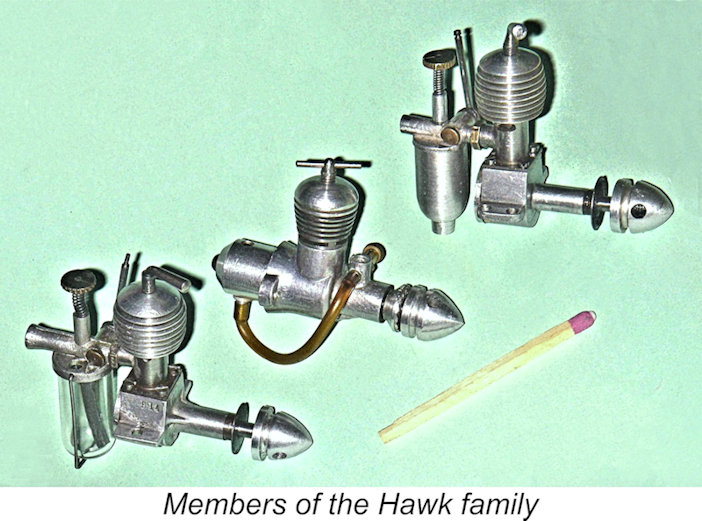 Here we share a detailed look at a little gem from the early years of the post-war British model engine manufacturing industry - the 0.2 – 0.25 cc Kemp (later “K”) Hawk diesel of 1948-49. This cute little powerplant was one of the first and most successful true sub-miniature model diesels to be produced commercially in Britain. Although it's a much sought-after collector's item today, it appears to have been rather sketchily documented in the past. Let's have a go at setting this right........
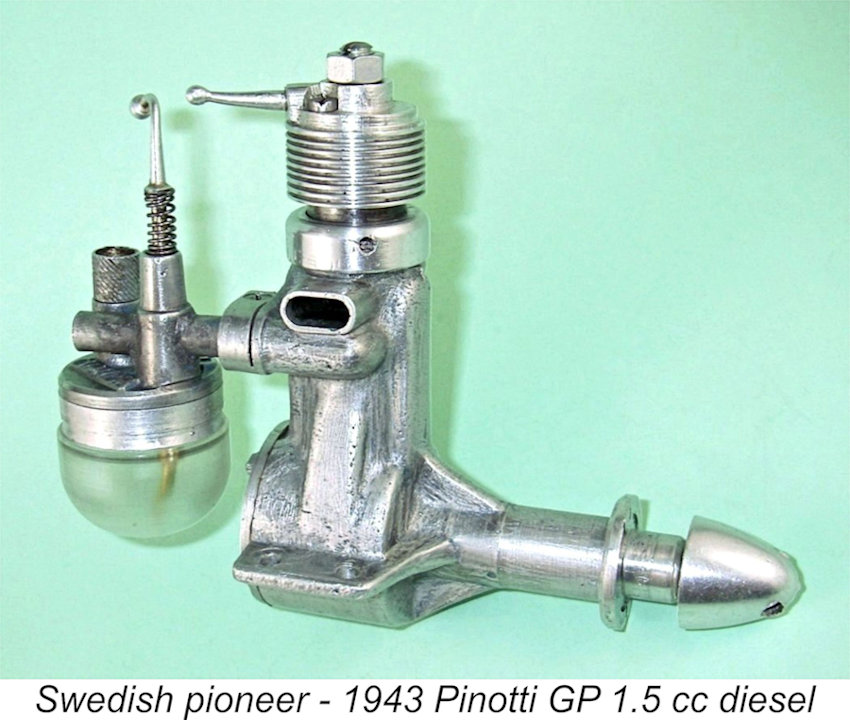 The basic principle of the model “diesel” (or more correctly, compression ignition) engine originated well before WW2. However, it took some time for the potential of the concept to be realized, and it was not until the WW2 years that it finally took shape in the form of a practical model powerplant. This development was initially confined to Switzerland and a few other European and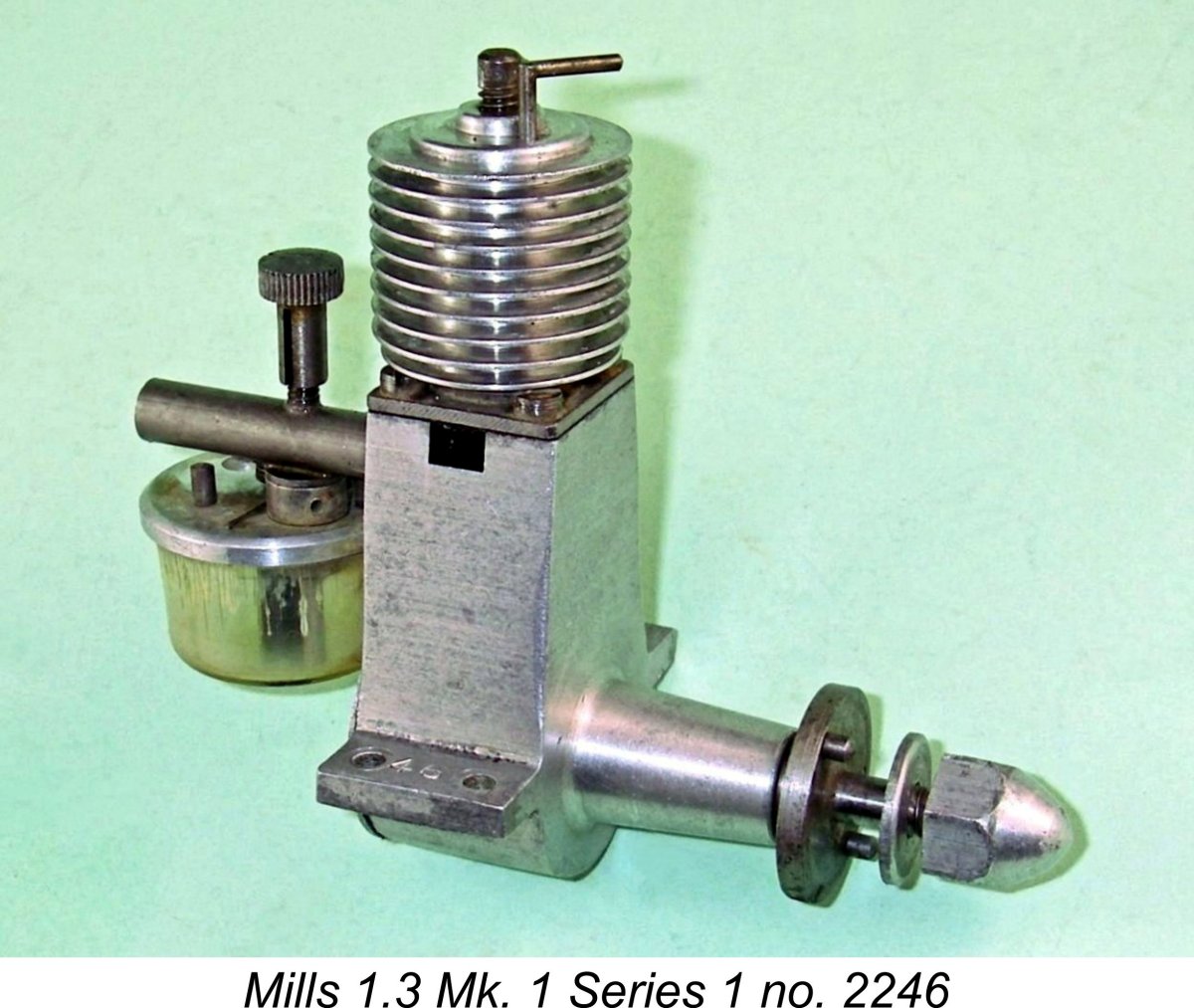
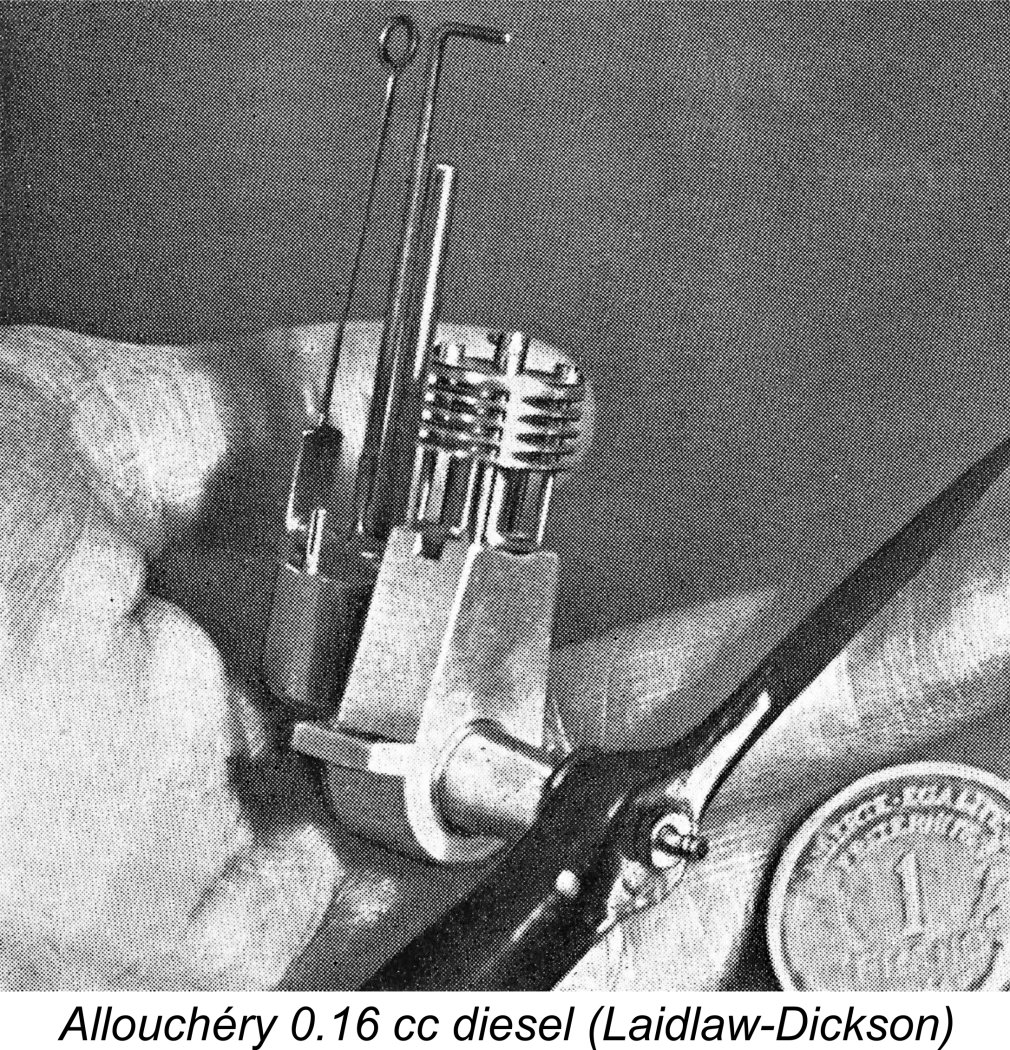 The French took the early lead with the remarkable little
 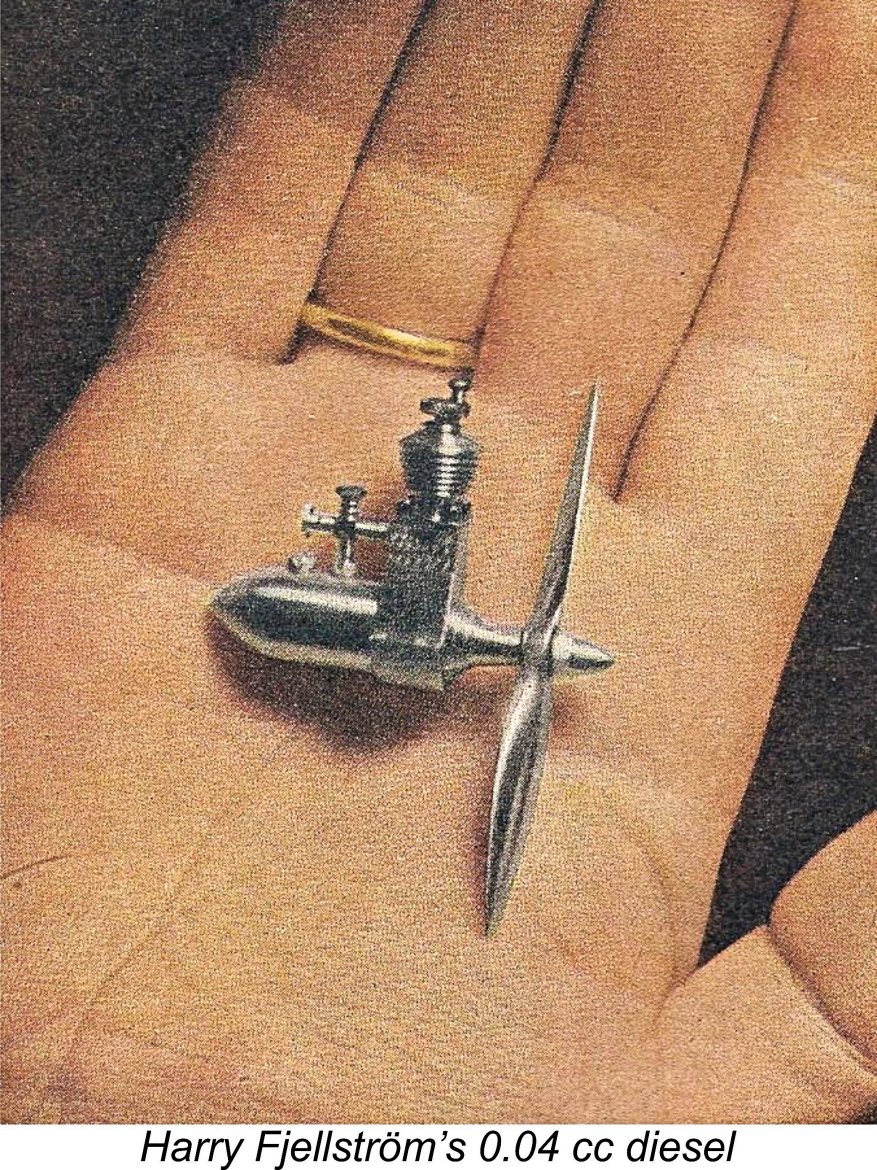 Amazingly enough, Harry Fjellström's little masterpiece still exists, forming part of the Harry Fjellström collection at the Stockholm Technical Museum in Sweden. The original bore and stroke of this incredible creation were 3.16 mm and 5.2 mm respectively for a displacement of 0.041 cc! Following a good deal of demonstration running at exhibitions, the engine was rebored to 3.3 mm, which increased the displacement to 0.044 cc, where it remains today. The unit weighs a mere 9.5 gm and reportedly turned a matching hand-made aluminium airscrew at over 5,000 RPM, sounding like an over-excited gnat in doing so! Quite an achievement!
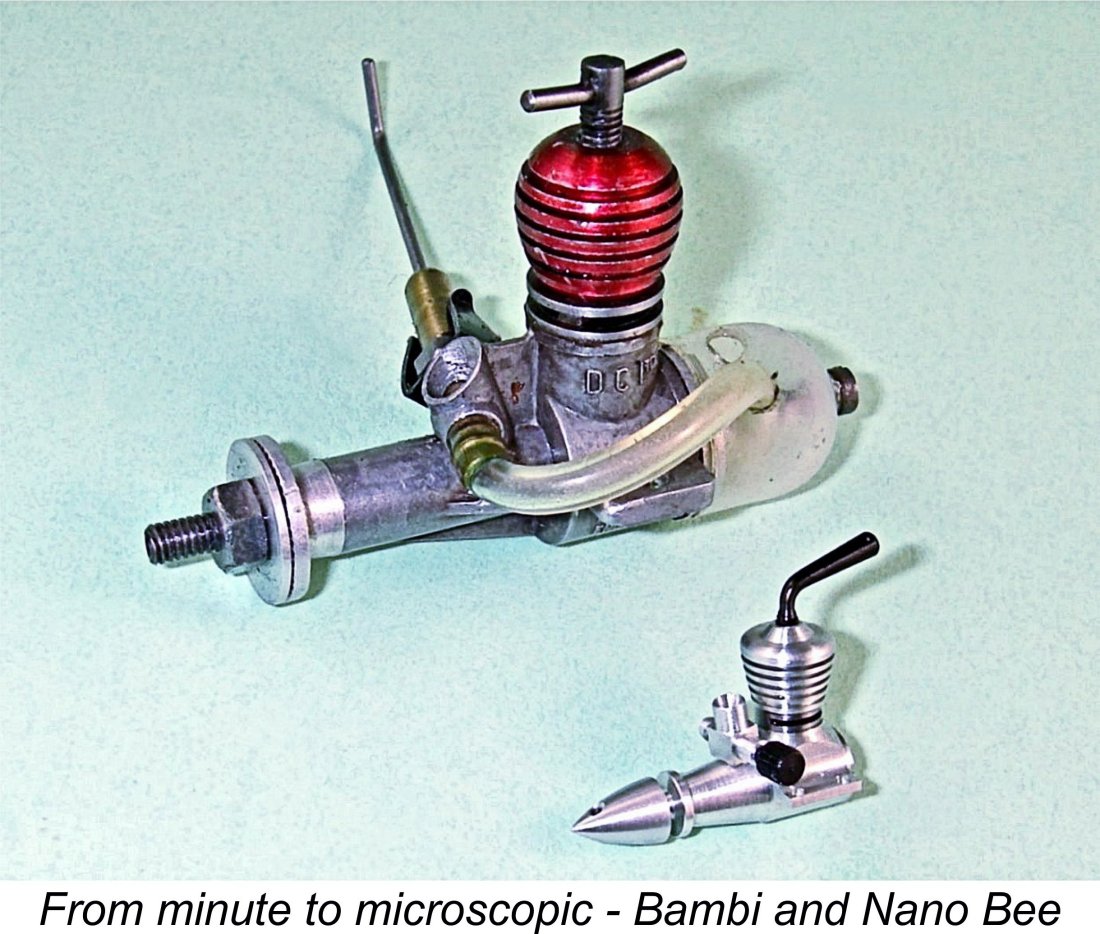 In passing, one wonders what Sparey's reaction would have been to the astonishing near-microscopic diesels made in the USA in later years by Ronald Valentine! Ronald's record for the smallest operating model diesel is held by his truly amazing little custom-made Nano Bee model, a precision limited-edition masterpiece which checks out at an almost unbelievable 0.006 cc (no, I didn't skip a decimal point - that really is 0.00037 cuin!). The Nano Bee makes a Bambi look like a large engine!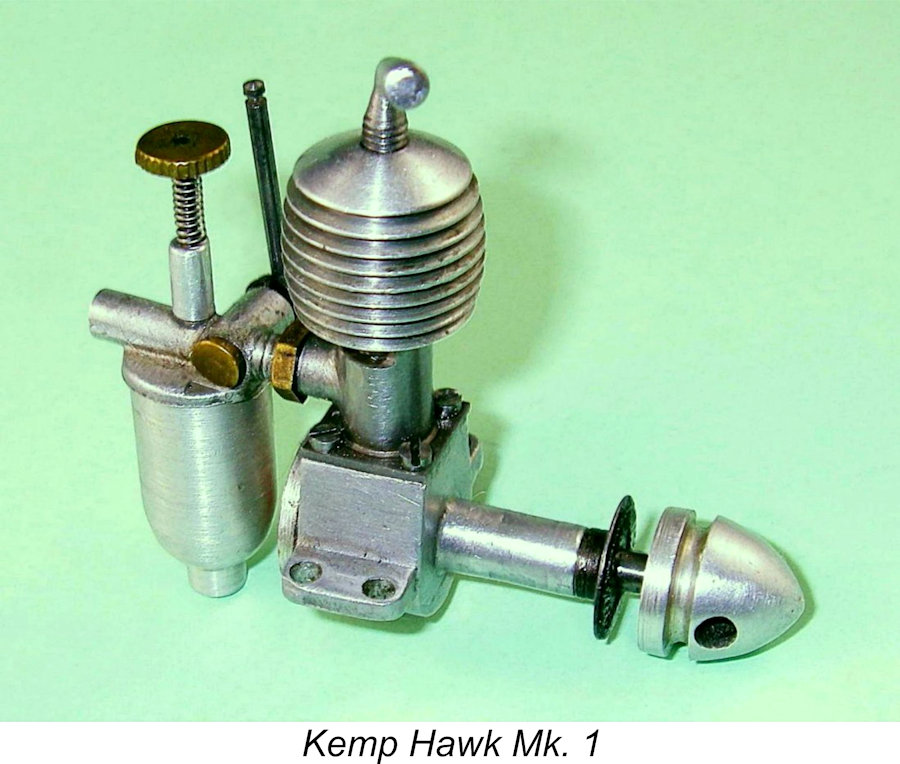
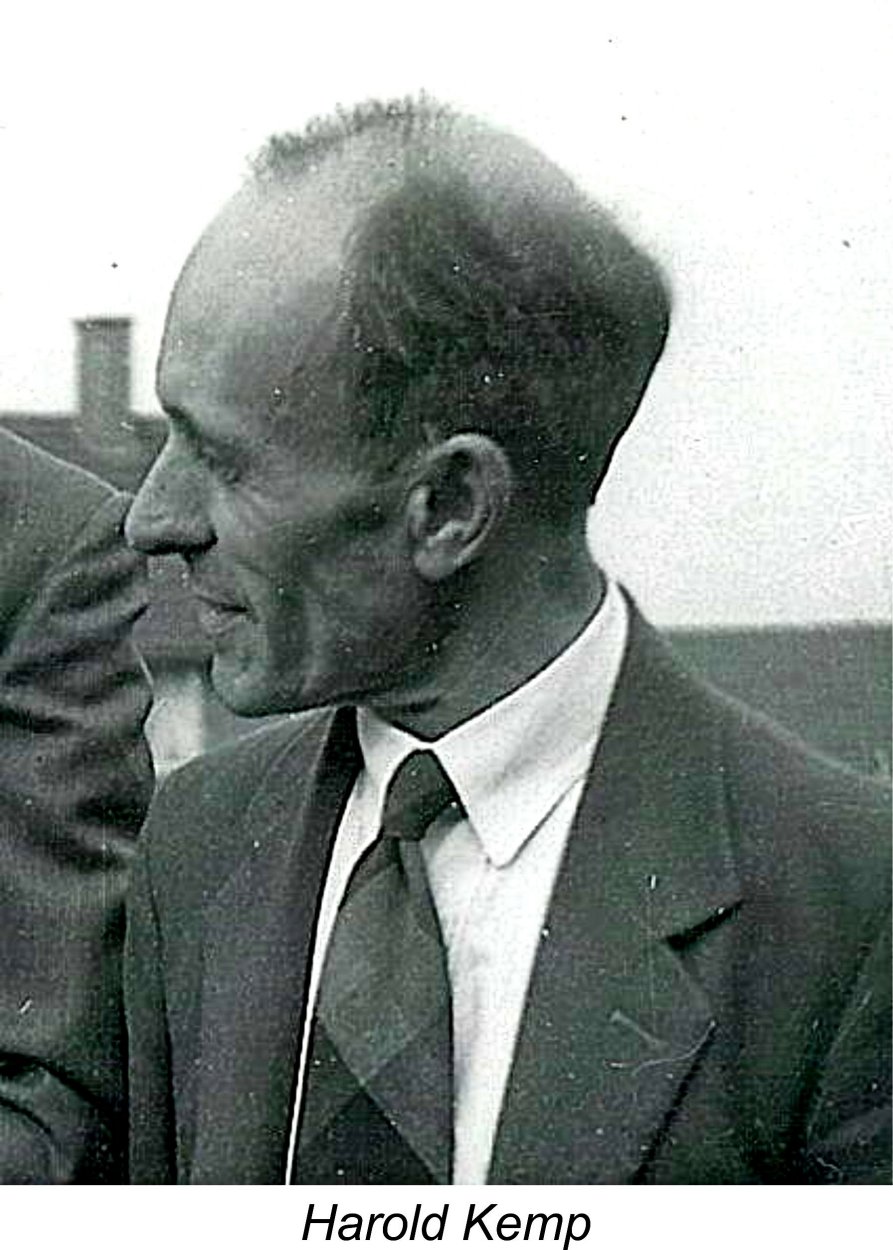 The company which introduced the Hawk series was founded in 1946 by Harold Kemp. I've been unable to track down any record of his birthdate, but circumstantial evidence suggests that he must have been born in around 1905 or thereabouts.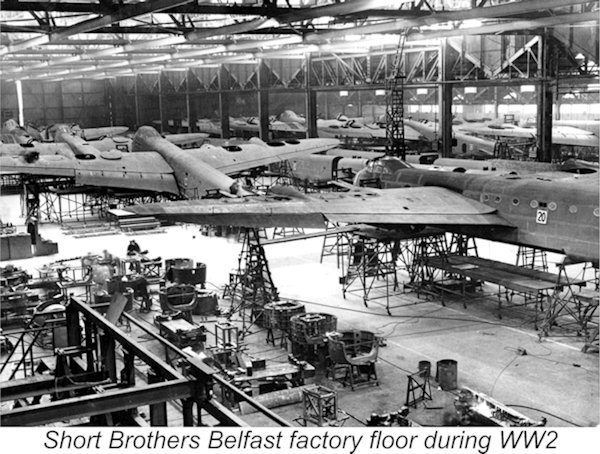
 In staking his future upon this entrepreneurial participation in the post-war model engine manufacturing industry, Kemp was far from being alone. To take one other well-known example, the soon-to-be famous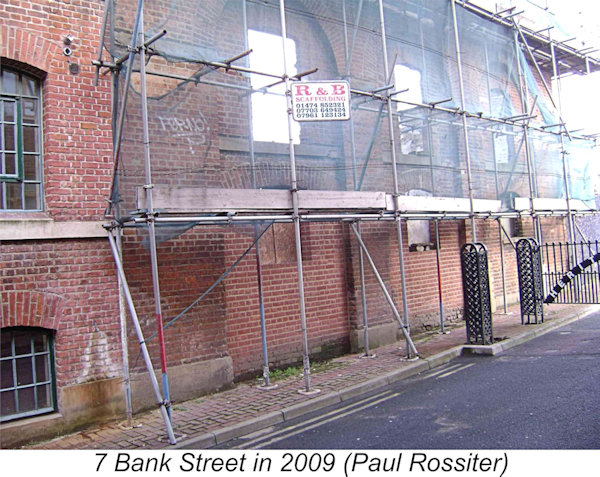
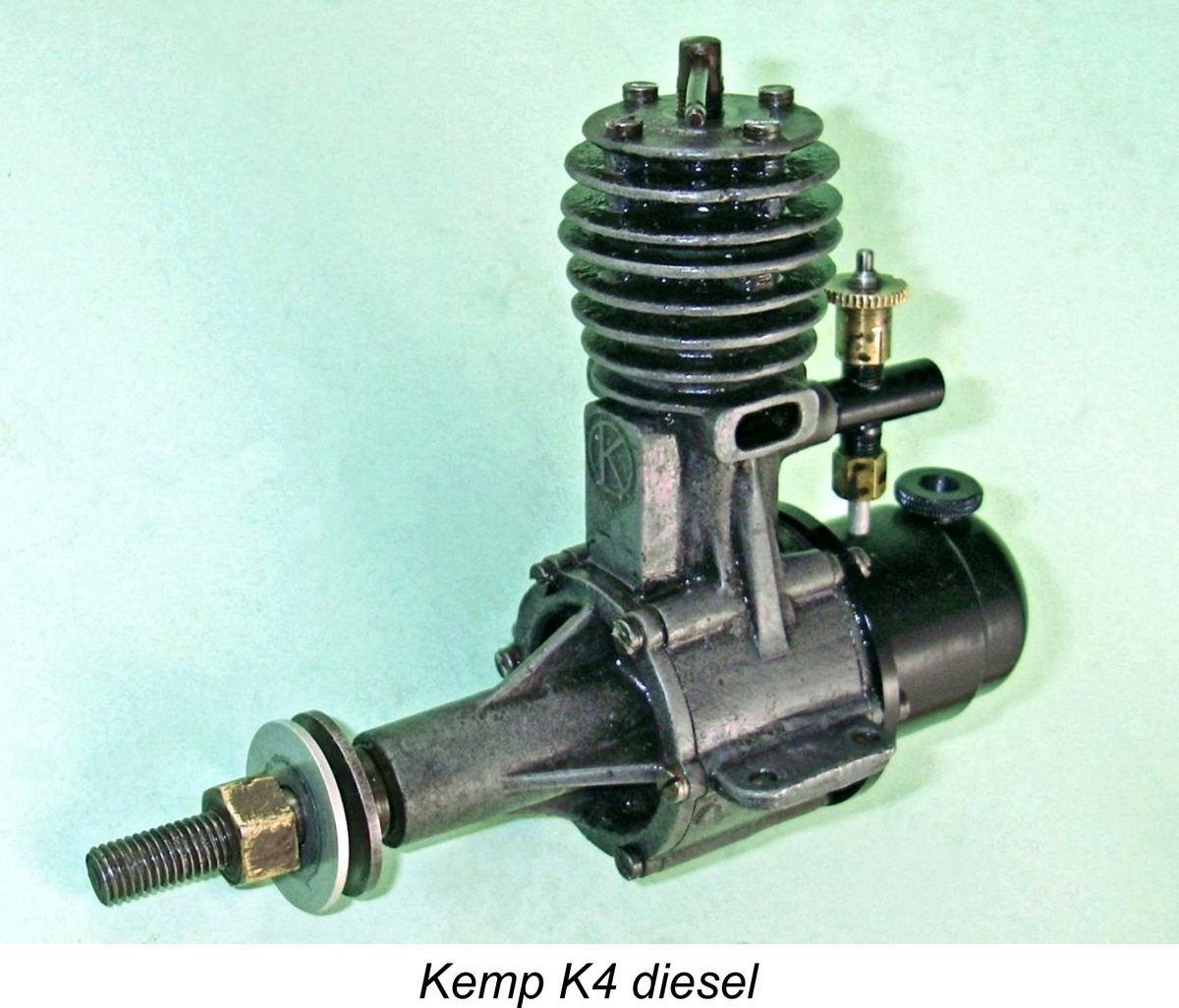 The establishment of production facilities and the completion of design and tooling seem to have taken up the later part of 1946, with the first commercial product of the new company appearing in early 1947. This was the 4.4 cc
 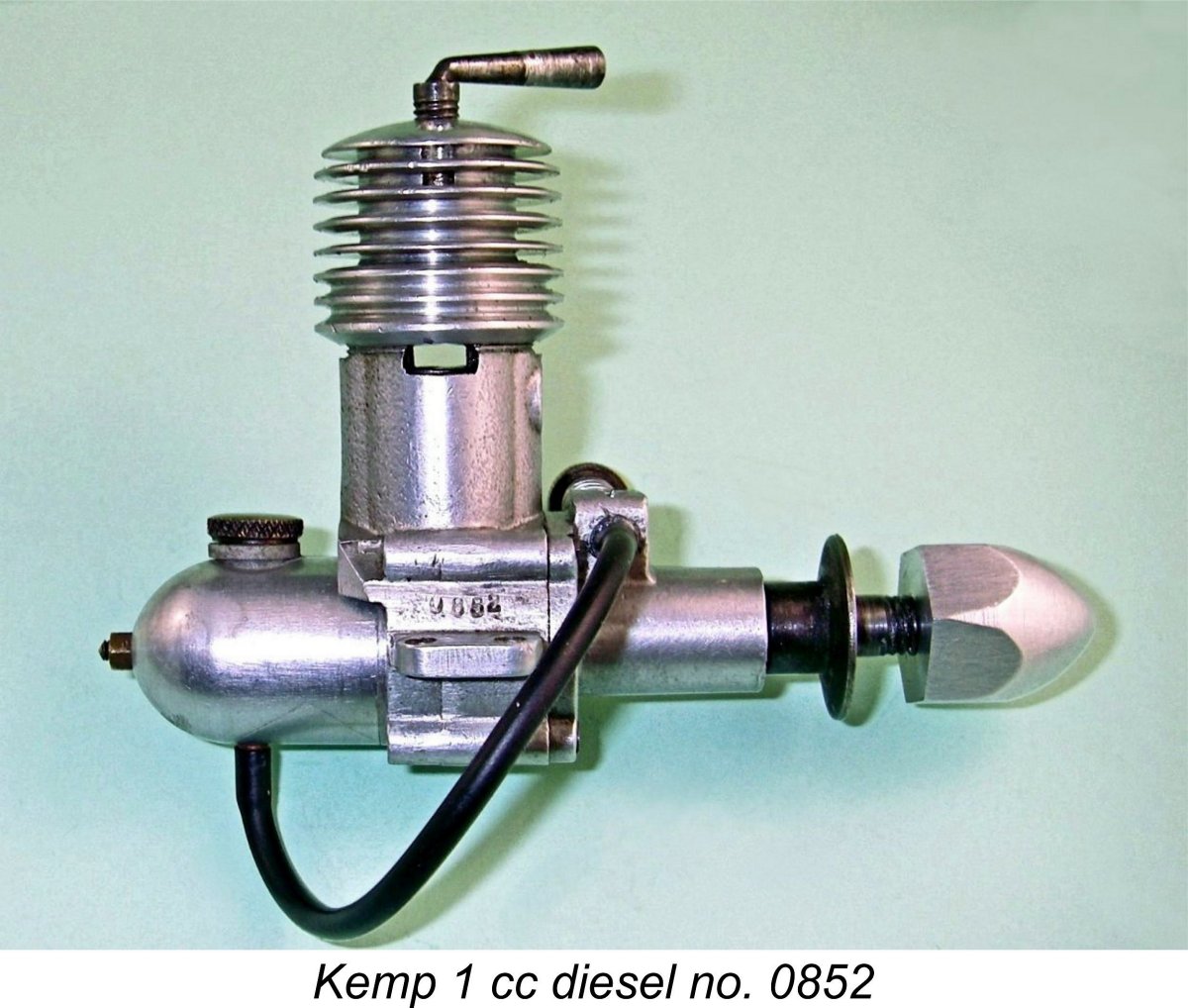 Although a rather unspectacular performer by emerging standards, this version of the engine earned a very good reputation for being well made, easy starting and reliable. It was a steady seller, albeit in the relatively small quantities dictated by the production limitations of the very small workshop in which it was made.
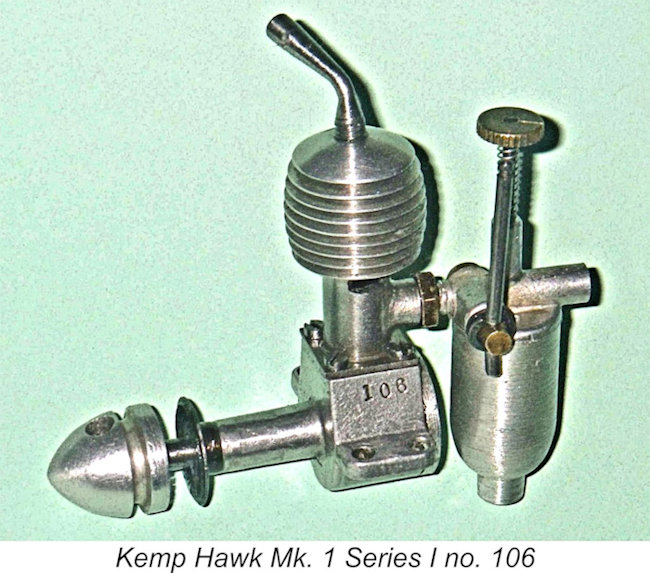 The expansion of the range continued in early 1948 with the initial appearance of the smallest engine that Kemp was destined to design and manufacture - the Hawk, which is our main subject here. This event followed the adoption of the well-known "K in a circle" trade-mark, since this mark appeared on the Hawk instruction leaflet, albeit not initially on the engines themselves.
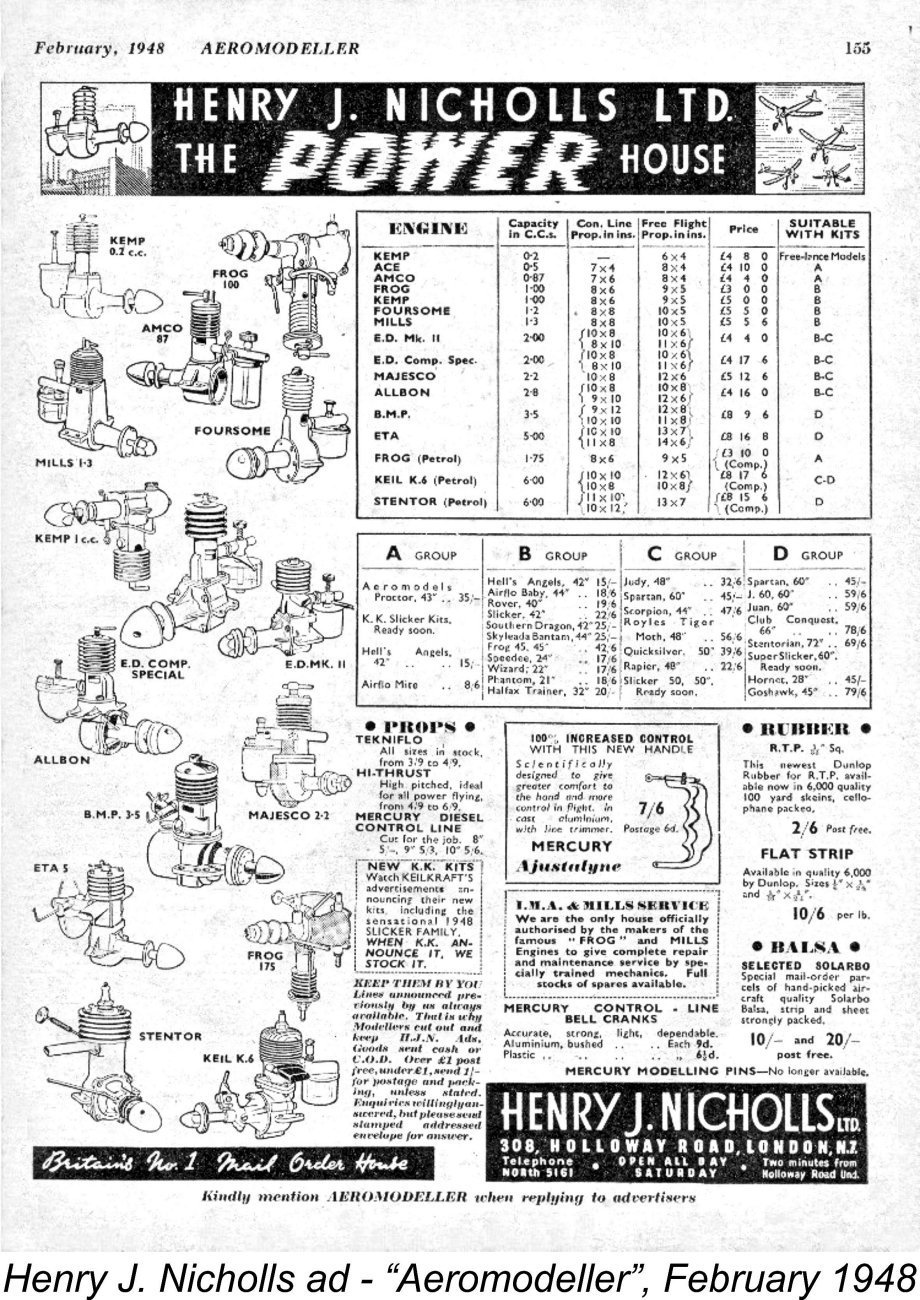 The engine actually made its advertising debut in Henry J. Nicholl's advertisement which appeared in the February 1948 issue of “Aeromodeller”. Taken together, this evidence appears to date the engine's introduction pretty conclusively to around January 1948. It seems likely that the intent had been to get the engine onto the market in time for Christmas 1947 but that production problems had prevented this from happening.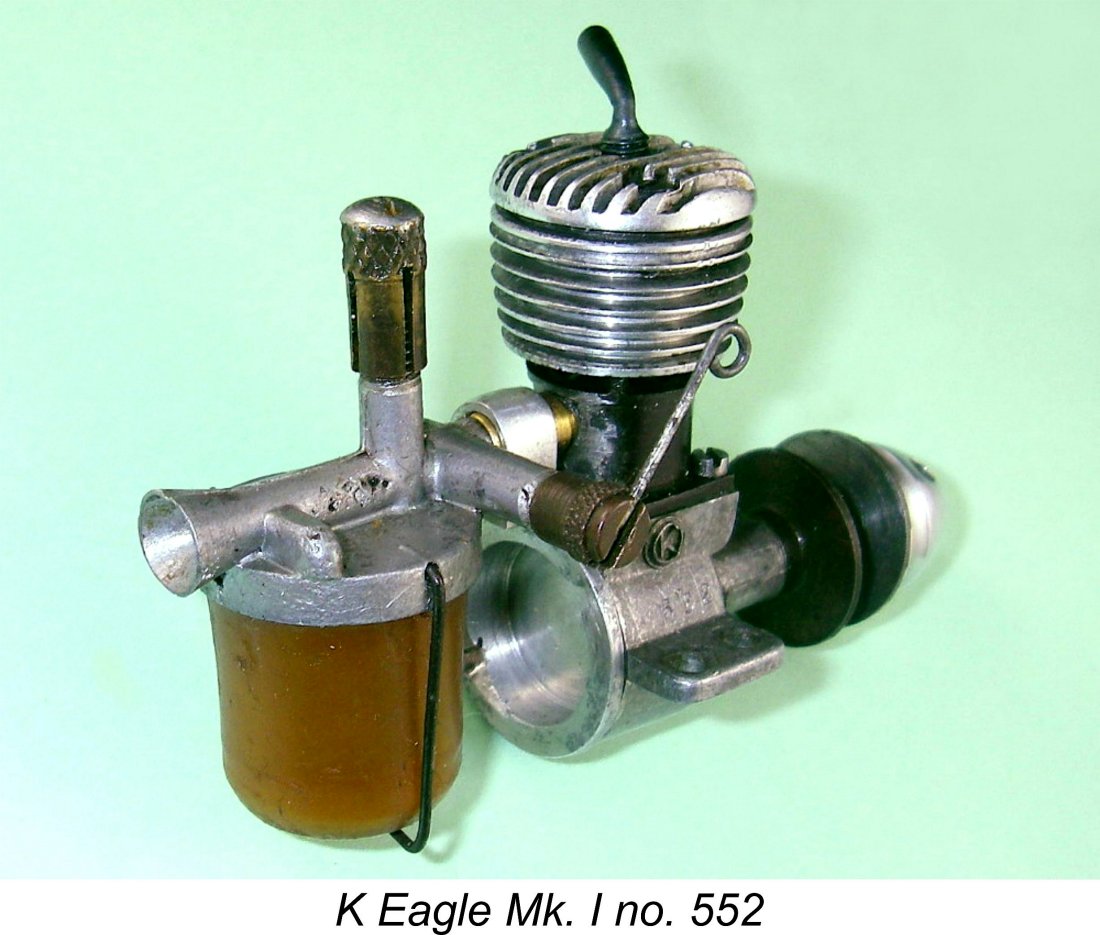
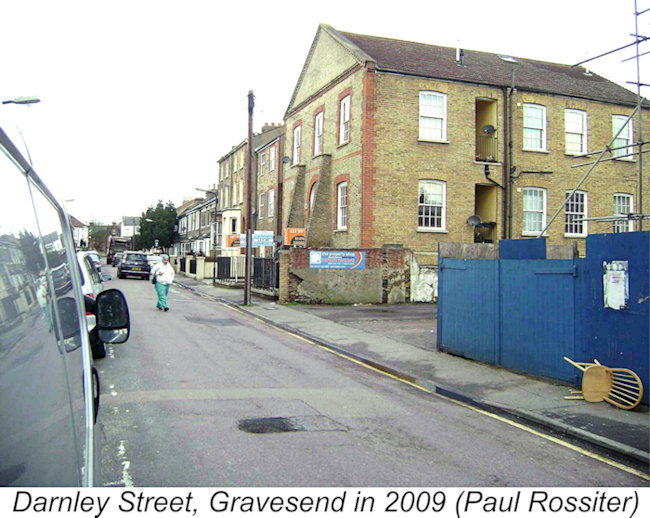 The immediate success of the Hawk along with the positive reception of the Eagle seems to have had the concurrent effects of turning the Kemp Engines business into an attractive investment proposition while at the same time creating a production capacity problem for the company. It appears that Harold Kemp was quick to appreciate both issues, and in mid-1948 he was successful in attracting additional investment through the transfer of the Kemp Engines business and premises to a new company, the "K" Model Engineering Co. Ltd. This name was presumably taken from the previously-mentioned "K in a circle" trade-mark already being applied to the Kemp engines.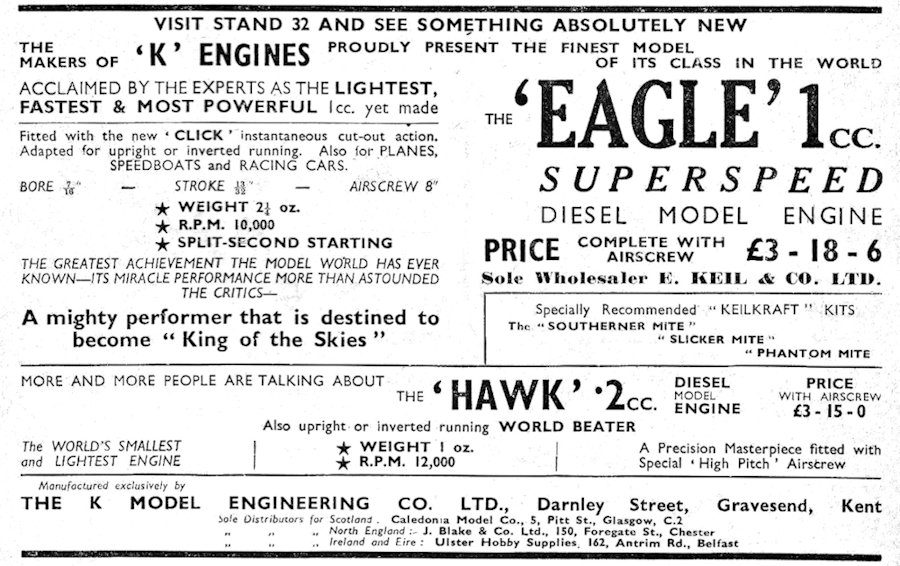
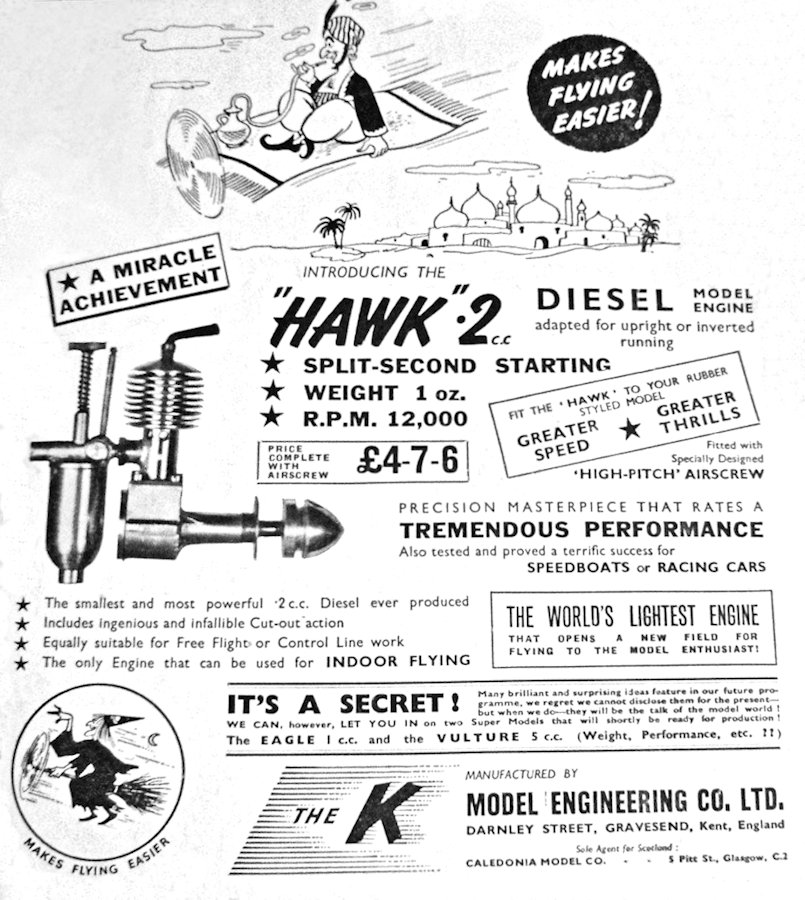 As stated above, the move to bring in additional investment likely stemmed primarily from the need to increase production capacity due to the success of the Hawk coupled with a desire to update and expand the range. It seems quite likely that production of the well-established and still popular Hawk model, and perhaps the continuing Eagle Mk. I design as well, continued uninterrupted at Bank Street in order to maintain a cash flow while the new company consolidated its expanded production facilities at Darnley Street and developed the updated product line that was soon to appear.
 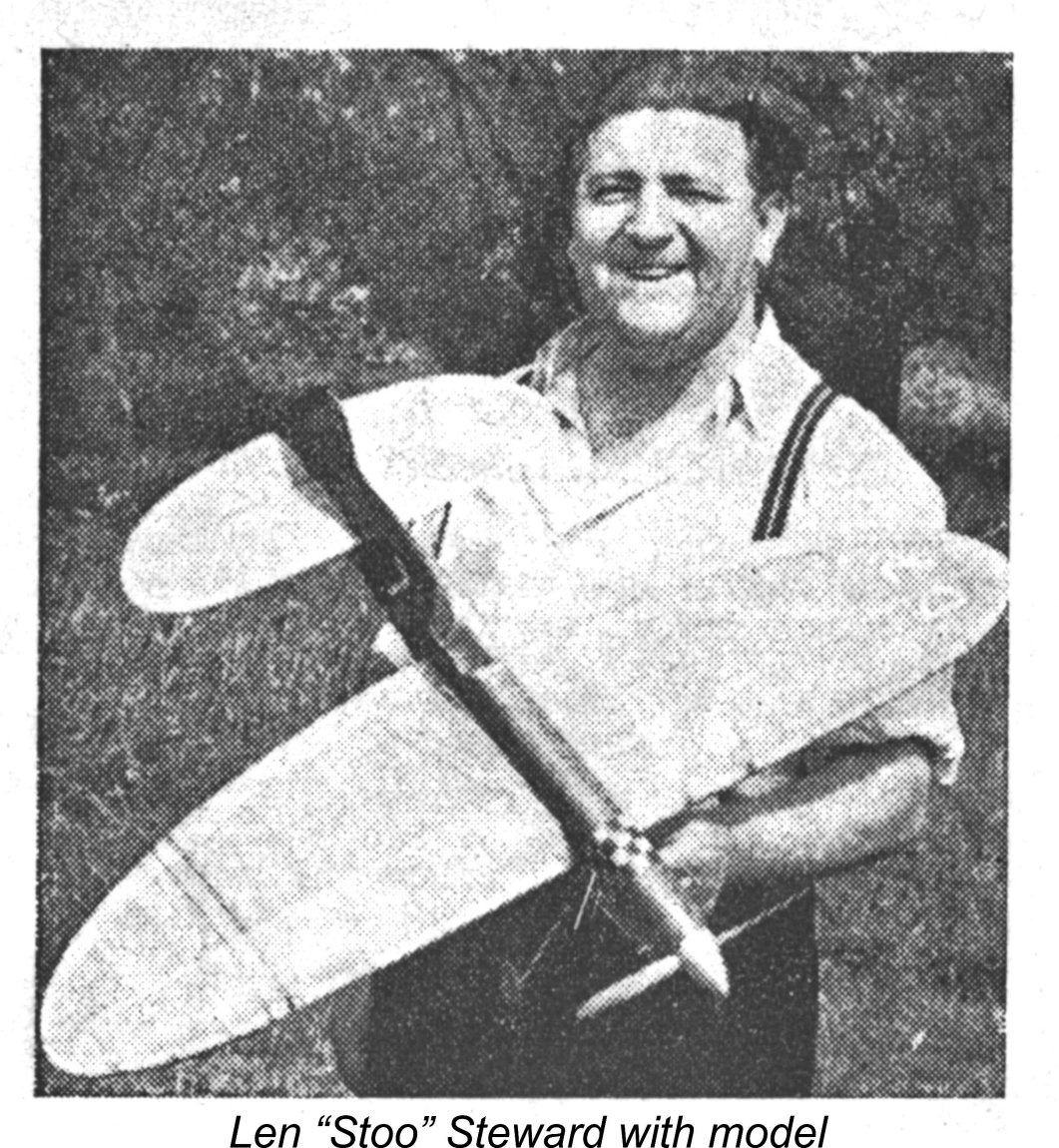 One of the principals in the new company was Len "Stoo" Steward, a jovial-looking character who was very well known in British aeromodelling circles. We may know nothing about Harold Kemp's involvement with modelling prior to his becoming a model engine manufacturer, but there's no doubt at all regarding "Stoo" Steward's participation in the hobby! He was a very prominent hands-on aeromodeller who was a charter member of the prominent West Essex club (est. 1947), becoming a regular fixture at early post-war contests, predominantly in control-line stunt events. He thus brought the invaluable perspective of a practical contemporary power modeller to the newly-reorganized company.
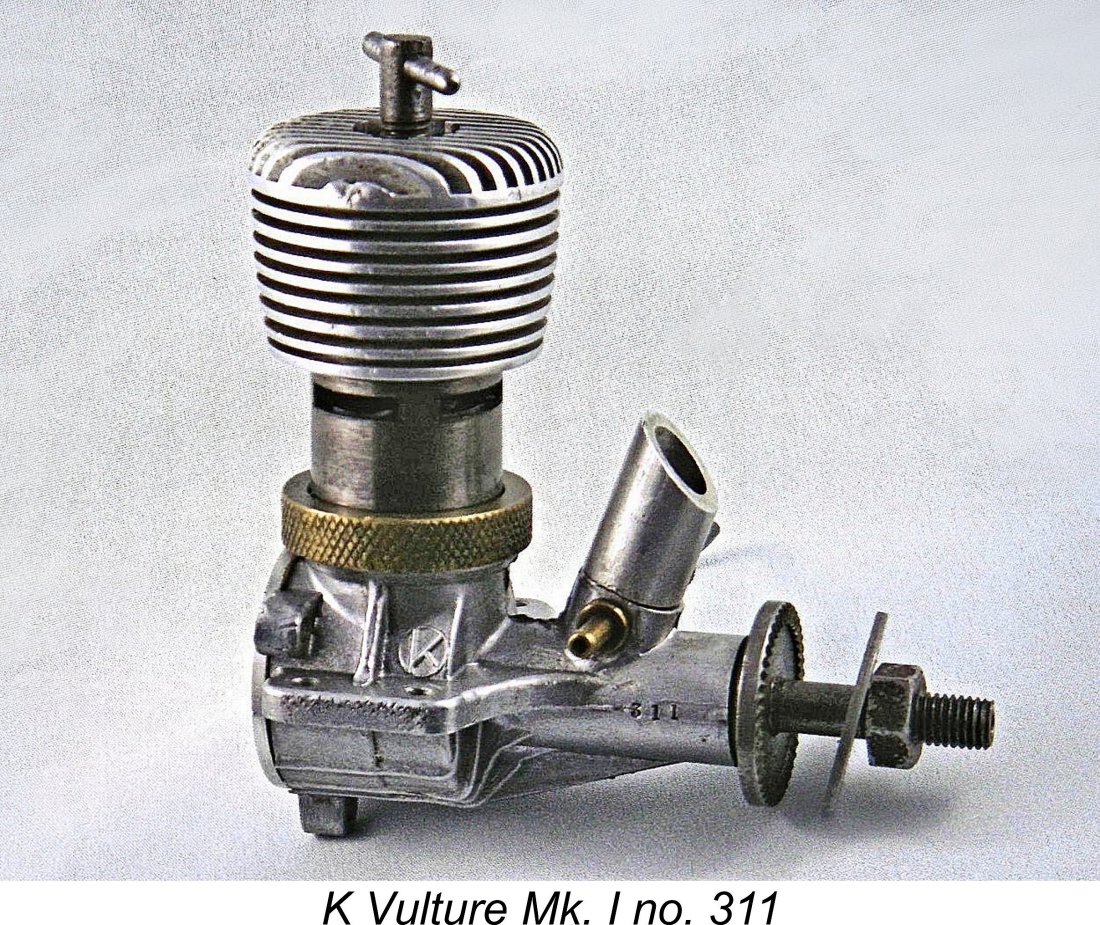 The K4 had been discontinued more or less concurrently with the early 1948 introduction of the Hawk, while production of the Eagle had been somewhat constrained by the Hawk's success. Steward had big plans to replace all three designs. The old 4.4 cc model was replaced by the far more powerful but highly cantankerous FRV 5 cc
  While all this development work was going on, Steward maintained a cash flow by continuing production of the still popular sideport Hawk model, merely renaming it the “K” Hawk and promoting it for a time as the "flagship" model of the new company pending the introduction of the significantly expanded range which was then being planned. The price initially remained unchanged at £4 7s 6d (£4.38), but was soon lowered to £3 15s 0d (£3.75).
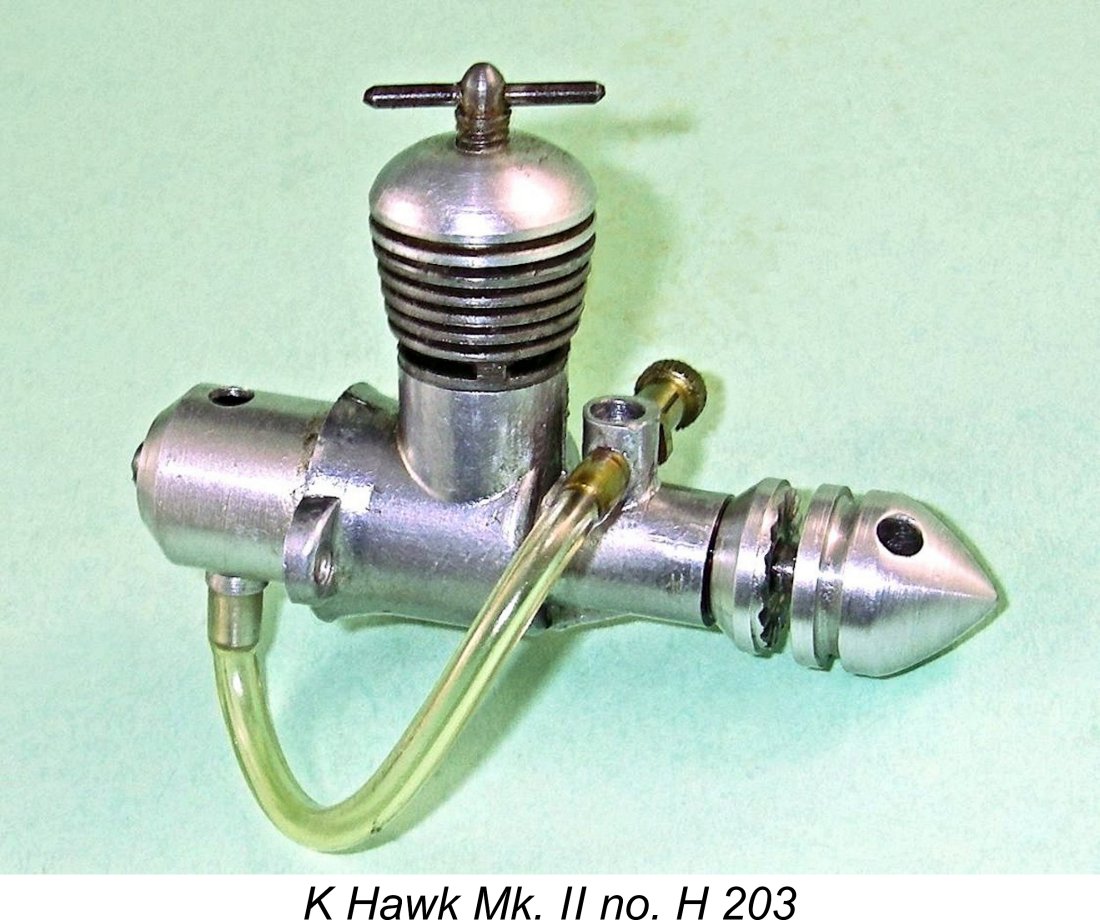 end of the Hawk - on the contrary, May 1949 saw the advertising appearance of the even smaller “K” Hawk Mk. 2 of 0.193 cc displacement. This was a completely new FRV design as opposed to being merely a further update of the original Hawk, as we shall see below. It was offered at a further reduced price of £3 7s 6d (£3.38), but doesn’t appear to have remained very long in production if surviving numbers are any indication, although it did continue to appear in the manufacturer's advertising until January 1950, with a few dealers continuing to list it until May 1950.
 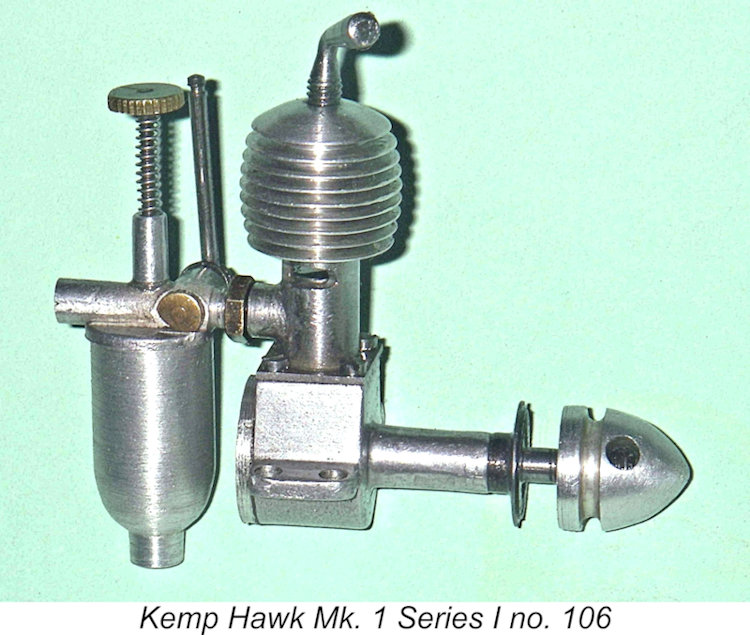 The original Mk. 1 version of this neat little powerplant was apparently launched upon the market in January 1948 or thereabouts, making its initial advertising appearance in the Henry J. Nicholls "Aeromodeller" placement of February 1948, as noted previously. It remained in production for about a year, undergoing a number of modifications over that period. It was named the Hawk from the outset, evidently being the first Kemp model to receive one of the well-known "Bird Of Prey" names with which the Kemp and “K” engines are associated. As noted earlier, the sideport version of the 1 cc Eagle appeared after the Hawk, thus becoming the second model to be so named. The Vulture, Falcon and Kestrel were all to follow.
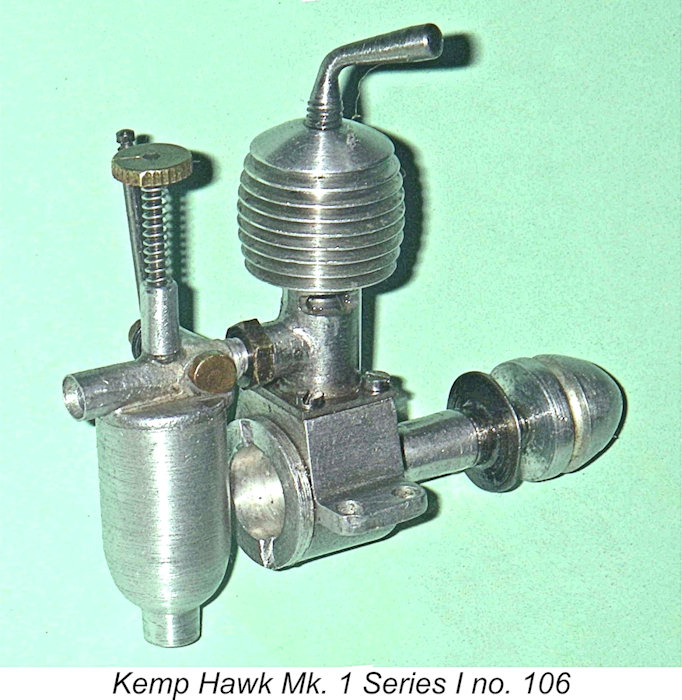 Naturally, this very low all-up weight opened up a number of new fields for the intrepid power modeller. Since the Hawk weighed little more than a typical rubber motor, the possibility existed of using it to power designs originally intended for rubber power, with the advantage of the consistent and controllable power output delivered by a diesel engine. Coupled with its low power and very modest noise levels, this also made it adaptable to small ultra-lightweight models suitable for indoor flying. The manufacturers were to quote both of these possibilities in their future advertising.
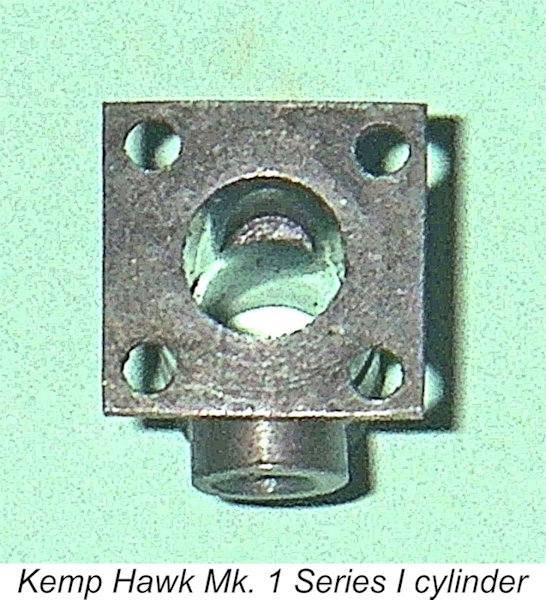 Looking first at the cylinder, this component differed from those of the later variants in terms of the bypass arrangements employed. This type is easily spotted - there's no sign of any external bypass passage at the front as there is with both of the later variants. Instead, the Series I cylinder features a bypass which consists of a single flute milled internally into the cylinder wall at the front. The cutter was slightly angled so that the passage began some distance up the bore from its open end and became progressively deeper and wider as it progressed up the bore to the actual transfer discharge location - a very tricky piece of machining at this tiny size, requiring an ultra-precise set-up! The slightest error would have resulted in a break-through at the top.
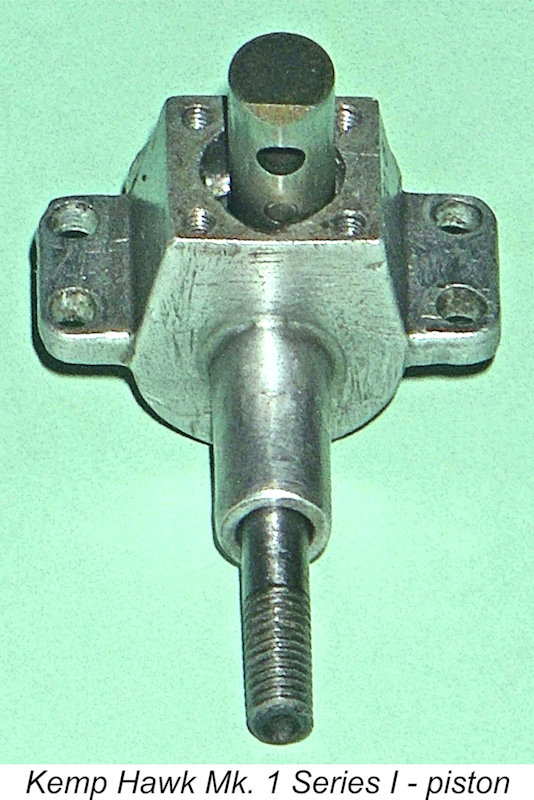 The bypass passage was supplied with mixture from the crankcase through a hole in the front piston wall above the pressed-in gudgeon pin, which was set very low in the rather lengthy piston. This hole maintained communication with the lower end of the bypass passage at and near bottom dead centre. Incoming mixture thus flowed through the piston interior past the small end of the steel conrod to reach the bypass passage through the piston port. Good for piston cooling and small end lubrication.
 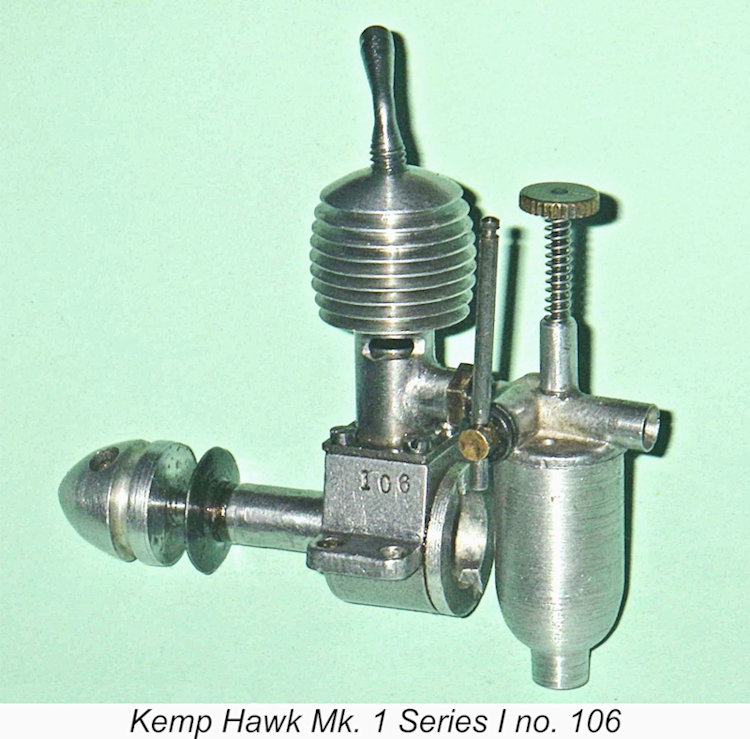 The outside diameter of the intake tube on this variant was parallel for its entire length, there being no bell-mouth at the actual intake. The fuel tank was of metal, and was mounted by screwing onto the full-depth brass fuel delivery pipe. This pipe in turn screwed at its upper end into the main venturi casting and incorporated the very fine fuel jet which protruded into the venturi throat. A rather inconvenient feature was the fact that only a single tiny hole was provided as a vent for the fuel tank. The tank could only be filled through this hole by the use of a needle syringe, and if this was not available the only recourse was the removal of the tank for filling.
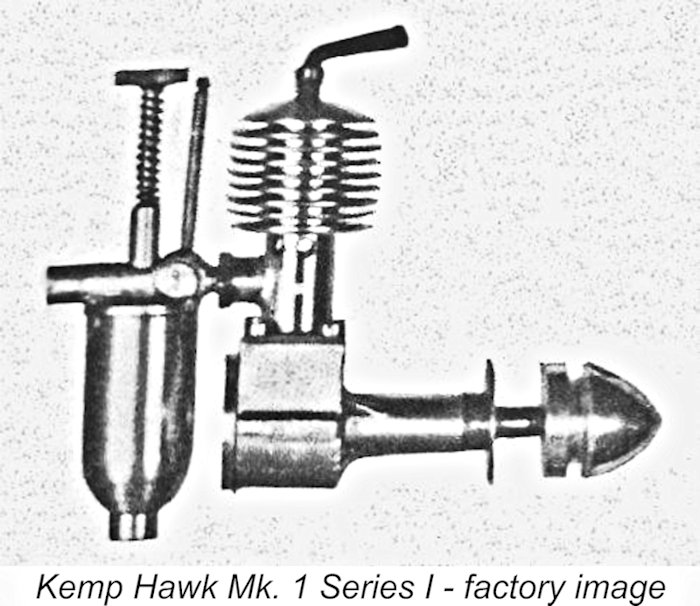 susceptible to crash damage, as one might expect. Accordingly, a revised casting was produced which incorporated three small bracing webs for the main bearing. This revised casting also carried the "K in a circle" trade-mark which had now been adopted by the company. This appeared cast in low relief onto the front of the main crankcase.
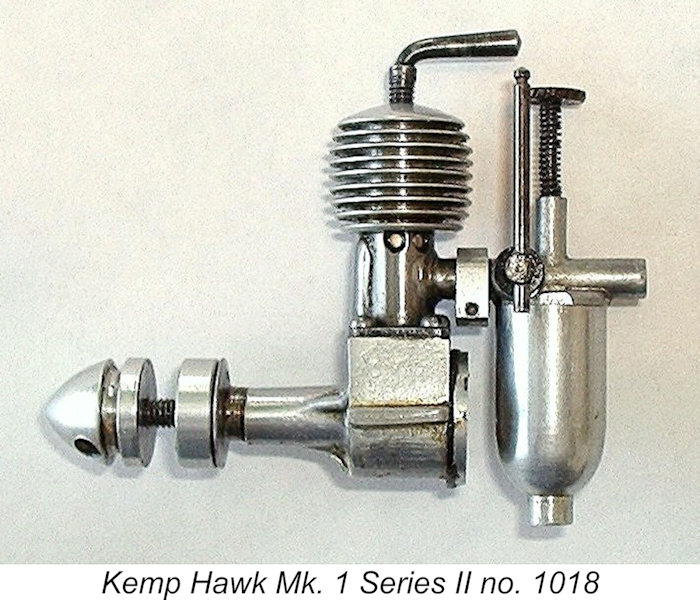 The second version of the Mk. 1 Hawk seems to have made its initial appearance by April 1948, only four months or so after production of the Hawk had commenced. It displayed a number of substantial departures from its predecessor, to the extent that it was in reality a different model, although this seems never to have been acknowledged by the manufacturer or widely recognized among the collector community. Most significantly, the bore was increased and the cylinder design was substantially altered, as was the means of attaching the carburettor assembly.
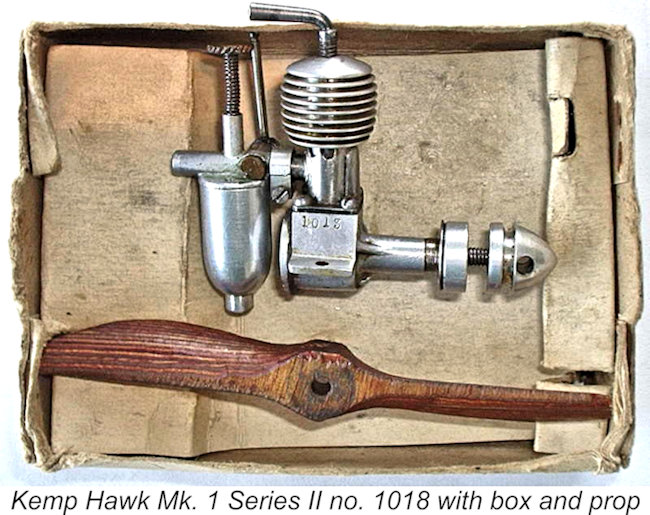 The stroke remained unchanged at 0.312 in. (as indeed it did throughout for all Mk. 1 Series), but the increased bore resulted in a revised nominal displacement of 0.251 cc - a 30% increase in displacement. It's reasonable to expect a significant performance improvement to result from this change alone. Interestingly enough, the manufacturers never appear to have acknowledged the displacement increase, continuing to promote the engine throughout as the "0.2 cc Hawk" and continuing to the last to feature the previously-reproduced illustration of the original Series I model in their advertising!
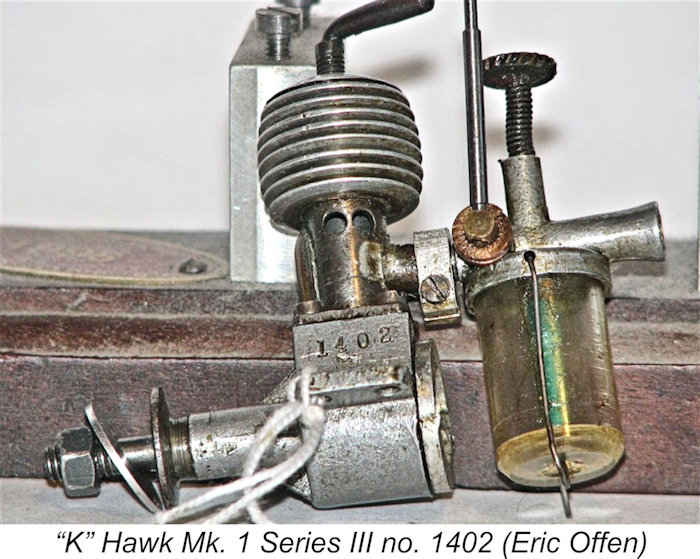 Present indications are that the third and final model of the Mk. 1 Hawk appeared in around August of 1948, shortly after the change in ownership recorded earlier. It differed far less from its predecessor than had been the case with the first design change. However, the differences are more than sufficient to warrant the recognition of this version as a distinct variant.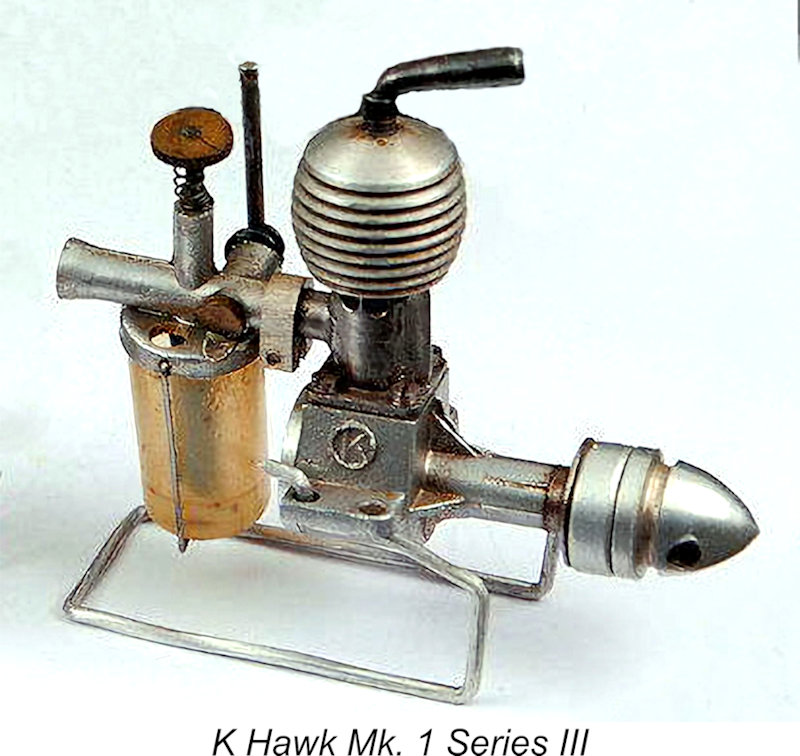
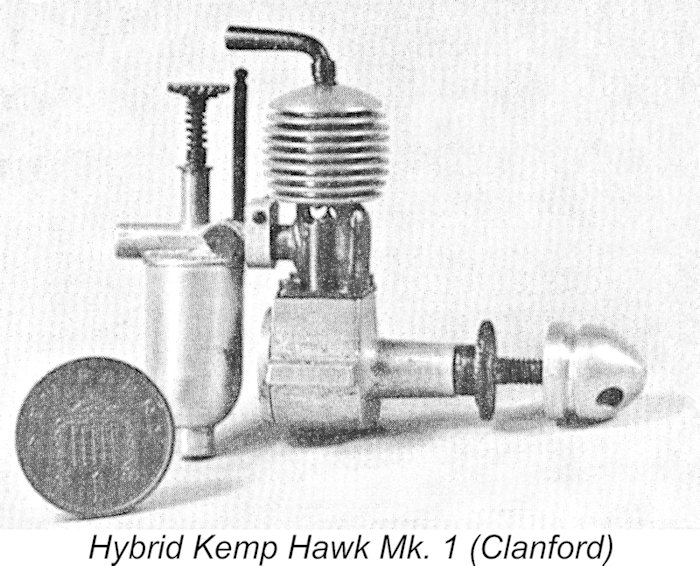 Examples of all three of these variants are illustrated on page 110 of Mike Clanford's entertaining but frequently-unreliable "
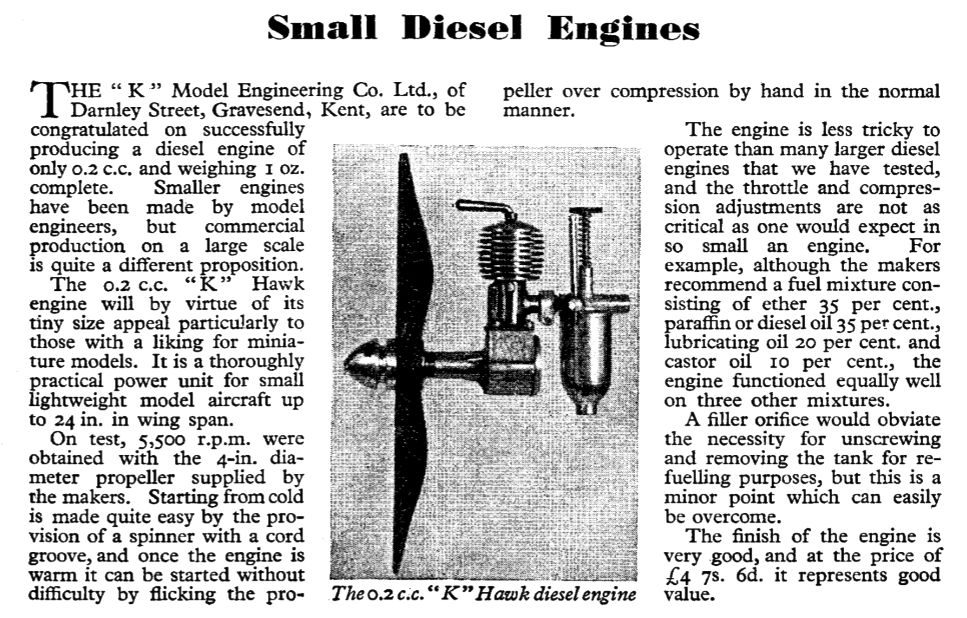 The only contemporary test of the "K" Hawk of which I'm aware appeared in the July 9
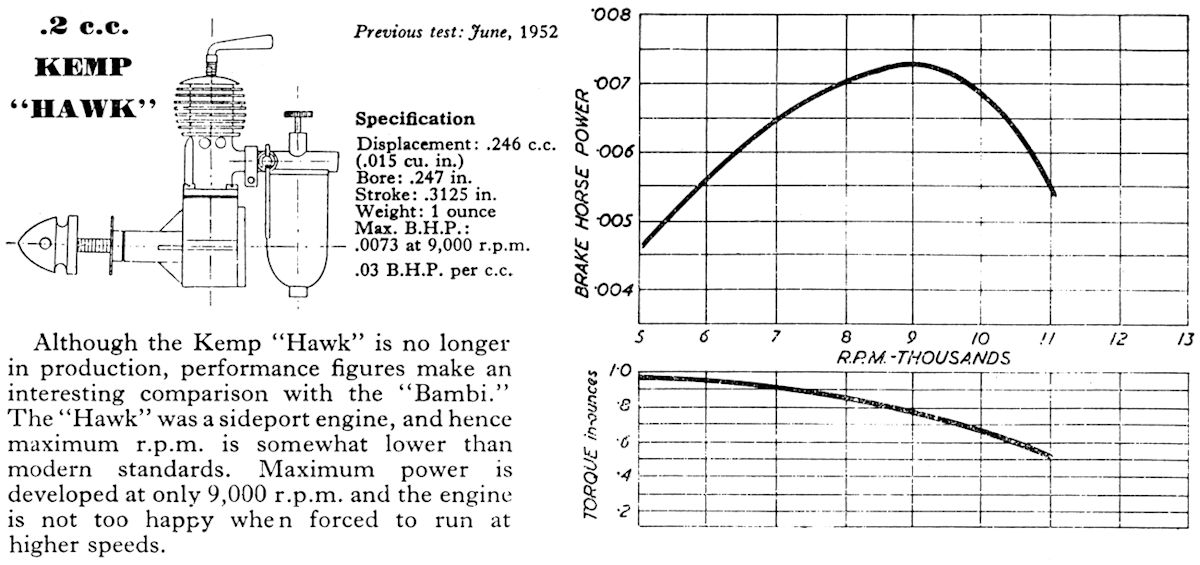 A summary retrospective test of one of the Hawk Mk. 1 Series III sideport models was published in the August 1954 edition of “Aeromodeller” magazine, where it appeared in conjunction with the test of the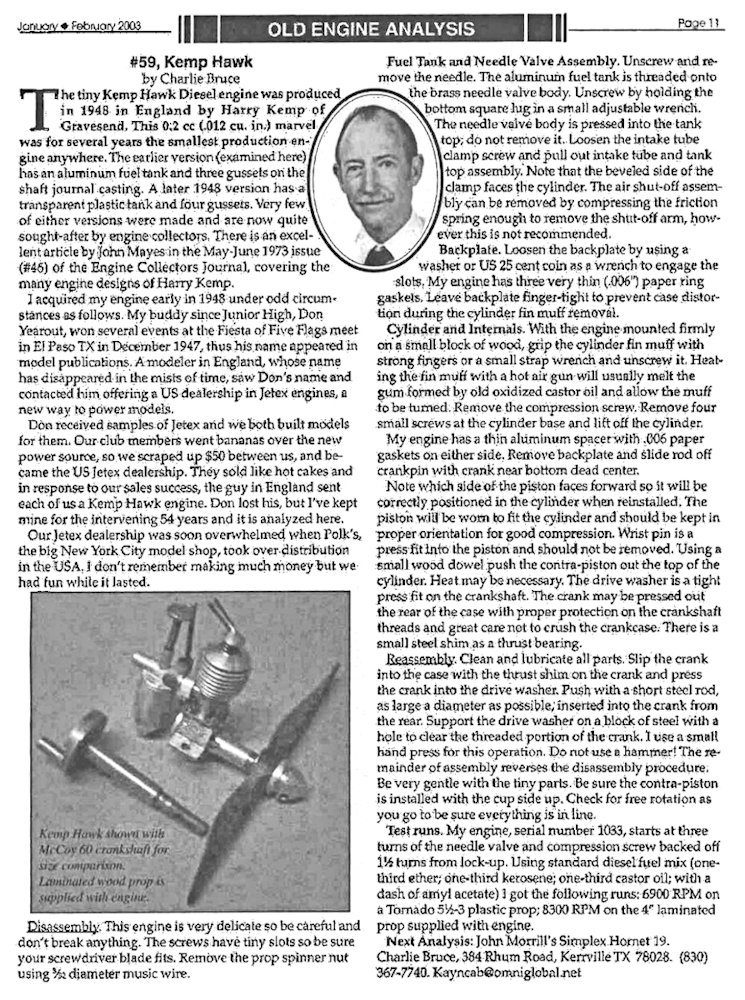
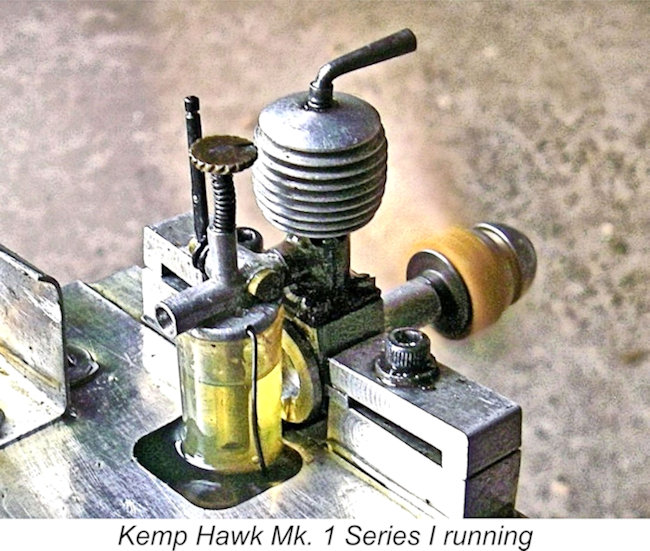
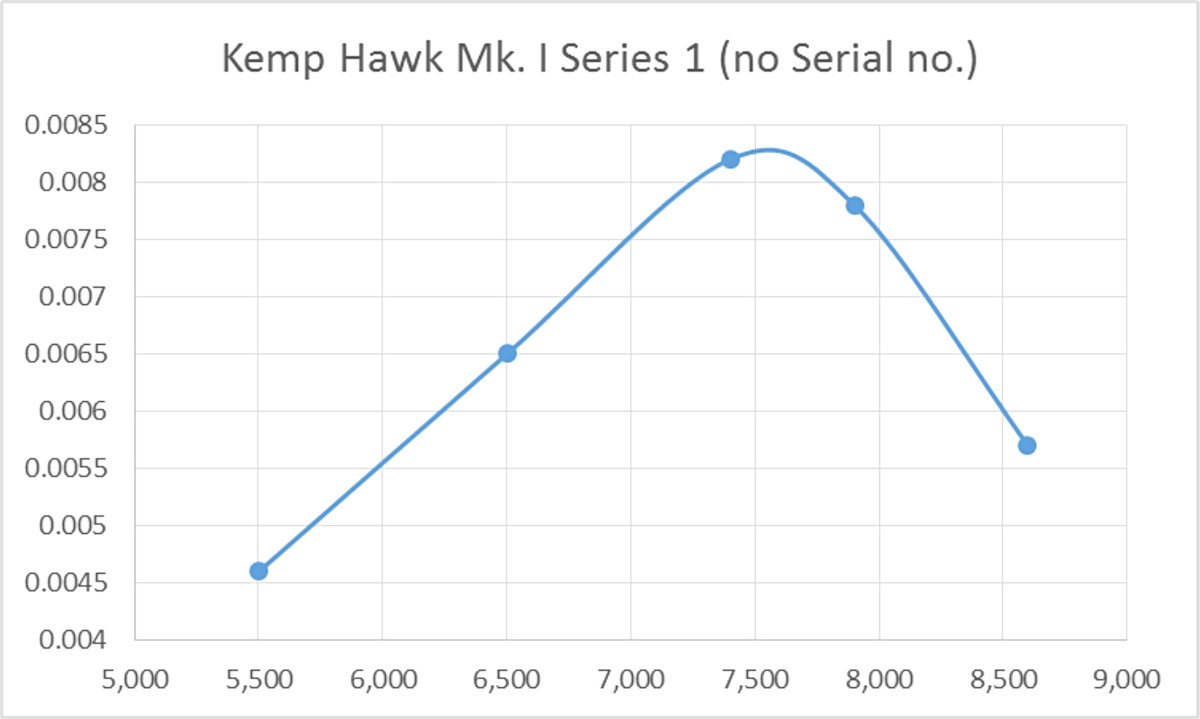
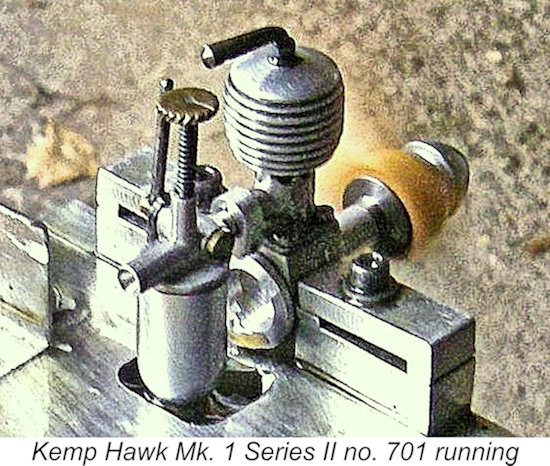
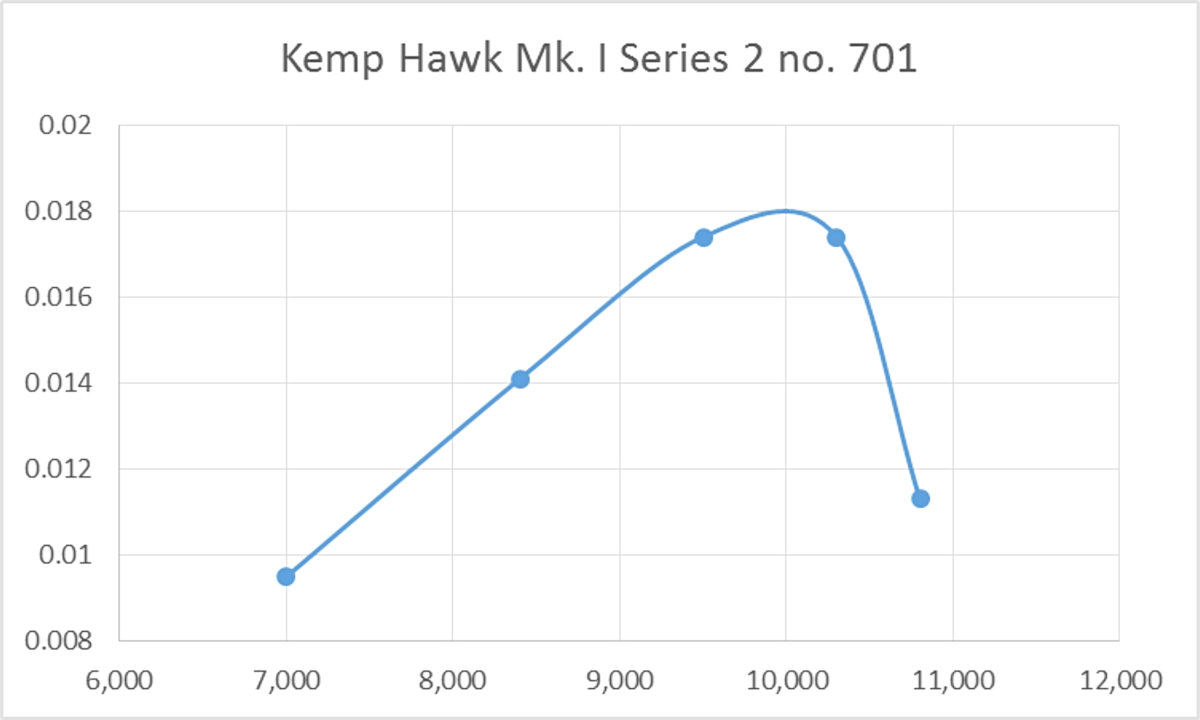
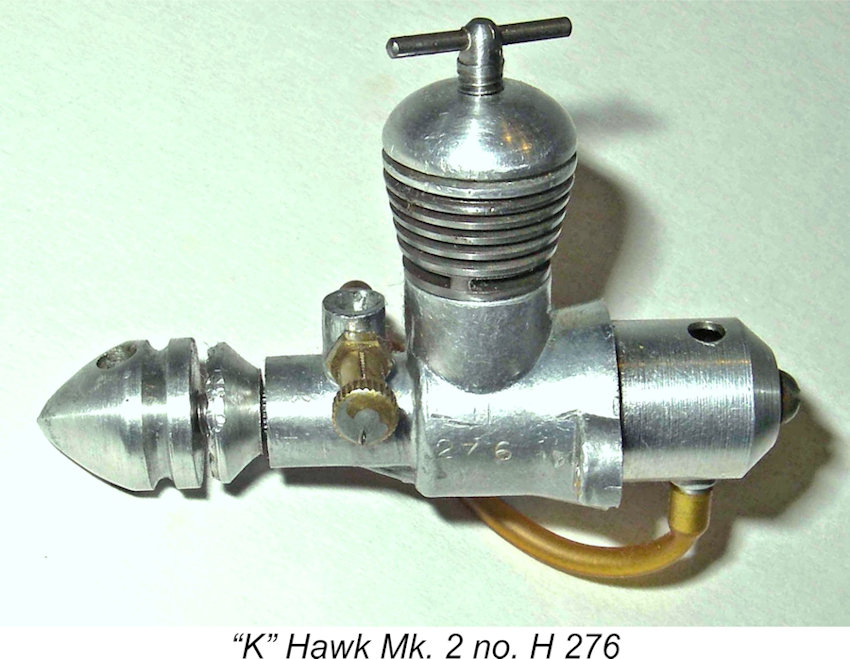 The Mk. 1 Series III version of the sideport Hawk seems to have survived in production for some time following the mid-1948 take-over by the "K" Model Engineering Co. However, the engine had disappeared from the manufacturer's advertising by December of 1948 and in May 1949 we find the company announcing a completely revised Mk. 2 model of the Hawk which used radial mounting in conjunction with front rotary valve (FRV) induction.
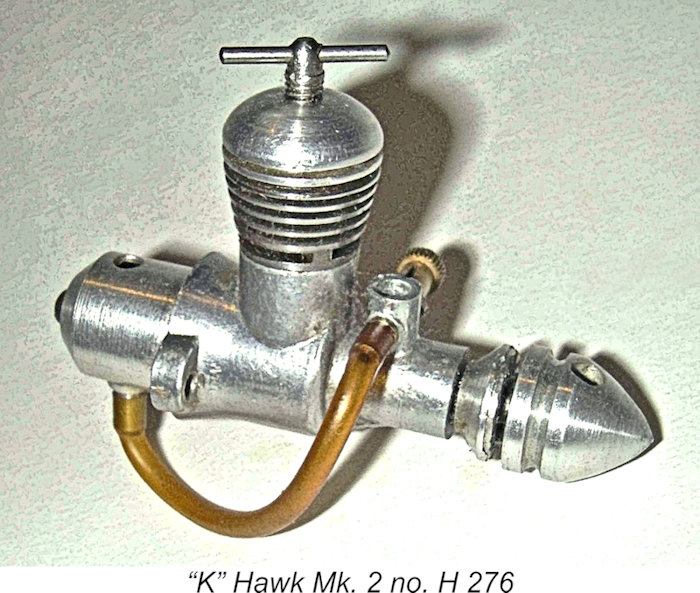 The serial numbering sequence was re-started with this model. The letter H (presumably standing for "Hawk") was initially appended in front of the numerical digits, after which the engines were simply numbered sequentially as they came off the line. Later, it appears that the H was dropped. Regardless, the numbers encountered do not approach those for the earlier Mk. I Hawk, making it appear certain that the revised model was produced in far smaller quantities. This is hardly surprising when we consider the fact that the Mk. 2 Hawk seems to have been in production for only five months or so.
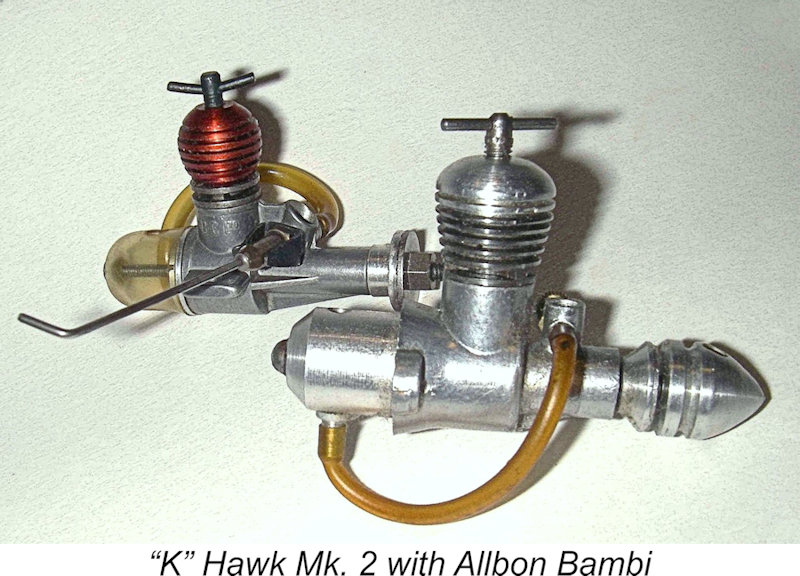 However, the revised radial-ported FRV Mk. 2 model could logically be expected to perform more efficiently than its sideport predecessor. For this reason, the extra displacement was no longer considered necessary. The Hawk Mk. 2 retained the 6.35 mm bore of its sideport predecessor but featured a substantially reduced stroke, which naturally combined to give a smaller swept volume. The two examples of the Hawk Mk. 2 that I have owned both indicated very slightly over-square nominal bore and stroke measurements of 6.35 mm x 6.10 mm for a displacement of 0.193 cc, more or less right back to where the Hawk series started out! At 31 gm (1.13 oz.) complete with tank and fuel tubing, weight was little changed from that of the Mk. 1 version.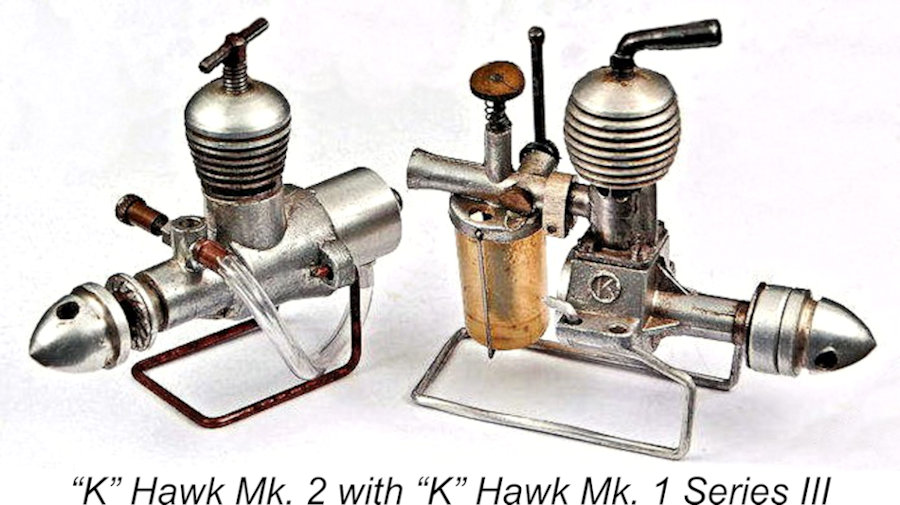
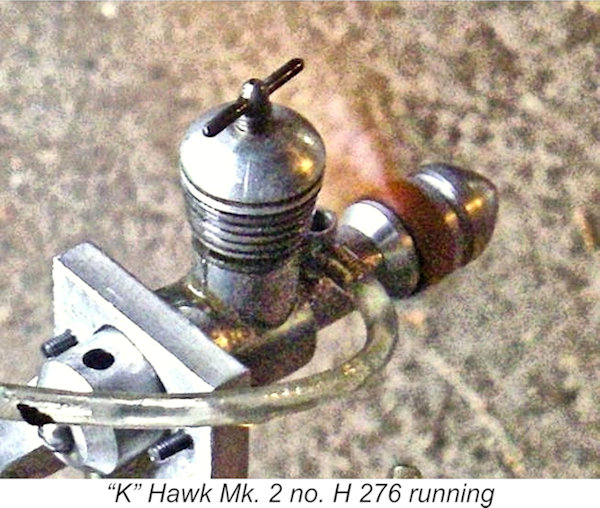 My test example of the Hawk Mk. 2, engine no. H 276, was formerly owned by my late long-standing Canadian friend Squadron Leader Laurie Ellis, RCAF (in his day, a frequently-published model designer - anyone else remember the APS Vultan, Javelan and Contra-Gyro?). Laurie had bought the engine new in 1949 and had put it to considerable use in small free flight models. Despite this previous use, the engine remains in excellent condition, with very slightly soft but still perfectly adequate compression and good bearing fits. I acquired it from Laurie many years ago now and have owned it ever since.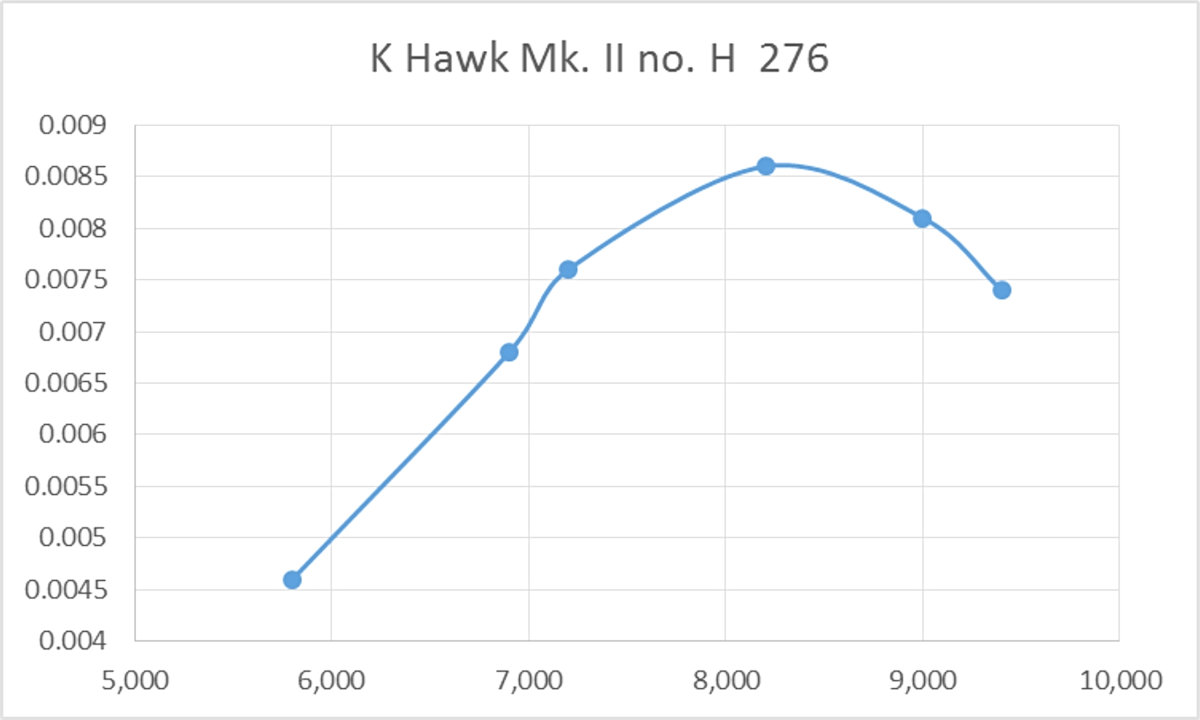
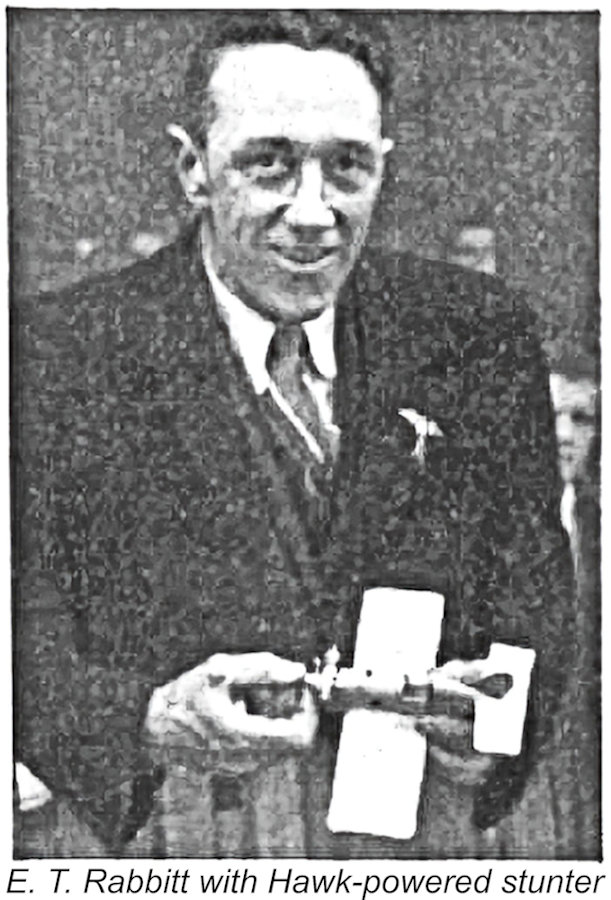 Based upon my own comparative test results, the Hawk Mk. 2 produced slightly more power than the later
 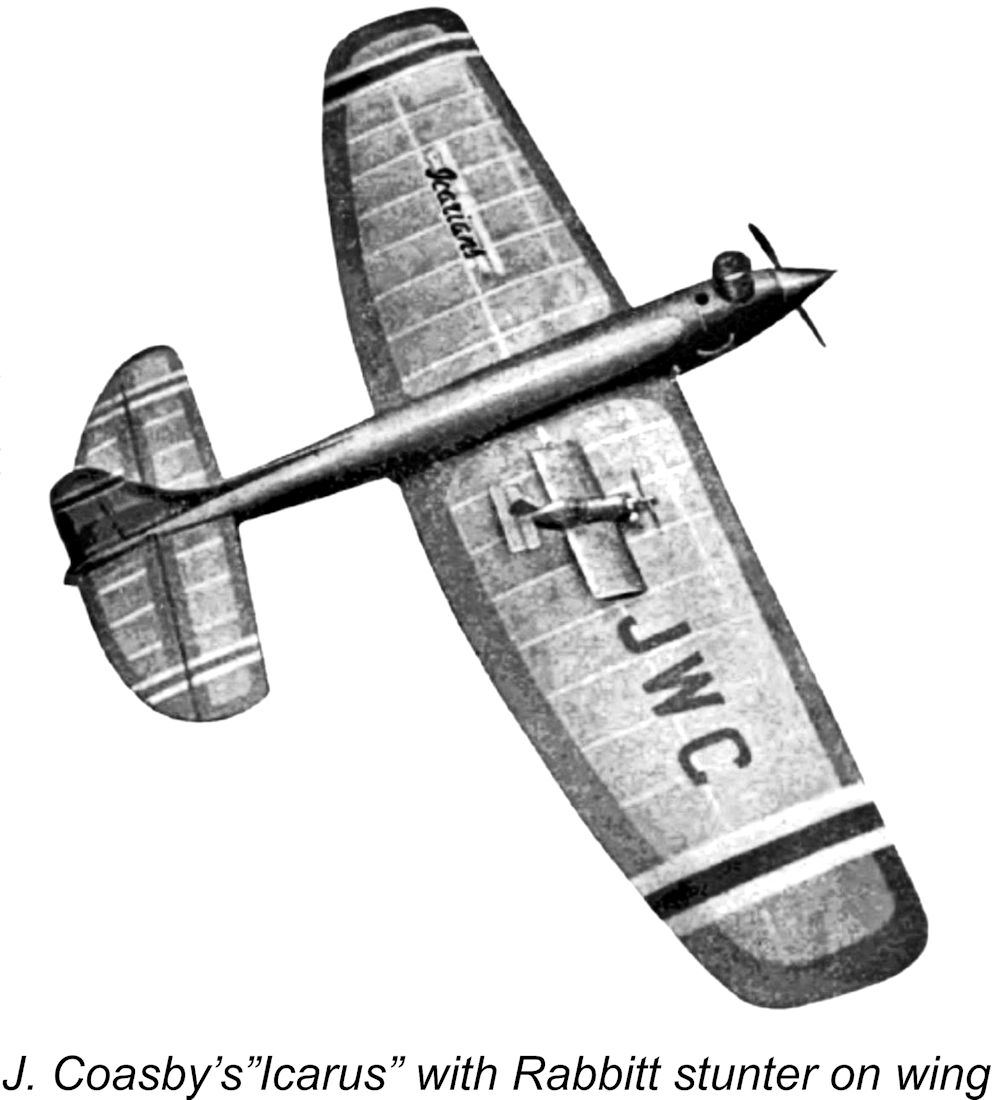 In this endeavour I was in fact preceded by an otherwise-unknown modeller named E. T. Rabbitt, who designed and built a tiny 10 in. span cabin stunter for a Kemp Hawk Mk. 2, which he demonstrated at the April 10
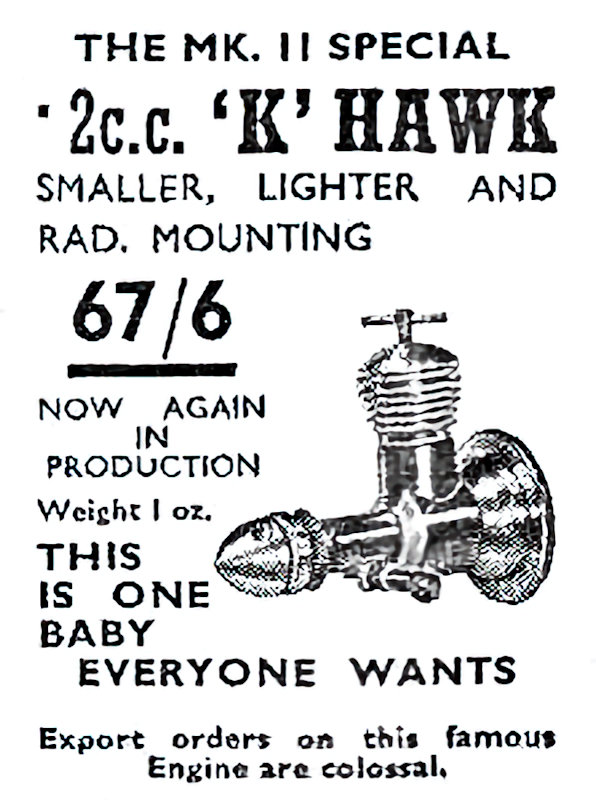 Despite its very worthy qualities, the Hawk Mk. 2 didn’t survive long on the market. Probably the fact that it really offered no performance advantage over the sideport Hawk models had a lot to do with that. A Series II “Special” version of this model was announced in a June 1949 advertisement (right) placed by the "K" Model Engineering Co. This retained the FRV induction of the original Mk. 2 and apparently used the same cylinder design. However, it employed a revised crankcase casting which featured an Arden-style radial mount and an updraft intake located beneath the main bearing to feed the crankshaft rotary valve. Overall, it displayed strong influences from the contemporary 1.96 cc
 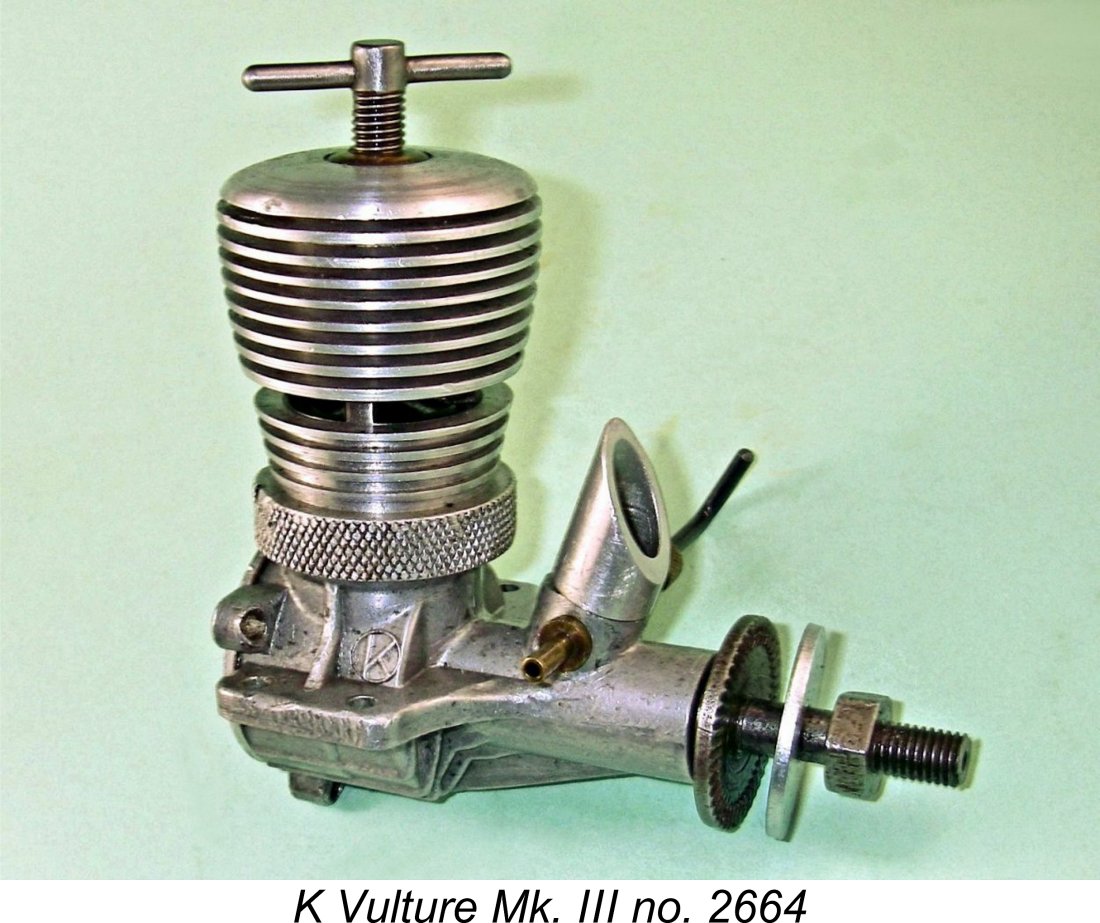 I mentioned previously that the "K" Model Engineering Co. Ltd was very active in developing new models over the course of the year or so following its take-over of the Kemp operation in mid-1948. During that period, the reorganized company developed an ever-widening range of updated FRV diesel designs, including the
 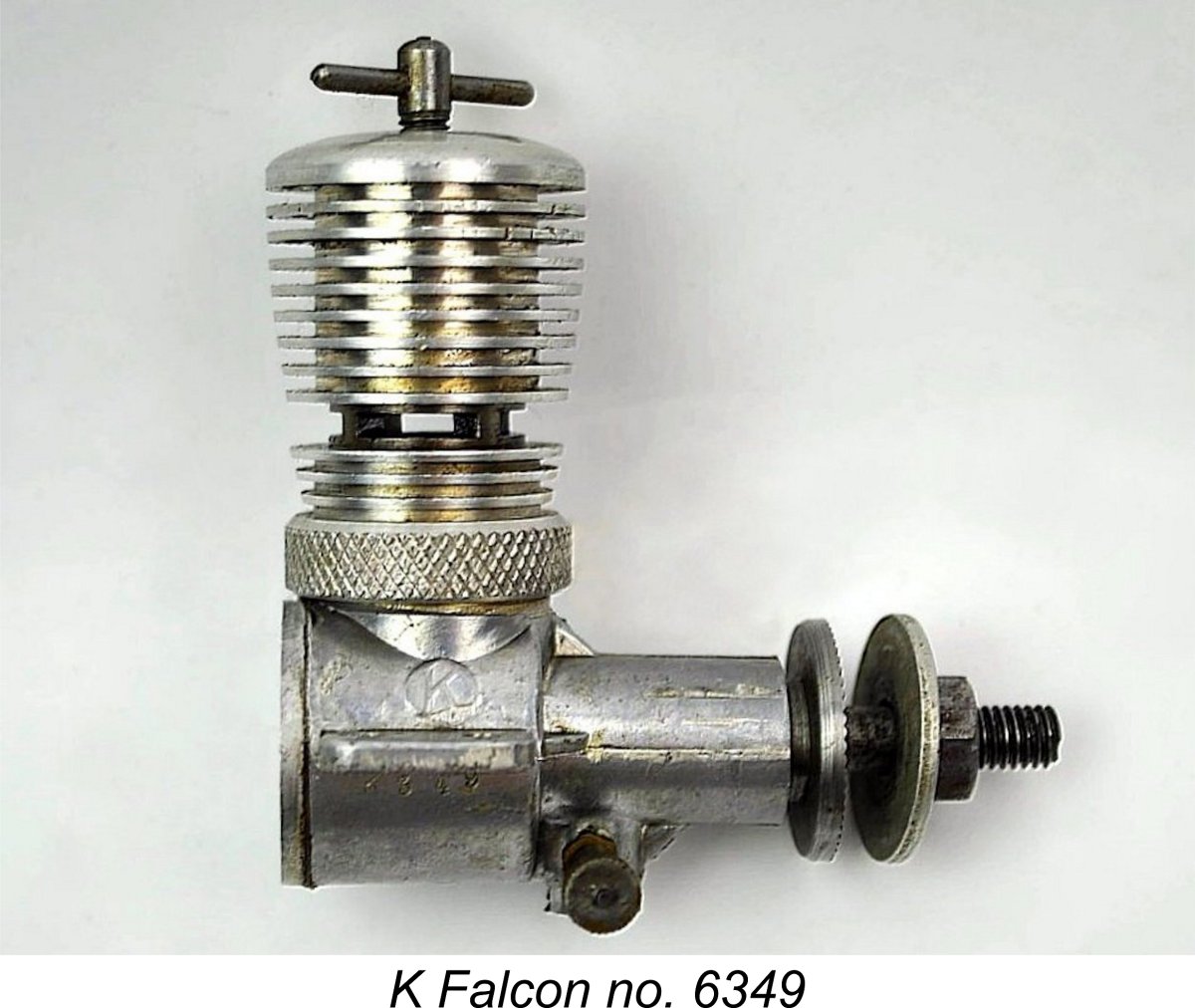 For all the relatively small scale of its operations, the company was quite active in promoting its products, continuing to advertise in the British modelling media throughout this period. The “K” engines also received favorable coverage in widely-read books such as the second edition of Col. Bowden's "
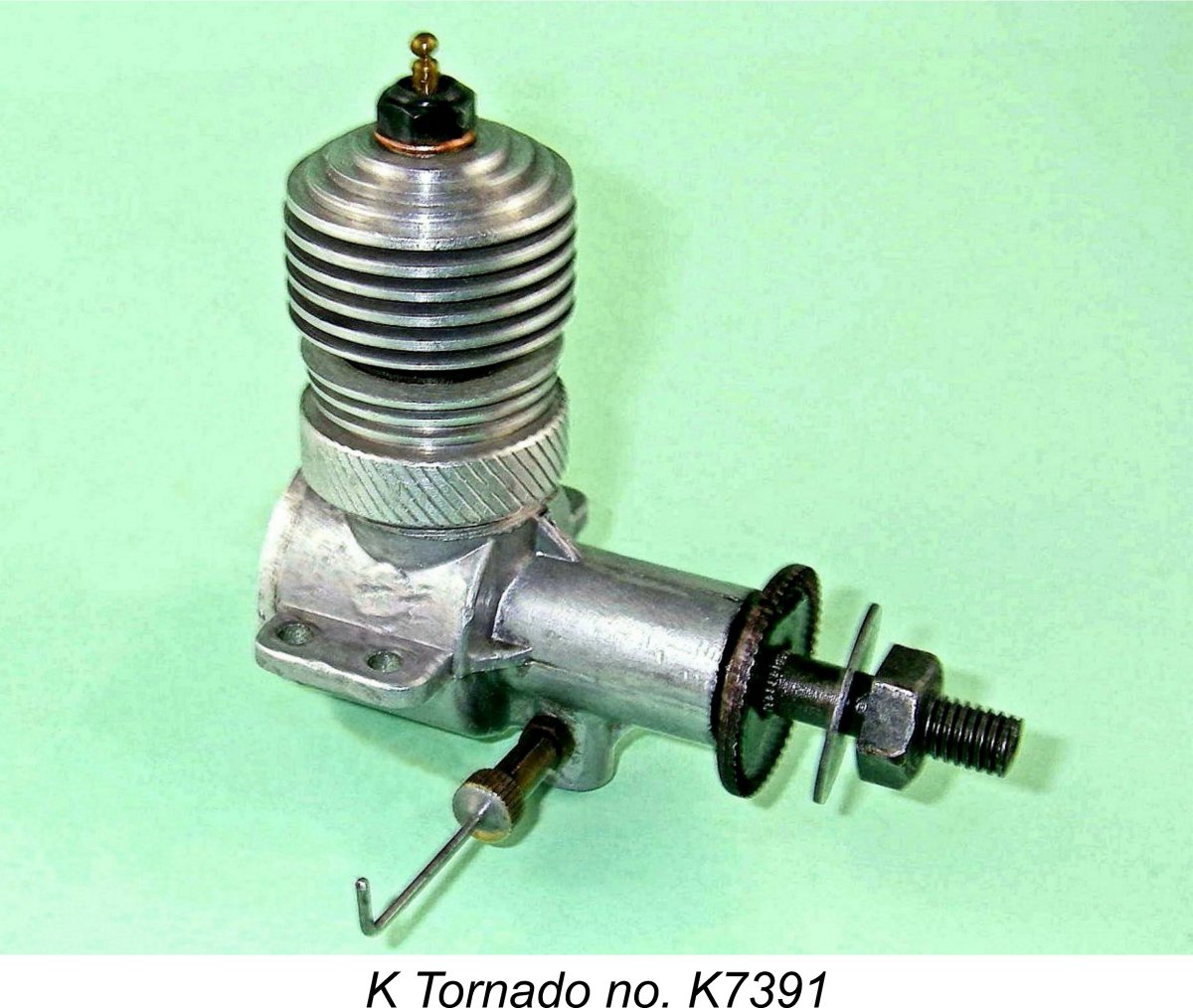 The second-last different “K” model which is known to have been offered was the
 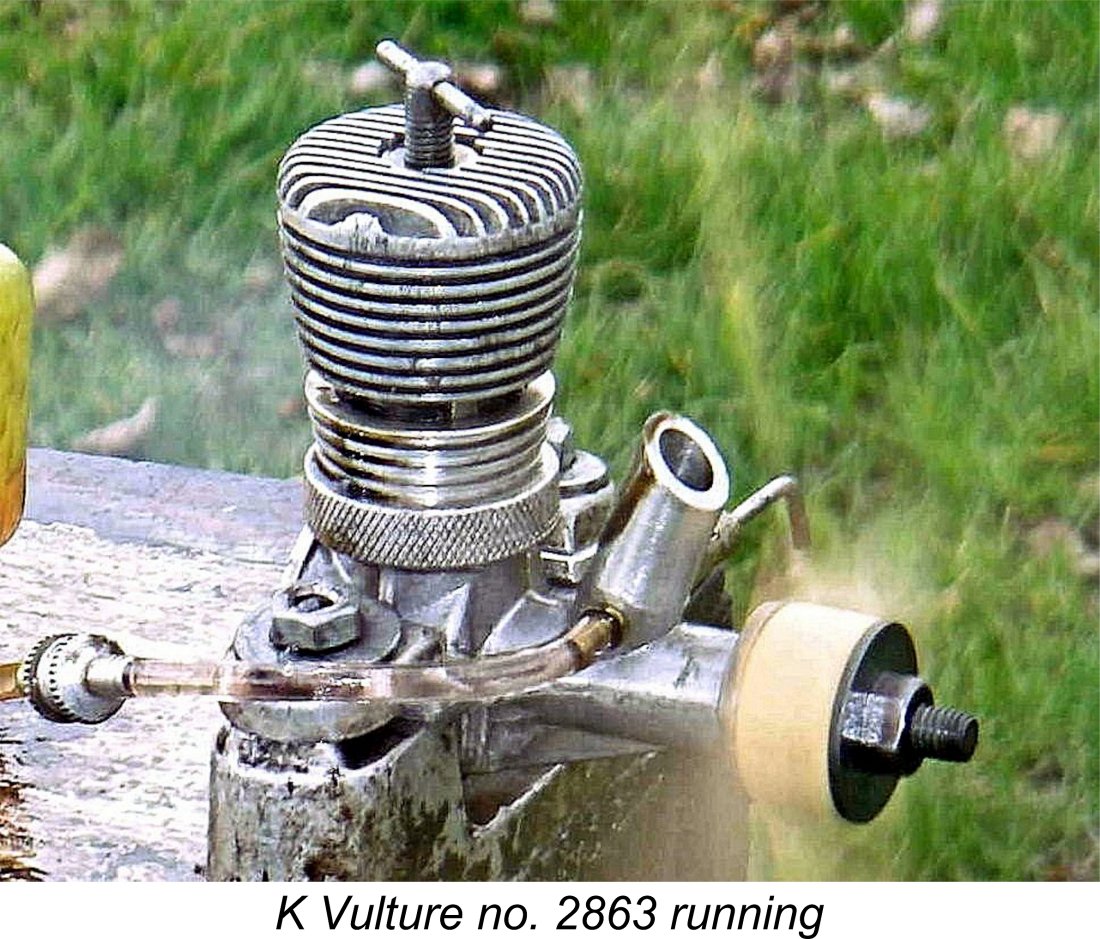 The company made a sincere attempt to rectify the design issues with the Vulture through the issuance of several improved variants, the last of which was actually a very good engine. However, these efforts were evidently insufficient to rehabilitate the Vulture in the eyes of the modelling public. In addition, it was a notoriously challenging engine to start (still is!), which certainly can't have helped. That said, it runs very nicely once going!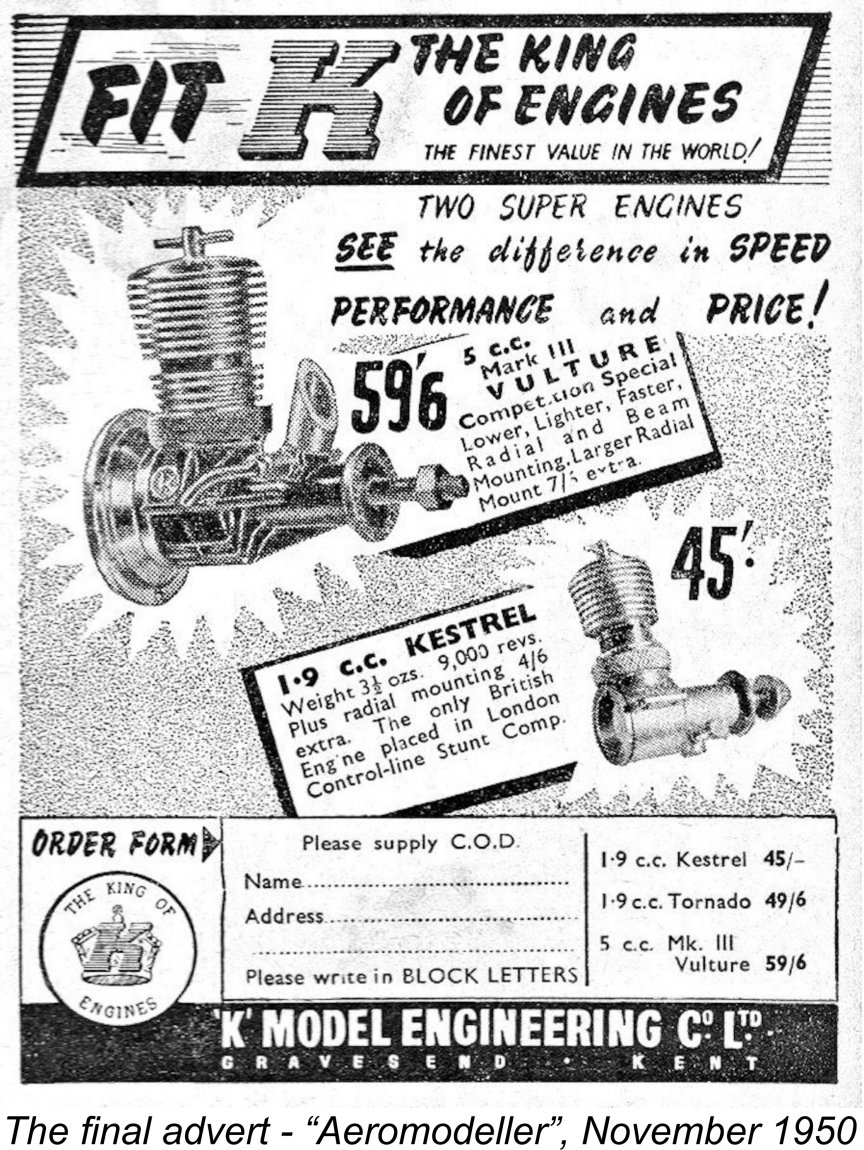
| |